
3 Pin End Scroll Saw Blades: Size, Tooth, and Material Guide
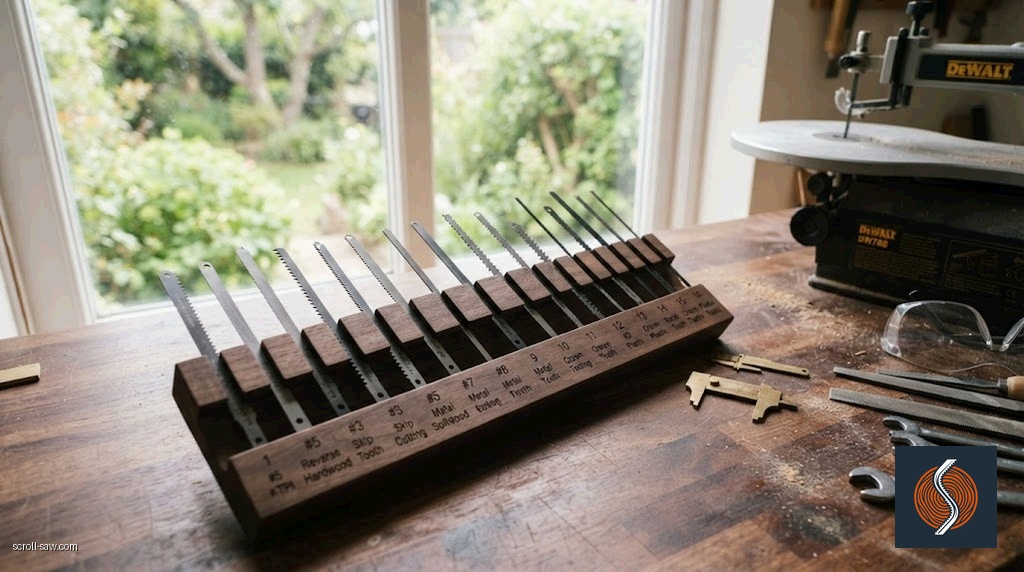
3 Pin End Scroll Saw Blades: Size, Tooth Geometry, and Material Guide
You stand in front of a pegboard at the woodworking store and there are 40 packages of scroll saw blades, all with different numbers, tooth counts, and confusing labels. The guy behind the counter says “just get a #5” and walks away. That advice will get you through a single project, but it will not help you on the next one when the material changes. If you want to pick the right 3 pin end scroll saw blades every time, you need to understand what the numbers and tooth types actually do in the wood.
Pin end blades are the format where both ends of the blade have small metal pins that lock into the saw’s blade holders. They fit most entry-level and mid-range scroll saws. The “3” refers to the blade length: 3 inches from pin to pin. Within that length, there is a range of sizes, tooth geometries, and steel types, and each combination is built for a specific job. This guide breaks down what each variable means and how to match it to your material.
Universal Blade Numbers Explained
The universal blade number is the closest thing the scroll saw world has to a standard. It runs from #2/0 (finest) through #12 (coarsest), and it encodes three physical dimensions: blade width, blade thickness, and teeth per inch (TPI).
Lower numbers mean narrower, thinner blades with more teeth. A #1 blade might measure 0.022 inches wide, 0.008 inches thick, with 20 to 25 TPI. A #9 blade might measure 0.050 inches wide, 0.017 inches thick, with 9 to 11 TPI. The lower number gives you tighter curves and smoother finishes. The higher number gives you faster cutting and better survival on thick stock.
Manufacturers like Olson and Pegas publish charts with exact dimensions for each number. The numbers are roughly comparable between brands, but there are small differences in width and thickness. When you buy 3” pin end scroll saw blades, check the actual specs on the package if the manufacturer provides them, because a #5 from one maker is not identical to a #5 from another.
Blade Width and Minimum Cutting Radius
Blade width is the single most important number for curve cutting. The narrower the blade, the tighter the curve it can negotiate. The minimum cutting radius is roughly equal to the blade width, so a blade that is 0.030 inches wide can cut a curve with a radius of about 0.030 inches, which is tight enough for most fretwork.
A wider blade, like a #9 at 0.050 inches, cannot make that same turn. If you try to force it, the blade will twist, the cut will widen beyond the kerf, and you will either break the blade or produce a ragged exit. For tight internal cuts in portrait work, you need a #1 or #2/0. For gentle arcs on toy parts, a #5 or #7 is fine.
This is where 3 pin end scroll saw blades have a natural advantage on fine work. The 3 inch length means less blade to control, which helps on tight curves where a longer blade would flex and wander. The tradeoff is that the short length limits you on thick material, where a 5 inch or 6 inch blade would run cooler and last longer.
Blade Thickness and Kerf
Blade thickness determines the kerf, which is the width of the slot the blade cuts. A thicker blade removes more material, which means a wider kerf. The kerf matters for two reasons: it affects how tight a curve you can cut (a wider kerf requires more clearance), and it affects how much material you lose to the cut.
For fretwork where you are cutting thin, delicate pieces and fitting them together, a narrow kerf is essential. A #3 blade with a thickness of 0.010 inches leaves a kerf of about 0.012 to 0.014 inches (slightly wider than the blade because of tooth set). That is thin enough for most fretwork joinery.
For construction cuts on toys or signs where fit is not critical, kerf is less important. A #7 blade with a thickness of 0.015 inches leaves a kerf of about 0.018 to 0.020 inches. You will not notice the extra material loss on a toy truck, but you will notice it on a marquetry panel where pieces need to fit precisely.
Teeth Per Inch and Chip Clearance
TPI is the count of teeth in one inch of blade length. Higher TPI means more, smaller teeth. Lower TPI means fewer, larger teeth. The TPI determines two things: how fast the blade cuts and how smooth the finish is.
A high-TPI blade (18 to 25) cuts slowly but leaves a very smooth surface. Each tooth removes a small amount of material, so the surface is clean and requires little sanding. The problem is that the small gullets between teeth cannot hold much sawdust, so on thick material the teeth load up and the blade overheats.
A low-TPI blade (9 to 12) cuts fast because each tooth removes a large chip. The gullets are deep, so chip clearance is good even on thick stock. The finish is rougher, with visible tooth marks, and you will spend more time sanding.
The sweet spot for most 3 pin end scroll saw blades is 12 to 18 TPI, which balances speed and finish. That range covers #3 through #7 blades, the most commonly used sizes for woodworking.
Tooth Geometry Types: A Full Breakdown
Tooth geometry is the shape and direction of the teeth. It affects cut quality, speed, and which face of the material gets tearout. Here are the six main types you will encounter in pin end blades:
Skip-tooth: Teeth have a gap between them. The gap provides chip clearance, so the blade runs cool on thick material. Cuts fast. Only cuts on the downstroke, so the bottom face gets tearout. Best for rough cuts on thick stock where finish does not matter.
Reverse-tooth: Same as skip-tooth but with a section of upward-facing teeth at the bottom of the blade. The upward teeth cut the bottom face on the upstroke, eliminating tearout. Cuts slower than skip-tooth. Best for clean work on 1/4 to 1/2 inch material where both faces matter.
Double-reverse: Teeth alternate up and down throughout the blade body. Produces the cleanest cut on both faces. Cuts the slowest of all geometries. Best for intarsia, marquetry, and portrait work where finish is everything and speed is secondary.
Spiral: Teeth are twisted 360 degrees around the blade. Cuts in all directions. You can cut forward, backward, and sideways without rotating the workpiece. The kerf is wider and the finish is rougher than any flat blade. Best for complex internal cuts where rotating the workpiece is impractical.
Crown-tooth: Teeth face both directions at the top of the blade. Designed for very thin material (under 1/8 inch) where reverse-tooth blades do not have enough blade engagement. Also good for plastic and acrylic. Best for thin stock and non-wood materials.
Modified-geometry: A hybrid tooth shape that blends skip-tooth speed with reverse-tooth cleanliness. A good general-purpose blade if you cut a mix of materials and want one blade that does everything reasonably well. Not the best at anything, but good at most things.
Matching 3 Pin End Scroll Saw Blades to Material: A Practical Chart
Here is how to pair blade number and tooth geometry with common materials:
| Material | Thickness | Blade Number | Tooth Geometry | Why |
|---|---|---|---|---|
| Softwood (pine, cedar) | 1/8 to 1/4 inch | #3 | Reverse-tooth | Clean finish, tight curves |
| Softwood | 1/4 to 1/2 inch | #5 | Skip-tooth | Fast cutting, tearout acceptable |
| Hardwood (oak, maple) | 1/8 to 1/4 inch | #3 | Reverse-tooth | Clean finish, slower feed |
| Hardwood | 1/4 to 1/2 inch | #5 | Reverse-tooth | Clean both faces, moderate speed |
| Hardwood | 1/2 to 3/4 inch | #7 | Skip-tooth | Chip clearance, prevent breakage |
| Plywood | 1/4 inch | #5 | Reverse-tooth | Prevent veneer tearout |
| Thin metal (aluminum) | 1/16 inch or less | #1 | Skip-tooth, high TPI | Fine teeth for clean metal cut |
| Acrylic | 1/8 to 1/4 inch | #3 | Crown-tooth | Prevent grabbing and cracking |
This chart is a starting point, not a rule. Adjust based on your saw, your feed rate, and the specific piece you are cutting. The principle behind every entry is simple: match the blade size to the material thickness, and match the tooth geometry to the finish you need.
Pin Size and Saw Compatibility
Not all pin end blades fit all saws. The pins on 3 pin end scroll saw blades come in a few sizes, and your saw’s blade holders are designed for one specific pin diameter. The most common pin size is 5mm, used by Delta, Dremel, and most Central Machinery saws. Some older saws use a smaller pin.
If you buy blades with the wrong pin size, they will not seat in the holders. Check your saw manual for the pin diameter before buying. If the manual does not specify it, measure the pins on a blade that currently fits your saw with calipers.
Some saws accept both pin end and pinless blades through an adapter. If your saw has this capability, you have the most options. You can use 3 pin end blades for quick swaps and easy loading, and switch to pinless blades for fine work where you need a size or tooth geometry that pin end blades do not offer.
Steel Quality and Blade Life
The steel in a scroll saw blade determines how long it stays sharp and how it handles heat. Most pin end blades are made from high-carbon steel or high-speed steel. High-carbon steel is less expensive and works well for softwoods, but it dulls quickly on hardwoods and heat-sensitive materials. High-speed steel holds an edge longer and handles heat better, but it is more brittle and can snap if tensioned too hard.
Some manufacturers offer bi-metal blades, which combine a flexible back with hardened teeth. These are the most durable option but are rare in pin end format. If you can find them, they are worth the extra cost for production work.
Pegas blades, made in Switzerland, are widely considered the best pin end blades available. They use high-quality steel and precise tooth geometry. Olson blades, made in the USA, are a solid mid-range option. No-name import blades are cheap and will cut, but they dull fast and the tooth geometry is often inconsistent from blade to blade.
The Verdict on 3 Pin End Scroll Saw Blades
If you are buying 3 pin end scroll saw blades, the best approach is to stock three sizes: a #3 reverse-tooth for clean work on thin stock, a #5 skip-tooth or reverse-tooth for general purpose, and a #7 skip-tooth for thicker hardwood. That covers most woodworking tasks. Buy from manufacturers that print the specs on the package, because a blade without a number and TPI is a gamble. The biggest mistake scrollers make is using one blade for everything. A #5 is not a universal answer. It is a compromise, and on thick hardwood or thin fretwork, a compromise is exactly the wrong tool.
FAQ
What do the numbers on pin end scroll saw blades mean? The universal blade number indicates the blade width, thickness, and teeth per inch. Lower numbers like #1 and #3 are finer with more TPI for tight curves and smooth finishes. Higher numbers like #7 and #9 are coarser for faster cutting on thicker material. The numbering system is used across manufacturers like Olson and Pegas.
What is the difference between skip-tooth and reverse-tooth pin end blades? Skip-tooth blades have gaps between teeth for chip clearance and cut on the downstroke only, which leaves tearout on the bottom face. Reverse-tooth blades have a section of upward-facing teeth at the bottom that cut the underside on the upstroke, eliminating bottom tearout. Reverse-tooth cuts slower but produces a cleaner finish.
What size pin end blade do I need for hardwood? For 1/8 to 1/4 inch hardwood, use a #3 reverse-tooth blade. For 1/4 to 1/2 inch, use a #5 reverse-tooth. For 1/2 to 3/4 inch, step up to a #7 skip-tooth for chip clearance. Hardwood dulls blades faster than softwood, so expect shorter blade life and keep spares on hand.
What is the minimum cutting radius for different blade sizes? The minimum cutting radius is roughly equal to the blade width. A #3 blade at about 0.030 inches wide can cut a radius of about 0.030 inches. A #7 blade at about 0.045 inches wide needs a wider radius. For very tight internal cuts, use the finest blade your material thickness allows.
Do all pin end blades fit all scroll saws? No. Pin end blades come in different pin diameters, most commonly 5mm. Your saw’s blade holders are designed for one pin size. Check your saw manual or measure a blade that fits before buying. Some saws accept both pin end and pinless blades through an adapter.
Are Pegas blades better than Olson blades? Pegas blades, made in Switzerland, are generally considered higher quality with better steel and more precise tooth geometry. Olson blades, made in the USA, are a solid mid-range option that performs well for most users. Both are better than no-name import blades, which have inconsistent quality.
What is the kerf of a #5 scroll saw blade? A #5 blade with a thickness of about 0.012 inches produces a kerf of roughly 0.014 to 0.016 inches. The kerf is slightly wider than the blade thickness because of the tooth set. For fretwork where pieces need to fit precisely, a narrower kerf is better. For construction cuts, kerf width is less critical.
Can I use 3 pin end scroll saw blades on plastic and acrylic? Yes, but you need the right tooth geometry. Crown-tooth blades work best on plastic and acrylic because the dual-direction teeth prevent the material from grabbing and cracking. Use a fine blade (#1 or #3) with high TPI, feed slowly, and avoid stopping mid-cut, which can cause the plastic to weld itself back together behind the blade.
How do I choose between 3 inch and 5 inch pin end blades? Use 3 inch blades for fine detail work on thin stock (under 1/2 inch). Use 5 inch blades for thicker stock (1/2 to 3/4 inch) where you need more blade length for chip clearance and heat dissipation. If your saw accepts both lengths, keep both on hand and match the length to the material.
References
- Olson Saw Company. Scroll Saw Blade Specification Charts. Manufacturer product data.
- Pegas by Niqua. Scroll Saw Blade Technical Specifications. Manufacturer data.
- Occupational Safety and Health Administration (OSHA). Machine Guarding and Woodworking Safety. osha.gov.
- Fine Woodworking. Understanding Scroll Saw Blade Geometry. Established woodworking publication.


