
Choosing Between Scroll Saw and Jigsaw
Choosing Between Scroll Saw and Jigsaw
A jigsaw and a scroll saw are the two tools that show up when someone Googles “how do I cut a curve.” They can both start from a drilled hole, both cut interior shapes, and both handle wood and thin plastic. That is where the similarity ends. Buying one when you needed the other is one of the most common tool regrets in a hobby shop, and the difference is not subtle once you have used both.
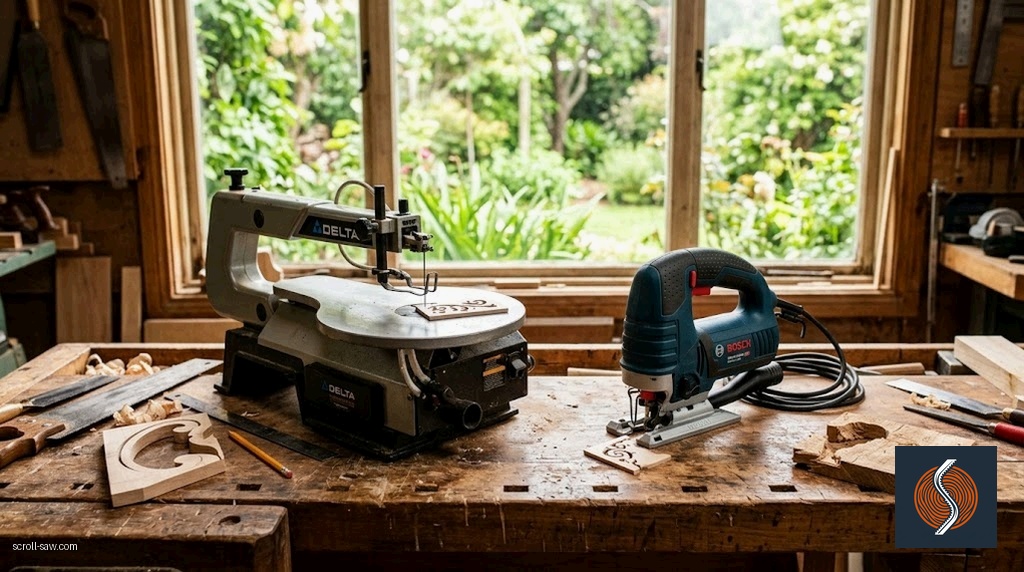
A scroll saw is a stationary benchtop tool with a fine reciprocating blade fixed between two arms. The workpiece moves; the tool sits still. A jigsaw is a handheld powered saw with a wider vertical blade that pushes down through the wood. The tool moves; the workpiece sits still (usually clamped to a bench). That single mechanical difference is what decides which one you should own.
The short answer
Buy a scroll saw for small pattern work, puzzles, ornaments, fretwork, and any curve tighter than about 3/8-inch radius in thin stock. Buy a jigsaw for cutting curves out of full-sized panels (kitchen counter cutouts, plywood shapes for furniture, sheathing), for portable job-site work, and for cuts too far from an edge to reach with a scroll saw. If you draw at a table, a scroll saw earns its keep. If you cut plywood on a set of sawhorses, a jigsaw earns its keep. Very few projects need both.
What each tool physically does
A scroll saw’s blade is 0.02 to 0.04 inch wide and about 5 inches long. It runs at 400 to 1,750 SPM in a short stroke (typically 3/4 inch). The workpiece moves across a table, and the operator steers by rotating the piece. Tight radii, tiny inside corners, and pierced holes are all natural on a scroll saw.
A jigsaw’s blade is 3/8 to 3/4 inch wide, several inches long, and runs at 500 to 3,000 SPM. The saw is held by the operator and the blade cuts on the upstroke. Cutting depth is limited only by the blade length (typically up to 4 inches). The saw goes to the wood, not the other way around, so unreachable-corner cuts on a large panel are trivial.
Radius: scroll saw wins tight, jigsaw wins wide
With a #2/0 spiral scroll blade you can cut a radius smaller than the tip of a pencil. With a 1/4-inch jigsaw blade you are limited to about 3/8-inch radius before the blade binds. Any interior curve tighter than that is scroll-saw territory.
For sweeping curves in a 4-foot panel, the jigsaw wins because portability wins. A scroll saw’s throat depth caps the panel size at 16 to 22 inches; a jigsaw will cut a curve in an 8-foot sheet of plywood without breaking a sweat.
Edge finish and precision
A scroll saw leaves a surface that is nearly ready to sand and finish. Blade wander is measured in fractions of a pencil line at reasonable feed speeds. A jigsaw leaves a rougher edge, often with mild scoring on the top face and possible tearout on the bottom, especially with cheaper blades. For visible edges on a finished piece, the scroll saw’s edge is a shortcut.
For edges that will be routed, jointed, or joined, the jigsaw’s rougher cut is fine and its speed wins. Cutting out a sink hole in a laminate counter is a jigsaw job, not because a scroll saw could not, but because the panel is too big and the edge will be covered by the sink flange anyway.
Interior cuts on both tools
Both tools can cut a shape out of the middle of a panel by starting from a drilled hole. The workflow differs.
On a scroll saw: drill a 1/16 to 1/8-inch starter hole in the waste, release the top blade clamp, thread the blade through the hole, reclamp, cut.
On a jigsaw: drill a starter hole slightly larger than the blade width, then lower the running jigsaw blade into the hole and cut from there. Interior cuts on a jigsaw are faster to start but rougher to finish, and the radius limit is much larger.
For pierced fretwork with dozens of interior cutouts, no jigsaw will keep up with a scroll saw. For a single hole cut in a 3/4-inch panel, no scroll saw can even reach the location.
Portability and workspace
A scroll saw needs a bench, a stool, and a wall outlet. It sits in one spot. A jigsaw goes in a toolbox, runs on cord or battery, and follows you to the work. If you rent, work in a shared garage, or build outdoors, that portability may decide the buying question entirely.
Materials
Both tools cut wood and thin plastic well. Metal is a different story. A scroll saw with a jeweler’s blade cuts thin non-ferrous metal (brass, aluminum up to about 1/16 inch). A jigsaw with a metal-cutting blade cuts thin steel, aluminum, and copper sheet up to 1/8 inch or so, and the handheld form factor lets you cut a panel of steel that would never fit on a scroll saw table.
For tile, cement board, or laminate, the jigsaw is the only option of the two.
Cost and blade budget
A hobby scroll saw and a mid-tier jigsaw sit in a similar bracket. Scroll saw blades are cheap and consumable; expect to burn through them and replace often at pennies each. Jigsaw blades cost more per blade but last longer per cut in normal work.
Running costs are close enough that the buying decision should be about the work you do, not about consumables.
Comparison table
| Factor | Scroll Saw | Jigsaw |
|---|---|---|
| Form factor | Benchtop stationary | Handheld portable |
| Tightest radius | Under 1/16” | About 3/8” |
| Max panel size | Limited by throat (16-22”) | Unlimited (handheld) |
| Interior cuts | Excellent | Good |
| Edge finish | Very clean | Rougher |
| Best material thickness | Up to 2” | Up to 3-4” |
| Best for | Craft, pattern, puzzle work | Panel work, on-site cuts |
Who should pick each one
Pick a scroll saw if the work you finish comes from pattern books, magazines, or your own drawings on paper up to about 20 inches wide. Ornaments, puzzles, fretwork, name signs under a foot, intarsia, and small toys are all scroll saw work.
Pick a jigsaw if the work you finish involves full sheets of plywood, kitchen counter cutouts, on-site trim, panel shapes for furniture, or any curve too far from an edge to reach with a fixed-arm tool. If you own an SUV and a garage more than a bench and a stool, the jigsaw is your first cut tool.
Verdict
A jigsaw is not a portable scroll saw and a scroll saw is not a stationary jigsaw. They solve different problems even when the marketing copy makes them sound the same. The scroll saw wins on tight radii, interior pierced cuts, and clean edges in thin stock. The jigsaw wins on portability, panel size, and material versatility. Buy the one that matches the work you already do, not the one you might grow into. Growing into a tool you do not currently need is the most expensive way to buy a tool.
FAQ
Can a jigsaw do what a scroll saw does? Up to a point. A jigsaw can make interior cuts and follow a pattern line, but not with the same tight radius or edge quality as a scroll saw. For fretwork or puzzles, it is not a substitute.
Can a scroll saw replace a jigsaw? No. A scroll saw is stationary and its throat depth limits the workpiece size. Any cut that has to be made in place, or in a panel bigger than the throat, needs a jigsaw.
Which is easier to learn? Both are beginner-friendly. Scroll saws are more forgiving of feed pressure and posture; jigsaws are more forgiving of workpiece size and location. Neither has a steep curve.
Can either tool cut metal? Both can cut thin metal with the correct blade. Jigsaws handle thicker steel and aluminum panels than scroll saws. Scroll saws are limited to thin non-ferrous stock with jeweler’s blades.
Which is safer? A scroll saw is safer for most users. The blade is thin, low-momentum, and stops fast. A jigsaw is safe when used correctly but handheld operation carries more risk of a slip cut than a benchtop tool.
If I could only afford one, which should I buy? If your work is decorative and portable, a scroll saw. If your work is structural or panel-based, a jigsaw. The two rarely overlap enough to matter.
References
-
Bosch JS470E Jigsaw Owner’s Manual, blade compatibility and cut specs
-
DeWalt DW788 Instruction Manual, throat and cut depth specs
-
Fine Woodworking, side-by-side coverage of scroll saw and jigsaw uses
-
Wood Magazine, tool selection archives
Title: Scroll Saw vs Jigsaw: Which One Fits Your Work Meta description: How a scroll saw and a jigsaw differ in radius, panel size, edge finish, and portability, and which one belongs in your shop first. Slug: scroll-saw-vs-jigsaw Excerpt: A scroll saw is not a stationary jigsaw and a jigsaw is not a portable scroll saw. Here is what each one does well, what each one cannot do, and how to pick the right one for the work you actually finish.


