
Pinned vs Pinless Scroll Saw Blades: Which Setup Fits Your Work
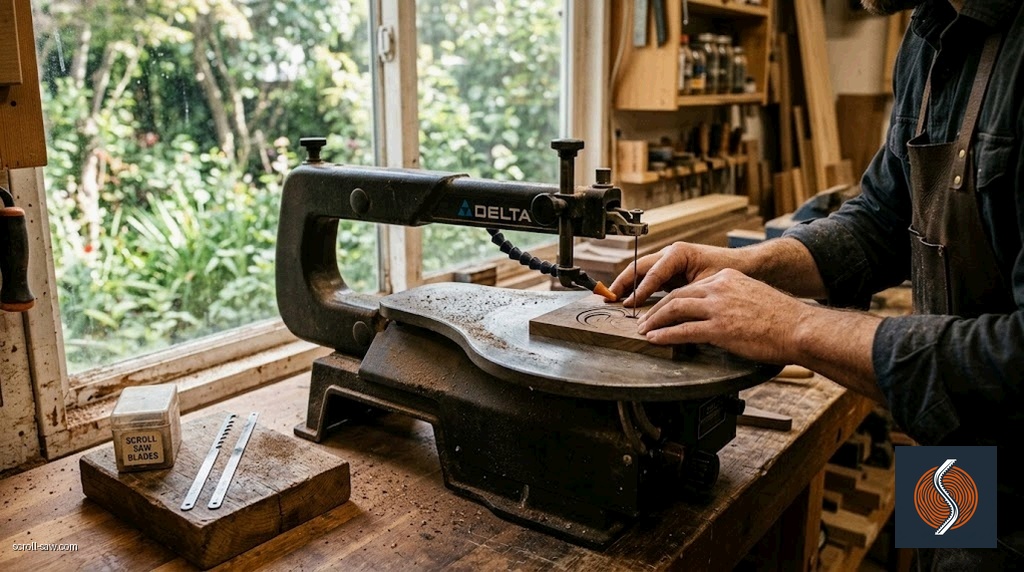
Pinned vs Pinless Scroll Saw Blades: Which Setup Fits Your Work
Walk into a scroll saw forum with the question “pinned or pinless?” and you will get thirty answers, most of them wrong for you. The right answer is not about the blade. It is about which saw you own, how tight the curves are in the projects you actually cut, and whether you plan to buy or convert a saw in the next year.
This is a plain-language comparison of pinned and pinless scroll saw blades, side by side, with real product picks for each side and a real pick for the middle ground: a conversion kit that makes a pinned saw accept plain-end blades.
The one-sentence difference
A pinned scroll saw blade has a tiny crossbar (a pin) at each end that seats into a matching upper and lower clamp. A pinless (plain-end) scroll saw blade is a flat strip of steel with no pin at either end, held in place by set screws or thumb clamps.
Everything else, tooth style, TPI, kerf, length, is independent of pin type. You can find 10 TPI blades in both. You can find spiral blades in both. The pin is just about how the blade attaches to the saw.
What your saw decides for you
Here is the part most articles bury. Most consumer scroll saws will not accept both. A pinned saw ships with pin-shaped clamps and will not grip a plain-end blade. A pinless saw ships with flat clamps and cannot hold a pinned blade. Before you buy blades, look at your saw’s clamps.
Common 15-inch and 16-inch imports (WEN 3921, WEN 3922, Ryobi SC165VS, older Craftsman, Delta 40-540, some Dremel) are pinned-only unless converted. Bench-grade and pro-grade saws (Excalibur EX-16, DeWalt DW788, Pegas, Hegner, Jet JWSS-22) are pinless. A few saws (Hegner, Pegas, some Dewalts with the right chuck) accept both by design.
If you own one of the pinned-only imports, you have two paths: buy pinned blades and stay pinned, or install a pinless conversion adapter and switch. The second path costs a set of clamps and 20 minutes of setup, and it opens the entire plain-end blade market to you.
What pinned blades do well
Pinned blades are thicker, wider, stiffer, and easier to install. They are also more forgiving of over-tensioning by beginners because the pin distributes stress at the ends. On a 15-inch saw doing 3/4-inch hardwood work, a pinned 10 TPI blade will outrun a plain-end 10 TPI in stability without much cost in finish quality.
The tradeoff shows up in tight interior curves. Pinned blades bottom out around a 1/8 inch radius at their finest (18 to 20 TPI), and closer to 3/8 to 1/2 inch on coarser counts. If your work is calligraphy, filigree, or intarsia with sub-1/16-inch counters, pinned blades will not do it.
What pinless blades do well
Pinless blades are thinner and narrower. That means tighter radii (down to about 1/32 inch on a 2/0 blade), cleaner finish on fine work, and much more variety of tooth styles: precision-ground double-tooth, reverse-tooth, skip-reverse, ultra-fine spirals, and jeweler’s blades that a pinned saw simply cannot mount.
The tradeoff is fussier setup. Plain-end blades are held by set screws or thumb clamps, and misaligning them by a few degrees will cause the blade to wander. On production runs of dozens of blade changes a day, pinless costs a few extra seconds each swap. On a puzzle or a portrait, that is nothing.
The picks
Best pinned blade for the workhorse job: Olson SC41201, 10 TPI
The Olson SC41201 is a 10 TPI, 5-inch pinned blade sized for standard 15-inch and 16-inch saws (WEN, Ryobi, Delta, Craftsman, Penn State). It cuts 1/2 to 3/4 inch hardwood cleanly, tracks straight, and does not leave the fuzzy underside a fine-tooth blade sometimes leaves on plywood.
Drawback: not fine enough for detail work in 1/4 inch or thinner stock. On small letters the tooth mark shows even after sanding. Pair it with a finer pinned blade (Olson 42401, 18.5 TPI) for detail cuts.
Best for: pinned-saw owners cutting most projects in 1/2 to 3/4 inch hardwood. Skip if: your saw is pinless, or your work is thin and delicate.
Best pinless blade for detail work: Olson FR49202 reverse tooth
The Olson FR49202 reverse tooth is a 5-inch plain-end blade with a reverse-tooth pattern that cleans up the underside of the cut. Reverse teeth at the bottom of the blade point upward, so they knock down the fuzz that would otherwise form on the exit side of the wood. On plywood and Baltic birch this is a real, visible difference.
Drawback: pinless only. It will not seat in a WEN, Ryobi, or any other pinned-clamp saw without a conversion kit installed.
Best for: pinless-saw owners cutting plywood, Baltic birch, or any material where the underside shows. Skip if: you own a pinned saw and are not converting it.
Best precision pinless: Olson PG45702 precision-ground reverse tooth
For the finest work, the Olson PG45702 PGT precision-ground reverse is a plain-end blade with milled teeth (not stamped) and reverse-tooth geometry. The tooth uniformity produces a noticeably straighter cut than any stamped blade. This is the closest a wood blade gets to feeling like a jeweler’s saw.
Drawback: it is expensive per blade compared to standard reverse-tooth, and it is not forgiving of over-feed. Push it too fast and the fine geometry loads up and burns.
Best for: fine work in hardwood and thin plywood on a pinless saw. Skip if: you do rough or thick cuts. This blade is overqualified for that.
Best pinless spiral: Flying Dutchman Ultra Reverse #5
The Flying Dutchman Ultra Reverse #5 pinless pack is a 72-piece plain-end blade with a reverse-tooth pattern where every third tooth is flipped. Flying Dutchman is a long-standing scroll saw specialty brand, and the Ultra Reverse line is a common recommendation on scroll saw forums for pinless-saw users who want clean edges top and bottom.
Drawback: pinless only, and 72 blades is more than a casual scroller uses in a year. Buy the smaller packs first to confirm the size matches your work.
Best for: heavy pinless users on hardwood and plywood. Skip if: you are new to scrolling and not sure what TPI you need yet.
The middle path: pinless conversion adapter for pinned saws
If you own a pinned import (WEN 3921, Ryobi SC165VS) and want access to the pinless blade market without buying a new saw, a universal pinless conversion kit replaces the upper and lower clamps with plain-end holders. Two pieces, 20 minutes with a hex key, and the saw accepts 5-inch plain-end blades.
Drawback: the fit is not always perfect on every import model, and blade alignment takes some fussing on the first install. Also, the pin-clamp base of some saws limits how much travel the new clamp gets, so the widest plain-end blades may not seat as well as they would on a native pinless saw.
Best for: WEN 3921 and similar owners who want to run pinless blades without buying a new saw. Skip if: your saw already accepts plain-end blades, or you have no interest in fine-detail work.
Comparison at a glance
| Feature | Pinned | Pinless |
|---|---|---|
| Blade install speed | Fast | Slower (set screws) |
| Blade thickness | Thicker, wider | Thinner, narrower |
| Tightest radius | About 1/8 inch (fine TPI) | About 1/32 inch (2/0 blade) |
| Tooth variety | Limited (mostly straight and hook) | Very wide (reverse, PGT, spiral, jeweler) |
| Beginner-friendliness | Higher | Lower (setup fussier) |
| Typical saws | WEN 3921, Ryobi SC165VS, Delta 40-540 | Excalibur, DeWalt DW788, Pegas, Hegner |
Verdict
Your saw makes this decision for you. If you own a 15-inch or 16-inch import (WEN, Ryobi, older Delta, older Craftsman), buy pinned blades and stay pinned unless your projects specifically demand sub-1/16-inch curves. The Olson SC41201 (10 TPI) plus the Olson 42401 (18.5 TPI) covers most work.
If you own a plain-end saw (Excalibur, DeWalt DW788, Pegas), the pinless market is where you belong. Start with the Olson FR49202 reverse tooth for everyday work and add the Olson PG45702 precision-ground for detail.
If you own a pinned saw and cutting fine detail is a repeated frustration, the pinless conversion kit is worth the small cost. Twenty minutes of install opens the entire plain-end blade catalog to a saw you already own.
FAQ
What is the difference between pinned and pinless scroll saw blades? The pin. A pinned blade has a small crossbar at each end that seats in a matching clamp on the saw. A pinless (plain-end) blade is a flat strip of steel held by set screws or thumb clamps.
Are pinless blades better than pinned blades? Not better, different. Pinless blades are thinner and turn tighter curves and come in more tooth styles. Pinned blades are stronger, easier to install, and cover 80 percent of hobby scroll work fine.
Can my scroll saw use both pinned and pinless blades? Most cannot. Check your saw’s clamps. WEN 3921 and most 15-inch imports are pinned-only. Excalibur, DeWalt, and Pegas saws are pinless. A few (Hegner, some Pegas, some Dewalt with the right chuck) accept both.
Can I convert a pinned saw to accept pinless blades? Yes. A universal pinless conversion kit replaces the upper and lower clamps. Install takes about 20 minutes with a hex key. Alignment on the first setup takes a few tries.
Which lasts longer, pinned or pinless blades? Blade life depends on steel and how the blade is used, not on the pin. Higher-quality steel (Olson, SuperCut, Flying Dutchman) outlasts generic brands regardless of pin type.
What is the smallest radius pinned vs pinless can cut? Fine-TPI pinned blades bottom out around 1/8 inch interior radius. Pinless 2/0 blades reach roughly 1/32 inch. For sub-1/16-inch work, pinless is the only realistic option.
Should a beginner start with pinned or pinless? Whichever the saw takes. If you have not bought a saw yet, pinned is easier to learn on for the first few months because installation is faster and misalignment is rarer.
References
-
Olson Saw Company, blade catalog and specifications: olsonsaw.net
-
Flying Dutchman Scroll Saw Blades, blade catalog: mikesworkshop.com
-
WEN Products, scroll saw documentation: wenproducts.com
Title tag: Pinned vs Pinless Scroll Saw Blades: Which Setup Fits Your Work Meta description: Pinned or pinless scroll saw blades? Your saw picks for you. Real product picks and a conversion option for pinned-saw owners who want plain-end access. Slug: pinned-vs-pinless-scroll-saw-blades Excerpt: Pinned vs pinless scroll saw blades is really a question about which saw you own. This guide compares the two side by side, names the best pinned blades for standard imports, the best pinless blades for bench-grade saws, and the conversion kit that lets a pinned saw run plain-end blades.


