
5 Pinless Scroll Saw Blades: Size, Tooth, Material Guide
5 Pinless Scroll Saw Blades: Size, Tooth Geometry, and Material Guide
A friend showed me a dragon she had been cutting for three weeks. Hundreds of scales, each one a tight curve cut into 1/4 inch cherry. She was using a #7 skip-tooth blade because it was the only one she had. The curves were rough, the scales looked melted instead of crisp, and she had broken four blades. I gave her a pack of #3 reverse-tooth blades. She cut the next dragon in half the time with scales so clean they barely needed sanding. The blade was the only thing that changed.
5 pinless scroll saw blades are the thin, flat-end blades that let you do the kind of work that makes people stop and stare. “Pinless” means the blade has no pins at the ends. It clamps into a blade holder on your saw. The 5 inch length is the standard size for most scroll saws that accept plain-end blades.
The short answer to choosing the right pinless blade: pick the smallest blade number your project allows (smaller means tighter curves and finer cuts), choose a tooth geometry that matches the finish you need, and use high-carbon steel blades for general work or high-speed steel for abrasive materials. Get those decisions right and your cuts will be cleaner, your blades will last longer, and you will spend less time sanding.
Blade Size: The Universal Numbering System
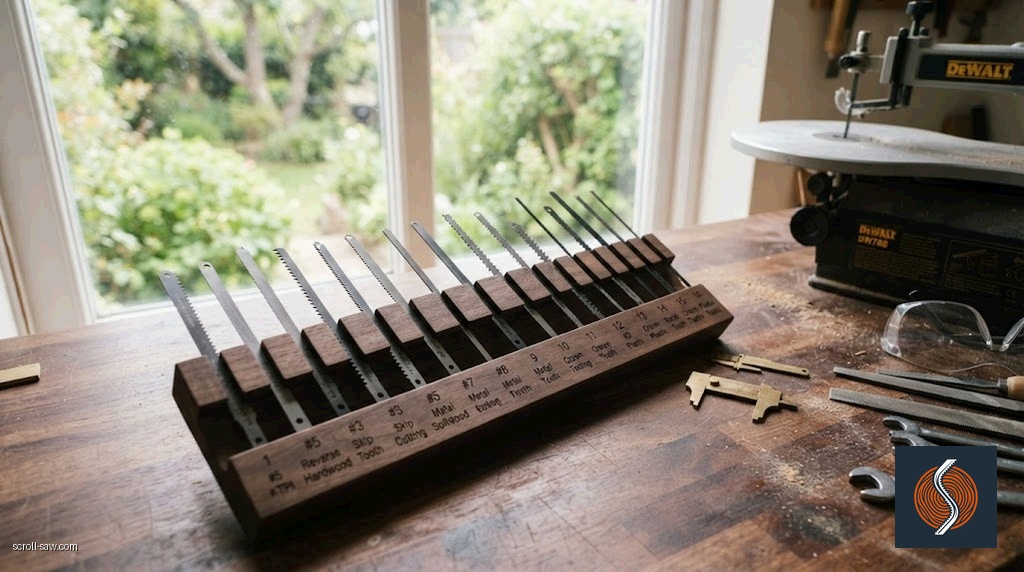
Pinless scroll saw blades are sized using a universal numbering system that runs from #2/0 (finest) to #12 (heaviest). Each number corresponds to a specific blade width and thickness. Here is what each common size means in practice:
#2/0: Width approximately 0.010 inches, thickness approximately 0.008 inches. This is a very fine blade for delicate fretwork, thin veneer, and extremely tight curves. It breaks easily and cuts slowly. Use it only in thin material (1/8 inch or less). This is the blade for work where the kerf needs to be nearly invisible.
#0: Width approximately 0.012 inches. Slightly heavier than #2/0 but still very fine. Good for detailed fretwork and marquetry in thin stock. Still fragile and still limited to thin material.
#1: Width approximately 0.014 inches. A fine blade that handles thin to medium stock (1/8 to 1/4 inch). This is where you start being able to cut real projects without breaking a blade every few minutes. Good for intarsia pieces with moderate detail.
#3: Width approximately 0.018 inches. A versatile fine blade that handles most detail work in 1/8 to 3/8 inch stock. This is the blade I recommend for people doing detailed work who are tired of breaking #2/0 blades. It cuts tight curves and leaves a clean surface.
#5: Width approximately 0.025 inches. The all-purpose blade. Handles 1/8 to 1/2 inch wood and cuts moderate curves. If you are buying one pack of pinless blades to start, buy #5. It is the blade that does most things acceptably.
#7: Width approximately 0.030 inches. A medium blade for thicker stock (1/4 to 3/4 inch) and larger curves. Cuts faster than #5 but cannot turn as tightly. Good for projects where speed matters more than fine detail.
#9 and #12: Heavy blades for thick stock and rough cutting. These are at the upper limit of what most people use on a scroll saw. They cut fast and handle thick wood, but the minimum cutting radius is large (3/8 inch or more).
The rule for choosing blade size: use the smallest blade that can handle your material thickness. A smaller blade cuts tighter curves, produces a narrower kerf, and leaves a cleaner surface. The tradeoff is that smaller blades break more easily and cut more slowly.
Tooth Geometry: Matching Teeth to Your Project
Blade size tells you how tight a curve you can cut. Tooth geometry tells you what the cut looks like when you are done. Here are the main options for pinless blades:
Skip-Tooth: The Workhorse
Skip-tooth blades have large gaps between teeth for excellent chip clearance. They cut fast, run cool, and handle thick material well. The surface finish is medium-rough, meaning you will see tool marks but not deep tearing.
Use skip-tooth for: general cutting, thick stock, rough work, and when speed matters more than finish. This is the blade to grab when you are cutting out the rough shape of a project before doing fine detail work.
The honest drawback: skip-tooth blades tear out the bottom of the cut. If the bottom surface matters, you need a different geometry.
Reverse-Tooth: The Clean-Edge Choice
Reverse-tooth blades (also called double-reverse) have most teeth pointing down, with a section of teeth at the bottom pointing up. The downward teeth cut on the downstroke, and the upward teeth clean the bottom edge on the upstroke. The result is a bottom surface that is much cleaner than a skip-tooth blade produces.
The reverse section typically covers about 1/2 inch of blade length. This means the cleaning effect only works on stock that is 1/2 inch thick or less. For thicker stock, the reverse teeth do not reach the bottom of the cut.
Use reverse-tooth for: any project where the bottom surface needs to be clean, thin to medium stock, and work where you want to minimize sanding.
The honest drawback: reverse-tooth blades can grab the wood on the upstroke, especially in thicker stock. This takes some getting used to. They also cut slightly slower than skip-tooth blades because the reverse teeth create extra drag.
Crown-Tooth: The Smooth-Surface Option
Crown-tooth blades have alternating up and down teeth along the entire blade length. They cut on both the upstroke and downstroke, which produces a smoother surface on both sides of the work.
Use crown-tooth for: projects where both surfaces need to be clean, thin stock, and delicate work where surface finish is the priority.
The honest drawback: crown-tooth blades cut slower than skip-tooth and are harder to control because they cut in both directions. The blade can grab in either direction, which takes practice to manage.
Modified-Geometry: The Specialist
Modified-geometry blades are custom tooth patterns from specific manufacturers. Olson and Pegas both offer blades with tweaked tooth angles designed for specific purposes, like reducing tearout in plywood or improving chip flow in hardwood. These are worth trying once you know what your standard blade does well and where it falls short.
Blade Material: High-Carbon vs. High-Speed Steel
The steel a blade is made from affects how long it stays sharp and how it handles different materials.
High-carbon steel (HCS): The standard material for scroll saw blades. It takes a sharp edge, cuts cleanly, and is inexpensive. The tradeoff is that it dulls relatively fast, especially in abrasive materials like MDF, plywood, and some hardwoods. Most general-purpose pinless blades are high-carbon steel.
High-speed steel (HSS): Harder and more wear-resistant than high-carbon steel. HSS blades stay sharp longer in abrasive materials and run cooler in dense hardwoods. The tradeoff is that they are more brittle and can snap more easily if over-tensioned or forced. HSS blades cost more but last longer in tough materials.
For most wood cutting, high-carbon steel is fine. You will go through blades, but they are cheap enough that replacing them is not painful. Switch to HSS if you are cutting a lot of MDF, plywood, or dense hardwoods and you are tired of blades dulling after 30 minutes.
Some manufacturers offer bi-metal blades that combine a flexible body with harder teeth. These are less common in scroll saw sizes but offer a middle ground between HCS and HSS.
Matching Blade to Material: A Quick Reference
Softwoods (pine, cedar, poplar): #5 or #7 skip-tooth, high-carbon steel. Softwoods cut easily and do not dull blades fast. Use a medium blade for speed and accept that you will sand the edges.
Hardwoods (oak, maple, walnut, cherry): #3 or #5 reverse-tooth, high-carbon or HSS. Hardwoods need a blade that can handle density without burning. Reverse-tooth gives you a cleaner edge. HSS lasts longer in dense wood.
Plywood: #5 reverse-tooth, HSS. Plywood is abrasive and tears out easily. Reverse-tooth reduces bottom tearout, and HSS handles the abrasive adhesive. Expect to replace blades more often than with solid wood.
MDF: #7 skip-tooth, HSS. MDF is very abrasive and will dull any blade fast. Skip-tooth gives you the chip clearance you need, and HSS extends blade life. MDF does not tear out, so skip-tooth is fine.
Thin stock (1/8 inch or less): #1 or #3 reverse-tooth, high-carbon steel. Thin material needs fine teeth and reverse geometry to prevent tearout. High-carbon is fine because thin stock does not dull blades as fast.
Blade Holders and Adapters: What You Need
Pinless blades require a blade holder to clamp the flat ends. Some saws have built-in holders. Others need an adapter that converts a pin-end clamp to accept plain-end blades.
If your saw has built-in holders, you are set. If you need an adapter, look for one that matches your saw model. Generic adapters exist but may not fit perfectly, which leads to blade slippage and misalignment.
Quick-change blade holders, like those on Hegner and DeWalt saws, make switching blades fast. This matters because you will switch blades often as you move between rough cuts and fine detail work in the same project.
Buying Pinless Blades: Practical Advice
Buy in packs of 12 or more. You will break blades, especially in fine sizes. A pack of 12 #3 reverse-tooth blades might last you a month of regular cutting, or a single weekend if you are doing intensive fretwork.
Buy from established manufacturers. Olson, Pegas, and Flying Dutchman all make consistent, high-quality pinless blades. The blade specs on the packaging match what is inside, which means your results are repeatable.
Be cautious with very cheap bulk blades from unknown sources. The steel hardness and tooth geometry can vary between blades in the same pack, which makes it hard to get consistent results. You save money but spend time dealing with blades that do not perform the same way twice.
The Verdict
Choosing 5 pinless scroll saw blades comes down to three practical decisions. First, pick the smallest blade number your project allows, because smaller blades cut tighter curves and cleaner surfaces. Second, match the tooth geometry to the finish you need: skip-tooth for speed, reverse-tooth for clean edges, crown-tooth for smooth surfaces. Third, use high-carbon steel for general work and high-speed steel for abrasive materials.
The honest tradeoff of pinless blades is that they are fragile and harder to install than pin-end blades. You will break blades while learning to tension them properly. You will spend time fiddling with blade holders. But the cut quality, the ability to thread through tiny pilot holes, and the tight curves you can achieve are worth the hassle for anyone doing detailed work.
Start with a pack of #5 skip-tooth for general cutting, a pack of #3 reverse-tooth for clean edges, and a pack of #1 for fine detail. Those three sizes cover most projects, and you can add finer or heavier blades as your work demands.
FAQ
What are pinless scroll saw blades? Pinless (plain-end) scroll saw blades have flat ends that clamp into a blade holder, as opposed to pin-end blades which have metal pins at each end. Pinless blades are thinner and can cut tighter curves and finer details.
What size pinless blade should I use for fretwork? For fretwork, use a #2/0 or #1 blade. These very fine blades cut tight curves and leave a clean surface in thin stock. They are fragile and break easily, so buy in bulk.
What is the best pinless blade for general cutting? A #5 skip-tooth blade is the best all-around choice. It handles wood from 1/8 to 1/2 inch thick, cuts moderate curves, and balances speed with a reasonable surface finish.
Do I need a special adapter to use pinless blades? If your saw has built-in plain-end blade holders, no adapter is needed. If your saw only accepts pin-end blades, you need an adapter that converts the pin-end clamp to hold flat-end blades.
What is the difference between high-carbon and high-speed steel blades? High-carbon steel blades are standard, inexpensive, and take a sharp edge, but they dull relatively fast. High-speed steel blades are harder, stay sharp longer in abrasive materials, and run cooler, but they are more brittle and cost more.
How do I choose between skip-tooth and reverse-tooth? Use skip-tooth for speed and chip clearance in thicker stock. Use reverse-tooth when you need a clean bottom edge, because the upward-pointing teeth clean up tearout on the bottom of the cut.
Can I use pinless blades on a beginner scroll saw? It depends on the saw. Some entry-level saws only accept pin-end blades. Check your saw’s manual. If it accepts plain-end blades or has an adapter available, you can use pinless blades.
How tight a curve can a pinless blade cut? It depends on the blade width. A #2/0 blade (about 0.010 inches wide) can cut a radius of nearly zero. A #7 blade (about 0.030 inches wide) needs a radius of about 1/4 to 3/8 inch. Smaller blades cut tighter curves but break more easily.
References
- Olson Saw Company, pinless blade product specifications and sizing charts (olsonsaw.com)
- Pegas by Niqua, blade material and geometry specifications (pegas.swiss)
- Fine Woodworking, scroll saw blade selection articles (finewoodworking.com)
- Wood Magazine, scroll saw blade buying guides (woodmagazine.com)
- Hegner, scroll saw blade compatibility information (hegner.com)


