
Metal Cutting Scroll Saw: A Clean-Cut Method
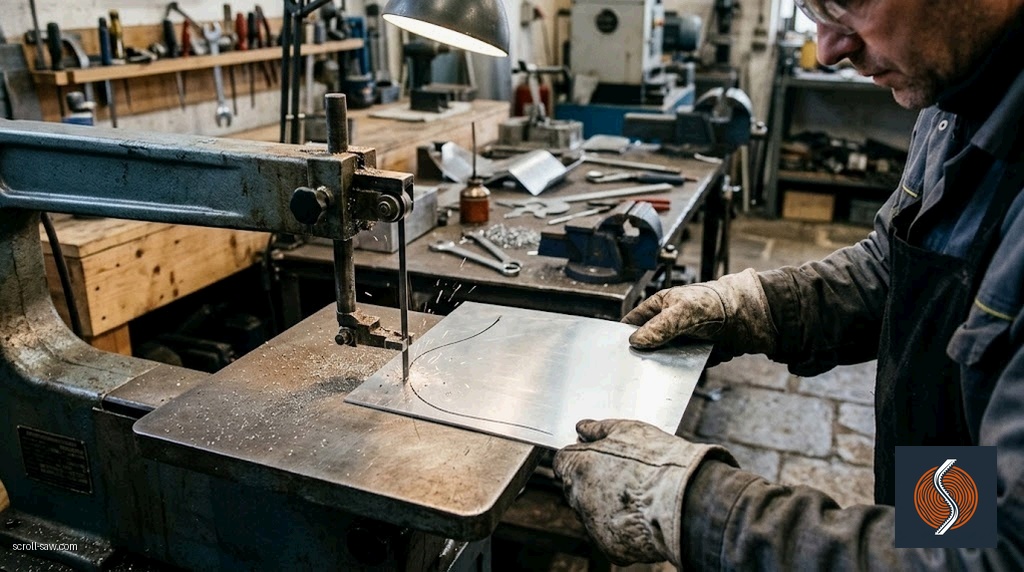
A Clean-Cut Method for Metal on the Scroll Saw
The shop smelled like hot aluminum and the cut edge was ragged enough to cut my finger. I was using a wood blade on a piece of 18-gauge aluminum sheet, pushing it through like I was cutting pine, and the result was everything you would expect from doing everything wrong. The blade was shot after six inches. The aluminum was burred on both sides. The kerf was twice as wide as it should have been. That was my first attempt at metal cutting with a scroll saw, and it took me a while to understand that the problem was not the saw. It was the method.
Metal cutting on a scroll saw is a legitimate technique that jewelers, model makers, and hobbyists use to cut thin sheet metal with precision. It is not fast, it is not loud, and it will not replace your metal-cutting bandsaw. But for thin sheet work with intricate curves, a scroll saw with the right blade and the right technique produces cuts that are clean, accurate, and surprisingly fast once you know what you are doing.
The short answer: you can cut aluminum, brass, copper, and thin mild steel on a scroll saw using hardened blades with high TPI, low speed, lubrication, and light feed pressure. The method matters more than the equipment. Get the blade right, slow down, lubricate, and let the saw do the work.
The Right Blade Makes or Breaks the Cut
Everything starts with the blade. A carbon steel wood blade will not cut metal. It will polish the surface, heat up, and lose its edge in inches. You need a blade made for metal.
Metal-cutting blades for scroll saws use harder steel than wood blades. The two types are through-hardened and bi-metal. Through-hardened blades are heat-treated throughout, making the entire blade hard but also brittle. Bi-metal blades have a flexible spring-steel back with hardened teeth welded to the cutting edge. Bi-metal is the better choice because the blade can flex without snapping while the teeth stay sharp.
TPI (teeth per inch) is the second critical spec. The rule for metal is that at least three teeth should be in the material at all times. For 20-gauge aluminum (about 0.032 inches), you need a blade with at least 30 TPI. For 16-gauge (about 0.060 inches), 18 to 25 TPI works. For anything thicker than 1/16 inch, you are pushing the limits of what a scroll saw can do efficiently.
A #3/0 metal-cutting blade with 36 to 40 TPI handles the thinnest sheet metal. A #5 metal-cutting blade with 24 to 28 TPI is the all-around workhorse for medium-gauge non-ferrous metal. If I could only buy two blades for metal work, those would be the two.
Tooth Geometry for Metal
Tooth geometry affects how the blade interacts with metal, and metal behaves differently from wood in ways that make geometry matter more.
Skip-tooth blades are the best general-purpose choice for metal. The wider gullet clears the small, hard chips that metal produces. Without that clearance, chips pack into the gullets and generate heat that kills the blade. A skip-tooth blade with 24+ TPI cuts aluminum cleanly and stays cooler than a standard-tooth blade at the same TPI.
Reverse-tooth blades can help on thin sheet metal where burr formation on the bottom edge is a problem. The reverse teeth on the downstroke break the chip before it can fold into a burr. The trade is that reverse-tooth blades can vibrate more in metal, which affects cut accuracy.
Modified-geometry blades designed specifically for non-ferrous metals have tooth profiles with rake and clearance angles tuned for the way metal shears. These blades cut cleaner and last longer than standard skip-tooth blades on aluminum and brass. If you cut metal regularly, they are worth seeking out.
Spiral blades are not recommended for metal. The omnidirectional cutting makes feed rate control difficult, and the wider kerf wastes material. Metal is too expensive to waste on a spiral blade’s wide cut.
Crown-tooth blades are a niche option that some metal scrollers prefer for specific alloys. They are harder to find in metal-cutting hardness but worth experimenting with if you cut a lot of one material.
Setting Up the Saw for Metal
Before you start cutting, three setup adjustments will make or break your results.
Speed: Set your saw to its lowest speed. If your saw is single-speed, you will need to compensate with very light feed pressure. Metal cutting generates far more heat than wood cutting, and high speed amplifies that heat. A blade running at 1,700 strokes per minute on aluminum will dull twice as fast as the same blade at 850 strokes per minute.
Tension: Tension the blade tighter than you would for wood. A loose blade flexes in metal, which produces a wider kerf and a less accurate cut. A properly tensioned metal-cutting blade should ring when plucked. If it thuds, tighten it.
Tooth direction: Teeth point down, cutting on the upstroke. This is the same as for wood, but the consequences of a backward blade are worse on metal. A backward blade on metal will rub, glaze, and ruin the tooth edges in seconds. Check every time.
The Cutting Method
Here is the method I use, and it works for aluminum, brass, and copper. Steel requires modifications, which I will cover separately.
Step 1: Lubricate the blade. Apply cutting wax to the blade before starting the cut and every two to three inches during the cut. Wax sticks to the blade and provides continuous lubrication. For aluminum, wax is sufficient. For brass and copper, a light cutting oil applied with a brush works better.
Step 2: Start the cut with light pressure. Let the blade find the line before you commit. Metal does not compress like wood, so the blade either cuts or it does not. If the blade is cutting, you will see a steady stream of fine chips. If you see no chips and the blade is making a grinding noise, you are too fast, too hard, or the blade is too coarse.
Step 3: Feed slowly and steadily. The ideal feed rate for metal on a scroll saw is much slower than for wood. If you are used to feeding wood at a brisk pace, cut your speed in half for aluminum and in half again for brass. The blade should never struggle. If it does, you are feeding too fast.
Step 4: Back out to clear chips. Every few inches, back the blade out of the cut to clear packed chips from the gullets. This is especially important in copper, which tends to gum up the teeth. Backing out takes two seconds and doubles blade life.
Step 5: Support the workpiece. Metal sheet can vibrate and ring on the saw table. Put a thin sheet of cardboard or masking tape on the table under the workpiece to dampen vibration and protect the metal’s surface from scratching.
Step 6: Deburr after cutting. Even with the best technique, metal cutting on a scroll saw produces small burrs on the bottom edge. A few passes with a deburring tool or a fine file cleans them up. This is normal and not a sign of poor technique.
Cutting Different Metals
Aluminum is the most forgiving metal for scroll saw work. It cuts relatively easily, generates manageable heat, and is available in thin sheet from any hardware store. Use a #5 skip-tooth blade with 24 to 28 TPI, cutting wax, and a slow feed. Aluminum is the metal I recommend for your first metal cutting project on the scroll saw.
Brass cuts harder than aluminum but produces cleaner chips that do not gum up. Use a #5 blade with 20 to 25 TPI and light cutting oil. Brass generates more heat than aluminum, so blade life is shorter. A modified-geometry blade for non-ferrous metal will outlast a standard skip-tooth on brass.
Copper is soft and gummy. It tends to weld itself to the blade teeth if you push too hard. Use the finest blade you have (30+ TPI), lubricate generously, and back out frequently to clear chips. Copper work-hardens as you cut, so the cut gets harder as it progresses. If the blade starts grabbing, stop, back out, and let the metal cool.
Thin mild steel (26 gauge and thinner) is the hardest metal you can cut on a scroll saw. You need a blade with 36+ TPI, hardened teeth, and liquid cutting fluid. The cut will be very slow. Expect to go through multiple blades on a single project. If you are cutting more than occasional thin steel, the scroll saw is the wrong tool.
Common Mistakes and How to Fix Them
Burning smell and discolored cut edge: You are feeding too fast, the blade is too coarse, or you are not using lubrication. Slow down, switch to a higher TPI blade, and apply cutting wax.
Burred edges on both sides: The blade is too coarse for the material thickness. Go to a higher TPI. Small burrs on the bottom edge are normal. Large burrs on both sides mean the blade is tearing rather than cutting.
Blade grabs and pulls the workpiece: The blade is too coarse, the speed is too high, or you are feeding too hard. All three cause the teeth to take bites that are too large. Reduce feed pressure first, then check TPI and speed.
Blade breaks quickly: The blade is too fine for the material thickness (not enough teeth in the material), the tension is too high, or you are forcing the blade through a turn tighter than the minimum cutting radius. Use a coarser blade, reduce tension slightly, or use a narrower blade for tight curves.
Cut wanders off the line: The blade is too loose, too fine for the material, or you are feeding too fast. Tighten the tension, go up one blade size, and slow down.
My Verdict
Metal cutting on a scroll saw is a technique that rewards patience and punishes haste. Every mistake I have made with it came from treating metal like wood. Metal is not wood. It does not compress, it does not forgive, and it will tell you immediately when you are doing it wrong.
Here is the method in four sentences:
- Use a hardened or bi-metal blade with enough TPI to keep three teeth in the material at all times.
- Set the saw to its lowest speed and lubricate the blade with cutting wax or oil.
- Feed at half the speed you would feed wood, and back out every few inches to clear chips.
- Start with aluminum. It is the most forgiving metal, and it will teach you the technique without punishing every mistake.
Once you get the method down, you will find yourself reaching for the scroll saw for thin metal work more often than you expect. It is quiet, precise, and capable of curves that no other tool in a hobby shop can match.
FAQ
Can a scroll saw cut metal? Yes, a scroll saw can cut thin sheet metal including aluminum, brass, copper, and thin mild steel. You need hardened or bi-metal blades with high TPI, low speed, lubrication, and light feed pressure. The scroll saw excels at intricate curves in thin metal.
What blade do I need for metal cutting on a scroll saw? Use a hardened or bi-metal blade with 18 to 40+ TPI depending on material thickness. A #3/0 blade (36 to 40 TPI) handles thin sheet. A #5 blade (24 to 28 TPI) handles medium-gauge non-ferrous metal. Skip-tooth geometry is the best general-purpose choice for chip clearance.
How fast should I feed metal into a scroll saw? Feed at roughly half the speed you would feed wood. The blade should never struggle or grab. If you hear chattering or see no chips, you are feeding too fast. Let the blade cut at its own pace.
Do I need lubrication for metal cutting on a scroll saw? Yes. Cutting wax or light cutting oil extends blade life dramatically and improves cut quality. Apply wax to the blade before and during the cut. For steel, use liquid cutting fluid applied with a brush.
What metals can I cut on a scroll saw? Aluminum, brass, and copper cut well in thin to medium sheet. Thin mild steel (26 gauge and thinner) is possible but slow and consumes blades quickly. Hardened steel and thick metal are beyond what a scroll saw can handle efficiently.
Why does my blade dull quickly when cutting metal? The most common causes are using a carbon steel wood blade instead of a hardened metal-cutting blade, running the saw too fast, feeding too hard, and not using lubrication. Switch to a bi-metal blade, reduce speed, lighten feed pressure, and lubricate.
How do I prevent burrs when cutting metal on a scroll saw? Use a blade with high enough TPI for the material thickness. Small burrs on the bottom edge are normal and can be removed with a deburring tool. Large burrs on both sides mean the blade is too coarse. A reverse-tooth blade can help reduce bottom-edge burrs on thin sheet.
Can I cut steel on a scroll saw? You can cut thin mild steel (26 gauge and thinner) with a hardened blade at 36+ TPI and liquid cutting fluid. The cut is slow and blade life is short. For regular steel work, use a metal-cutting bandsaw or nibbler instead.
What speed should my scroll saw be set to for metal? Set the saw to its lowest speed. Metal cutting generates more heat than wood cutting, and high speed accelerates blade wear. If your saw is single-speed, compensate with very light feed pressure.
Is metal cutting on a scroll saw safe? Yes, with proper technique. Wear safety glasses to protect against metal chips. Use light feed pressure to prevent the blade from grabbing. Support the workpiece to prevent vibration. Deburr cut edges to avoid sharp edges. The process is quieter and lower-force than most metalworking methods.
References
- Olson Saw Company, Metal Cutting Scroll Saw Blade Guide, olsonsaw.com
- Pegas (Grobet) Metal-Cutting Blade Specifications, pegas-saw-blades.com
- Flying Dutchman Metal-Cutting Blade Product Information, mikesworkshop.com
- Scroll Saw Woodworking and Crafts Magazine, Metal Cutting on the Scroll Saw, scrollsawer.com
- Suffolk Machinery (Timber Wolf) Blade Selection for Metal, suffolkmachinery.com


