
5 Inch Plain End Scroll Saw Blades: Selection Guide
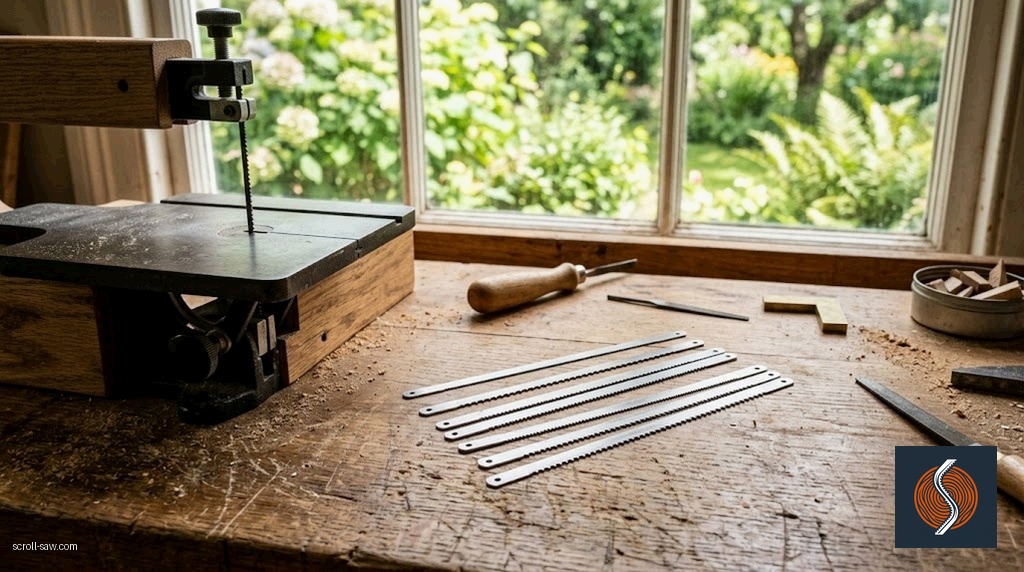
A Practical Selection Guide to 5 Inch Plain End Scroll Saw Blades
You stand in front of a pegboard at the hardware store, staring at a wall of small packages. Each one has a number on it: #2/0, #5, #7, #9. Some say skip-tooth, some say reverse-tooth, some say spiral. The packaging tells you almost nothing useful, and the person at the register has never used a scroll saw. You pick a pack based on a guess, get home, and discover the blades are wrong for what you need. If this has happened to you, this guide is for you.
5 inch plain end scroll saw blades are the unpinned, flat-end blades that work in most mid-range and better scroll saws. They are the same thing as pinless blades: “plain end” and “pinless” are two names for the same product. The 5 inch measurement refers to the blade length, which is the standard size for most scroll saws that accept plain-end blades.
The quick answer to selecting the right blade: learn the universal blade numbering system, pick your tooth geometry based on the finish you need, and match the blade width to the tightest curve in your pattern. If you get those three things right, you will have the right blade for the job.
The Universal Blade Numbering System Explained
Scroll saw blades use a universal numbering system that has been around for decades. The numbers run from #2/0 (the smallest) up through #12 (the largest). Lower numbers mean finer, thinner blades. Higher numbers mean wider, thicker, more aggressive blades.
Here is what the common numbers translate to in practical terms:
#2/0 and #0: Very fine blades for delicate fretwork, thin veneer, and extremely tight curves. Blade width is around 0.010 to 0.012 inches. These are fragile and break easily. Use them only for thin material (1/8 inch or less).
#1 and #3: Fine blades for detailed work in thin to medium stock. Width around 0.014 to 0.018 inches. Good for intarsia, small decorative pieces, and work where you need a clean finish with minimal sanding.
#5: A middle-of-the-road blade that handles most general scroll saw work. Width around 0.020 to 0.025 inches. This is the blade I would recommend if you are buying one pack to start with. It cuts 1/8 to 1/2 inch wood well and can handle moderate curves.
#7: A medium blade for thicker stock and faster cutting. Width around 0.030 inches. Good for 1/4 to 3/4 inch wood and patterns with larger curves. The tradeoff is that it cannot cut tight radius curves.
#9 and #12: Heavy blades for thick stock, rough cutting, and fast material removal. Width 0.040 inches and up. These are not really scroll saw blades in the traditional sense; they are closer to coping saw blades. Use them when you need to cut thick wood and do not care about fine detail.
The numbering system is not perfectly standardized between manufacturers. A #5 from Olson might be slightly different from a #5 from Pegas. The differences are small, but they exist. Once you find a brand you like, stick with it so your results are consistent.
Plain End vs. Pin End: Which Do You Need?
Plain end (pinless) blades and pin-end (pinned) blades are not interchangeable. Your saw either accepts one, the other, or both. Before you buy any blades, check what your saw takes.
Pin-end blades have small metal pins pressed into each end. You drop the pins into slots in the saw’s upper and lower blade clamps. Installation takes about five seconds. The tradeoff is that pin-end blades are thicker and wider, so they cannot cut fine details or tight curves.
Plain-end blades have flat ends. You clamp them into blade holders that grip the flat end between jaws. Some saws have built-in blade holders for plain-end blades. Others need an adapter that converts a pin-end clamp to accept plain-end blades. Installation is slower and requires more care to get the blade straight and properly tensioned.
If your saw accepts both, use plain-end blades for fine work and pin-end blades for rough cutting. If your saw only takes pin-end blades, you can sometimes use an adapter to run plain-end blades, but not always. Check your saw’s manual or the manufacturer’s website.
Tooth Geometry: What Each Type Does
The universal number tells you the blade size, but the tooth geometry tells you how it cuts. Here are the types you will encounter:
Skip-tooth: Large gaps between teeth for good chip clearance. Cuts fast, runs cool, leaves a medium-rough surface. The go-to for general cutting and thicker stock.
Reverse-tooth (double-reverse): Most teeth point down, with a few at the bottom pointing up. The upward teeth clean the bottom edge of the cut, reducing tearout. The tradeoff is that the blade can grab on the upstroke, and the reverse section only helps with thin stock (the reversed teeth typically cover about 1/2 inch of blade length).
Double-reverse: Teeth reverse at both the top and bottom of the blade. This gives clean edges on both top and bottom. Slower than skip-tooth and can be grabby in both directions.
Spiral: Teeth wrap around the blade in a spiral pattern, so the blade cuts in all directions. You do not need to rotate the workpiece to follow a curve. The tradeoff is a wider kerf, rougher surface, and less control. Spiral blades are a specialized tool, not a general-purpose choice.
Crown-tooth: Alternating up and down teeth. Cuts on both strokes for a smoother surface. Slower than skip-tooth and takes practice to control because it cuts in both directions.
For most work, skip-tooth and reverse-tooth cover 90 percent of what you need. Start with skip-tooth for general cutting and add reverse-tooth when you want cleaner edges.
How to Install and Tension Plain End Blades
Installing a plain-end blade is a skill that takes practice. Here is the process:
- Loosen the blade holder on both the upper and lower clamps.
- Insert one end of the blade into the lower holder. The teeth should point down (toward the table) for standard cutting. Check tooth direction before clamping.
- Tighten the lower clamp.
- Thread the blade through your pilot hole if you are doing interior cuts.
- Insert the upper end into the upper blade holder.
- Apply tension by tightening the tension knob or lever. You want the blade to ring at a high pitch when plucked, like a guitar string.
- Check that the blade is straight by rotating the saw arm by hand. The blade should stay in the same plane, not wobble left or right.
Too little tension and the blade wanders in the cut. Too much and it snaps. Finding the right tension is a feel thing. Start with moderate tension and adjust until the blade cuts straight without drifting.
Matching Blades to Common Projects
Fretwork and marquetry: Use #2/0 or #1 reverse-tooth blades. These give you the tightest curves and cleanest finish. You will go through blades fast because the fine teeth dull quickly, so buy in bulk.
Intarsia: Use #3 or #5 skip-tooth blades. Intarsia pieces are larger than fretwork, so you need a blade that cuts faster but still handles moderate curves.
Toys and puzzles: Use #5 or #7 skip-tooth blades. These projects use thicker wood (1/4 to 1/2 inch) and have larger curves, so a medium blade is the right call.
Signs and name plaques: Use #7 or #9 skip-tooth blades for the main cutting, then switch to a #5 reverse-tooth for fine details. The larger blade removes material fast for the big cuts, and the finer blade cleans up the details.
Thin plywood and veneer: Use #3 or #5 reverse-tooth with 20+ TPI. Thin material tears out easily, so you need fine teeth and reverse geometry to keep both surfaces clean.
Blade Holders and Adapters: What You Need to Know
If your saw does not have built-in plain-end blade holders, you need an adapter. The adapter fits into the saw’s pin-end clamp and provides a small jaw that grips the flat end of a plain-end blade.
Adapters work, but they add a point of failure. The adapter itself can slip, and the extra length reduces the effective stroke of the saw. If you are buying a new saw and plan to do fine work, get one that accepts plain-end blades natively.
Some saws, like the Hegner and the DeWalt DW788, have quick-change blade holders that make switching plain-end blades fast. Others require you to loosen and tighten screws manually, which is slower but works fine once you get the hang of it.
What About 6 Inch Blades?
Some scroll saws use 6 inch plain end scroll saw blades instead of 5 inch. The length difference is small, but the longer blade gives you more cutting depth before the blade exits the bottom of the cut. If your saw specifies 6 inch blades, use them. Using a 5 inch blade in a saw designed for 6 inch can work in a pinch, but the shorter blade may not reach the clamps properly or may reduce the maximum material thickness you can cut.
Signs You Are Using the Wrong Blade
If your cuts are burning the wood, the blade is too fine for the material or the blade is dull. If the surface is rough and torn, the TPI is too low or you need a reverse-tooth blade. If the blade keeps breaking, you may be over-tensioning, feeding too fast, or using too fine a blade for the thickness.
If the blade wanders off the line, tension is probably too low. If the blade catches and grabs, you may be feeding too fast or using a reverse-tooth blade that is too aggressive for your feed rate.
The Verdict
Selecting 5 inch plain end scroll saw blades comes down to three decisions: the universal number (which sets blade width and thickness), the tooth geometry (which sets the finish and cutting characteristics), and the TPI (which sets the speed and smoothness). Start with a #5 skip-tooth blade for general work, add a #3 reverse-tooth for cleaner edges, and keep a pack of #2/0 for fine fretwork. Those three cover most projects.
The main drawback of plain-end blades is the learning curve for installation and tensioning. It takes practice to get the blade seated correctly and tensioned right. Expect to break blades while you learn. That is normal and not a sign that you are doing something wrong.
Buy blades from established manufacturers like Olson, Pegas, or Flying Dutchman. The quality is more consistent, and the blade specs on the packaging are more likely to match what is actually inside. Cheap bulk blades from unknown sources can be inconsistent in hardness and tooth geometry, which makes it hard to repeat good results.
FAQ
What is the difference between plain end and pinless scroll saw blades? Nothing. Plain end and pinless are two names for the same type of blade. Both have flat ends that clamp into a blade holder, as opposed to pin-end blades which have metal pins at each end.
What size plain end blade should I start with? A #5 skip-tooth blade is the best all-around starting point. It handles most general scroll saw work in wood from 1/8 to 1/2 inch thick and can cut moderate curves. From there, you can go finer or heavier based on your projects.
Can I use 5 inch plain end blades in a saw that takes 6 inch blades? Sometimes, but it depends on the saw. A shorter blade may not reach the clamps properly or may reduce your maximum cutting thickness. If your saw specifies 6 inch blades, use them for best results.
Do I need an adapter to use plain end blades? If your saw has built-in plain-end blade holders, no. If it only has pin-end clamps, you need an adapter that converts the pin-end clamp to accept flat-end blades. Check your saw’s manual to find out what it accepts.
How do I know which direction the teeth point? Run your finger lightly along the blade. One direction will feel smooth, the other will catch. The teeth should point down (toward the table) for standard cutting, so the blade cuts on the downstroke. If the teeth point up, the blade is installed backwards.
What is the universal blade numbering system? Scroll saw blades are numbered from #2/0 (finest) to #12 (heaviest). Lower numbers mean thinner, narrower blades for fine work. Higher numbers mean wider, thicker blades for faster cutting and thicker stock. The system is roughly standardized but varies slightly between manufacturers.
Are reverse-tooth blades worth it? Yes, if the bottom surface of your cut matters. Reverse-tooth blades have a few upward-pointing teeth that clean up tearout on the bottom edge. The tradeoff is that they can grab on the upstroke, so you need to feed carefully.
How many blades should I buy at once? Buy in packs of 12 or more. Scroll saw blades are consumable, and you will go through several in a single session of fine work. Buying in bulk is cheaper and ensures you have spares when a blade breaks mid-project.
References
- Olson Saw Company, scroll saw blade product catalog and specifications (olsonsaw.com)
- Pegas by Niqua, blade numbering and product specifications (pegas.swiss)
- Fine Woodworking, scroll saw technique and blade guides (finewoodworking.com)
- Wood Magazine, scroll saw blade buying advice (woodmagazine.com)
- Hegner, scroll saw owner’s manuals and blade compatibility information (hegner.com)


