
Hegner Scroll Saw Blade Clamps: Selection Guide
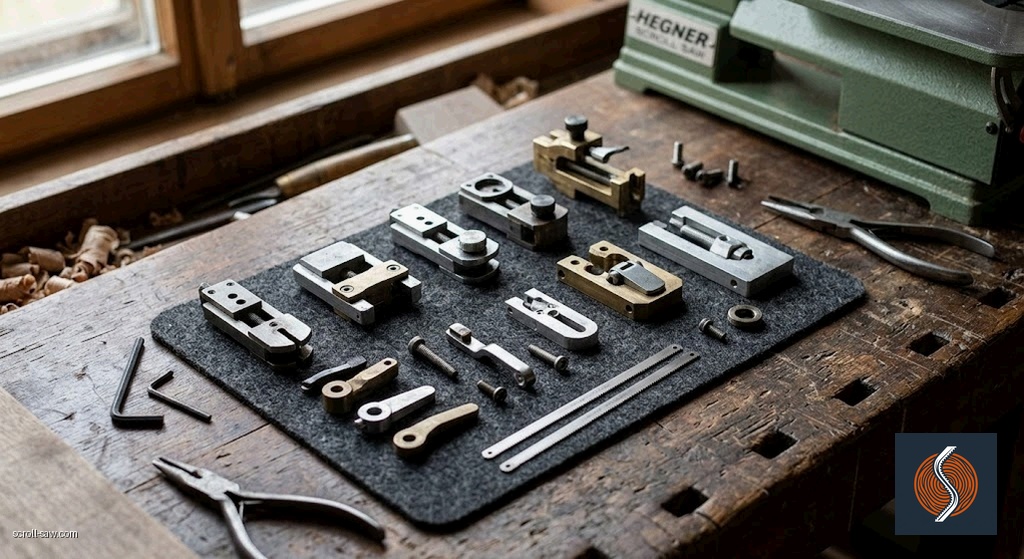
A Practical Selection Guide to Hegner Scroll Saw Blade Clamps
I was cutting a nameplate out of 1/2-inch maple on my Hegner 18V, and the blade kept drifting left. I checked the tension, checked the speed, checked the table for square. Everything was right. Then I looked closely at the upper blade clamp and saw that the set screw had backed out a quarter turn, letting the blade twist fractionally in the holder. That tiny movement was enough to send every curve off by an eighth of an inch. Hegner scroll saw blade clamps are small parts with an outsized impact: if they do not hold the blade perfectly straight and secure, nothing else you do matters.
Hegner scroll saw blade clamps are the mechanisms that grip the plain-end blade in the upper and lower positions on Hegner scroll saws. Unlike saws that accept pin-end blades, Hegner saws use plain-end blades exclusively, which means the clamps are doing all the work of holding the blade. The quick-release tension system on Hegner saws makes blade changes fast, but it also means the clamps are engaged and released repeatedly, which wears them over time.
If you are choosing replacement clamps or trying to understand why your blades are drifting or breaking, the answer is usually in the clamps. Knowing which type fits your Hegner model, how to install them, and how to spot wear will save you from ruined work and broken blades.
How Hegner Blade Clamps Work
On a Hegner scroll saw, the blade is held at two points: the upper blade holder on the end of the upper arm, and the lower blade holder under the table. Each holder contains a clamp that grips the plain end of the blade. The clamp tightens around the blade end, holding it firmly enough to resist the pulling and pushing forces of cutting.
The quick-release tension system is what sets Hegner apart from many other scroll saws. Instead of loosening and tightening a bolt every time you change a blade, the Hegner system has a lever or cam that releases the blade with one motion and re-tightens it with another. This makes inside cuts, where you have to thread the blade through a hole in the workpiece and re-clamp it, much faster than on saws without quick-release.
The tradeoff is that the quick-release mechanism has more moving parts than a simple bolt clamp. The cam surfaces and pivot points wear over time, and when they wear, the clamp does not hold the blade as squarely as it should. A blade that is held at even a slight angle will cut to one side, and no amount of tension or speed adjustment will fix it.
Hegner Models and Clamp Compatibility
Hegner has made several models over the years, and the blade clamps are not all the same. Here is what I know from working on different Hegner saws:
Hegner 14E and 14V: These are the smaller Hegner saws with a shorter upper arm. The blade clamps on the 14-series are compact and use a simpler quick-release mechanism. If you are replacing clamps on a 14E or 14V, check the parts diagram for the specific clamp assembly, because the 14-series clamps are not interchangeable with the larger saws.
Hegner 18S and 18V: The 18-series is the most common Hegner I see in workshops. The blade clamps are larger than the 14-series and use a more robust quick-release mechanism. The upper arm on the 18-series has more travel, which means the upper clamp moves farther with each stroke, so the clamp needs to hold the blade securely through a longer range of motion.
Hegner 22V: The largest Hegner, with the biggest throat depth. The blade clamps on the 22V are similar in design to the 18-series but sized for the larger arm. If you are ordering clamps for a 22V, confirm the part against the parts list, because the 22V has a different arm geometry than the 18-series.
Hegner Polymax: The Polymax is the top of the Hegner line and may use a different clamp design than the other models. If you have a Polymax, do not assume the clamps are the same as the 18V. Check the model plate and order from the correct parts list.
The Universal Precision Saw is another Hegner designation you may see on older saws. If your saw has this name on the model plate, it may use an earlier clamp design. Measure the existing clamps and compare to the parts diagram before ordering.
Choosing the Right Blade Clamps
When you are selecting replacement clamps, here are the things that matter:
Model match. This is the most important factor. The clamps must be designed for your specific Hegner model. A clamp that fits an 18V will not necessarily fit a 14E or a 22V. Always start with the model plate on your saw.
Blade size range. Hegner clamps are designed to hold standard plain-end scroll saw blades, but if you work with very fine blades (size 8/0 or smaller) or very thick blades (size 12), check that the clamp can grip the blade securely. Very fine blades can slip in clamps designed for larger blades, and very thick blades may not fit in the clamp opening at all.
Quick-release condition. If you are buying a used Hegner or replacing clamps on an older saw, inspect the quick-release mechanism. The cam surfaces should be smooth, not grooved or worn. A worn cam will not hold the blade securely, and the blade will drift or slip during cuts.
Set screw condition. Many Hegner clamps use a set screw to fine-tune the blade position. If the set screw is stripped or the threads in the clamp body are worn, the blade will not stay aligned. Replacement set screws are cheap, but a stripped clamp body means you need a new clamp.
How to Install a Blade in a Hegner Scroll Saw
If you are learning how to install a blade in a Hegner scroll saw, the process is the same whether you are working with the upper or lower clamp. Here is the sequence I use:
First, release the quick-release tension lever. This opens both clamps and relaxes tension on the upper arm. On most Hegner saws, this is a single lever on the upper arm that you flip forward to release.
Thread the blade through the hole in your workpiece if you are doing an inside cut. The teeth should face down, toward the table. Hegner scroll saws cut on the downstroke, same as most scroll saws.
Insert the bottom end of the blade into the lower blade clamp. Tighten the lower clamp. Then insert the top end into the upper blade clamp and tighten it. On models with a quick-release system, you may not need to manually tighten each clamp; the lever does both at once when you flip it back.
Apply tension using the quick-release lever. The blade should be taut and produce a clean ping when plucked. If the blade is loose after engaging the lever, the tension may need adjustment. Some Hegner models have a separate tension adjustment that you set once and then the quick-release lever brings the blade back to that tension each time.
Make a test cut in scrap. If the blade tracks straight, the clamps are aligned. If it drifts to one side, one of the clamps is holding the blade at an angle. Loosen, reseat the blade, and try again.
Common Clamp Problems and How to Spot Them
Here are the problems I see most often with Hegner blade clamps, and how to identify them:
Blade drift. The blade cuts to one side even when you are feeding straight. This means one clamp is holding the blade at an angle. Check the set screws and the clamp faces for wear or debris. A tiny wood chip caught between the clamp and the blade will angle the blade enough to cause drift.
Blade slippage. The blade pulls out of the clamp during a cut. This is dangerous because the blade can snap or the workpiece can kick. Slippage usually means the clamp is worn or the quick-release mechanism is not engaging fully. If the cam is worn, the clamp will not close tightly enough to hold the blade.
Blade breakage. If you are breaking blades more often than usual, the clamps may be the cause. A clamp that holds the blade too tightly, or at an angle, will stress the blade and cause it to snap. Check that the blade sits squarely in the clamp before tightening.
Difficulty changing blades. If the quick-release lever is stiff or does not move smoothly, the mechanism may need cleaning or lubrication. Sawdust can work its way into the pivot points and cause the lever to bind. A stiff lever is not just annoying; it can also mean the clamp is not opening or closing fully, which affects how securely it holds the blade.
The Blade Guard and Blade Holder: Knowing the Difference
People sometimes confuse the blade clamp, blade holder, and blade guard, so let me clarify. The blade holder is the assembly on the upper arm (and under the table) that contains the clamp. The clamp is the part inside the holder that actually grips the blade. The blade guard is a separate component that covers the blade above the workpiece to protect your fingers.
If you are looking for a Hegner scroll saw blade guard, that is a different part from the clamp. The guard is a safety feature, not a blade-holding component. You can replace the guard without touching the clamps, and vice versa.
The blade holder assembly includes the clamp, the quick-release mechanism, and the housing that mounts to the upper arm. When you order replacement parts, the parts diagram will show you whether you need the clamp alone, the full holder assembly, or the quick-release mechanism.
Maintaining Your Clamps
Good clamps last years if you take care of them. Here is what I do:
Blow out the clamps with compressed air after every few blade changes. Sawdust builds up inside the clamp faces and in the quick-release pivot points. A clean clamp holds the blade more securely than a dirty one.
Check the set screws periodically. If a set screw is backing out repeatedly, the threads may be wearing. Replace the screw before it strips the clamp body.
Lubricate the quick-release pivot points with a drop of light oil. Do not over-lubricate; oil attracts sawdust, which causes more problems than it solves. A single drop on each pivot is enough.
Inspect the clamp faces for grooves or wear. The faces that contact the blade should be flat and smooth. If they develop grooves from repeated clamping, the blade will not sit squarely, and you will get drift. Worn clamp faces mean it is time for replacement.
Conclusion
Hegner scroll saw blade clamps are the link between your saw and your blade. When they are clean, aligned, and in good condition, the blade tracks straight, cuts clean, and changes quickly. When they are worn, dirty, or misaligned, the blade drifts, slips, and breaks. Know your Hegner model, inspect your clamps for wear, keep them clean, and replace them when the clamp faces or quick-release mechanism show their age. A new set of clamps is the cheapest fix for a saw that has started cutting crooked, and it is the first thing I check before blaming the blade or the saw.
FAQ
What are Hegner scroll saw blade clamps? Hegner scroll saw blade clamps are the mechanisms that grip plain-end blades in the upper and lower blade holders. They hold the blade securely during cutting and release it for blade changes via the quick-release tension system.
How do I change the blade on a Hegner scroll saw? Release the quick-release tension lever, remove the old blade, thread the new blade through the workpiece if doing an inside cut, insert the bottom end into the lower clamp, insert the top end into the upper clamp, and engage the quick-release lever to apply tension.
Are Hegner blade clamps the same across all models? No. The 14-series, 18-series, 22V, and Polymax use different clamp designs. Always identify your model from the model plate and check the parts diagram before ordering replacement clamps.
Why is my blade drifting to one side on my Hegner scroll saw? Blade drift usually means one of the clamps is holding the blade at an angle. Check for sawdust in the clamp faces, a backed-out set screw, or worn clamp surfaces. Clean the clamps, reseat the blade, and test on scrap.
What is the difference between the blade clamp and the blade guard on a Hegner? The blade clamp grips the blade inside the blade holder assembly. The blade guard is a separate safety cover that shields the blade above the workpiece. They are different parts with different functions.
How do I know when to replace my Hegner blade clamps? Replace the clamps when you see grooves or wear on the clamp faces, when the quick-release mechanism does not hold the blade securely, when set screws are stripped, or when the blade repeatedly drifts despite cleaning and reseating.
Can I use pin-end blades on a Hegner scroll saw? No. Hegner scroll saws use plain-end blades exclusively. The blade clamps are designed to grip the flat ends of plain-end blades, not the pins on pin-end blades.
Where can I find the parts diagram for my Hegner blade clamps? Check the owner manual that came with your saw. The parts list will show the clamp assembly, service part numbers, and the quick-release mechanism components. If you do not have the manual, identify your model from the model plate and contact Hegner or a parts supplier.
References
- Hegner manufacturer owner manuals and parts diagrams for blade clamp specifications and model compatibility
- Hegner Universal Precision Saw reference documentation for quick-release tension system details
- Scroll saw maintenance guides on blade holder inspection and alignment
- Woodworking tool reference resources on plain-end blade clamp design and troubleshooting


