
Pégas Scroll Saw Blade Chuck Heads: Clean Curves
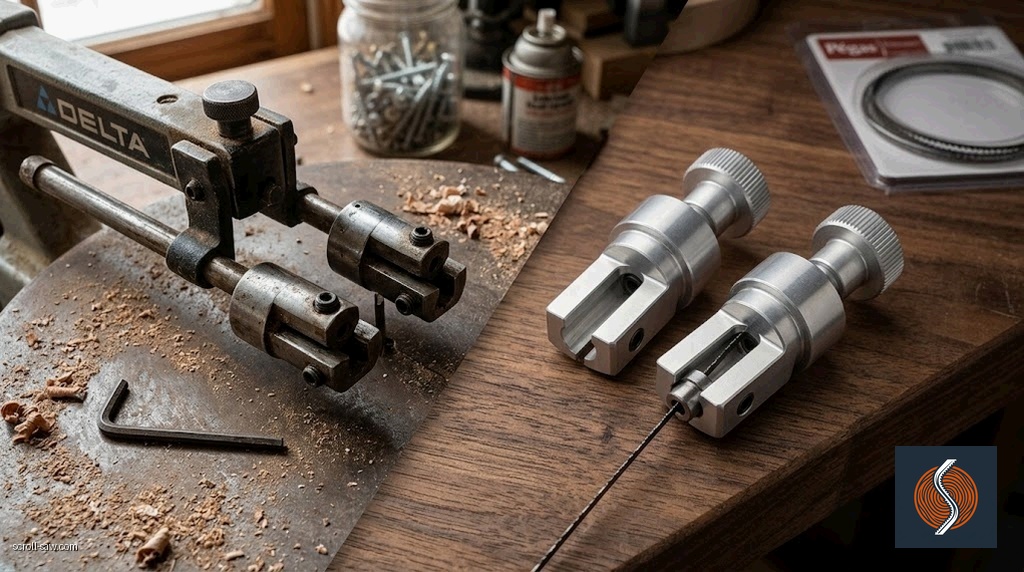
Choosing Pégas Scroll Saw Blade Chuck Heads for Clean Curves and Controlled Feed
The first time I put a Pégas blade in my saw, I understood what people meant when they said the blade was only half the equation. The blade was sharp, the geometry was right, but the cut still had chatter marks and the blade drifted on tight curves. The problem was not the blade. It was the chuck head, the piece that holds the blade in the saw. A loose or poorly aligned chuck head turns a good blade into a bad cut.
Pégas scroll saw blade chuck heads are the blade-holding mechanism on Pégas scroll saws and compatible saws. They grip the plain-end blade at the top and bottom of the stroke, keep the blade under tension, and maintain alignment so the blade tracks straight. The chuck head is the connection between the saw’s motor and the blade, and if that connection is loose, worn, or mismatched to the blade, every cut suffers.
The short answer: the right chuck head holds the blade firmly, maintains alignment between the upper and lower jaws, and fits the blade size you are using. If your chuck head is worn, loose, or designed for a different blade thickness, you will get vibration, blade wander, and poor finish quality no matter how good the blade is.
What a Chuck Head Does
The chuck head has one job: hold the blade. But that job has three parts. First, it grips the blade tightly enough that the blade does not slip under cutting load. Second, it holds the blade straight so the cutting edge tracks in a single plane. Third, it releases the blade quickly for blade changes.
When any of those three fails, the symptoms are predictable. A slipping blade produces inconsistent cut depth and the blade pulls out of alignment mid-cut. A misaligned blade wanders on curves and produces a kerf that is wider on one side. A chuck that does not release cleanly makes blade changes frustrating and can damage the blade end.
Pégas chuck heads are designed for plain-end blades. They use a clamping mechanism that grips the flat end of the blade between two machined surfaces. The precision of those surfaces determines how well the blade is held. Pégas chuck heads are machined to tight tolerances, which is why they are popular among scrollers who need clean, precise cuts.
The Pégas Chuck Head Lineup
Pégas makes chuck heads for their scroll saws in several sizes. The key spec is the blade width and thickness range the chuck can grip. A chuck head designed for heavy blades may not grip a fine fretwork blade securely, and a chuck head designed for fine blades may not open wide enough for a thick blade.
The Pégas SRP 13 DUAL chuck head is designed to handle a range of blade sizes, making it a versatile choice for scrollers who switch between fine and coarse work. The dual-jaw design grips both small and larger blades without needing to swap chucks.
The Pégas SRP 14 chuck head is built for heavier blades and thicker stock. If you are cutting half-inch hardwood or doing production work with aggressive feed rates, the SRP 14 holds the blade firmly under higher cutting loads.
The choice between them comes down to the blades you use. If you work across a range of blade sizes, the SRP 13 DUAL gives you flexibility. If you mostly run thicker blades in dense material, the SRP 14 gives you a more rigid hold.
The flaw: neither chuck head is universal. If you run ultra-fine fretwork blades (smaller than #2/0), even the SRP 13 DUAL may not grip them securely. For the finest blades, check the chuck’s minimum blade width spec before buying.
Chuck Head Alignment and Vibration Control
The single biggest factor in cut quality with Pégas chuck heads is alignment. The upper and lower chuck heads must be in line with each other so the blade runs in a single vertical plane. If the upper chuck is offset even slightly from the lower chuck, the blade twists, and the twist shows up as a wider kerf, chatter marks, and blade wander on curves.
To check alignment, install a blade and tension it. Look at the blade from the front of the saw. The blade should be perfectly vertical, with no visible twist. If the blade angles left or right, one of the chuck heads is misaligned. Some Pégas saws have alignment adjustments on the chuck heads, others require shimming.
Vibration is the second factor. A loose chuck head transmits motor vibration into the blade, producing chatter marks on the cut surface. A properly tightened chuck head dampens vibration and produces a smoother cut. The fix is simple: check the chuck head mounting hardware and tighten everything to spec.
The precision guide system on Pégas saws helps with both alignment and vibration. The guide system supports the blade near the cutting zone, reducing side-to-side movement. But the guide system only works if the chuck heads are aligned and tight. A good guide system cannot fix a bad chuck head.
Throat Depth and Blade Length Considerations
Pégas scroll saws come in 16-inch, 21-inch, and 30-inch throat depths. The throat depth determines how wide a workpiece you can cut, but it also affects the blade length requirement. Deeper throat saws may use longer blades, and the chuck heads must accommodate that length.
Most scroll saw blades are 5 inches long, and most Pégas chuck heads are designed for 5-inch blades. If you are using a non-standard blade length, confirm the chuck head can accept it. A blade that is too short may not seat properly in the chuck, and a blade that is too long may not fit between the upper and lower arms.
The chuck head’s blade length capacity is usually listed in the product specs. If it is not listed, assume 5 inches and verify before buying non-standard blades.
Blade Width and Chuck Compatibility
The chuck head must grip the full width of the blade end. If the blade is wider than the chuck’s jaw opening, the chuck cannot close on it. If the blade is narrower than the chuck’s minimum grip width, the chuck may not hold it securely.
For most scrollers, this is not a problem because the range of blade widths is small (0.010 to 0.030 inches). But if you are switching between ultra-fine fretwork blades and heavy skip-tooth blades, you may need a chuck head that handles the full range, or you may need to swap chuck heads when you change blade types.
The Pégas SRP 13 DUAL addresses this with its dual-jaw design. One jaw set grips fine blades, the other grips heavier blades. You do not need to change the chuck head, just use the appropriate jaw.
Who Should Upgrade Their Chuck Head
If you are using the chuck head that came with your saw and your cuts are clean, your blade changes are quick, and you have no vibration issues, you do not need to upgrade. The stock chuck head is doing its job.
If you are getting chatter marks, the blade is slipping, or blade changes are difficult, the chuck head may be worn or damaged. Chuck heads are consumable parts. The gripping surfaces wear over time, especially if you change blades frequently. A worn chuck head grips less firmly and introduces play into the blade.
If you are moving to finer blades than your current chuck head can grip, you need a chuck head rated for those blades. The same chuck head that holds a #9 blade firmly may not hold a #2/0 blade at all.
If you are doing production work and need fast, reliable blade changes, a precision chuck head like the Pégas system saves time and reduces the risk of a poorly seated blade.
The Verdict
The chuck head is the most overlooked part of the scroll saw setup. Scrollers spend hours choosing blades and ignore the piece that holds the blade. A good Pégas chuck head, properly aligned and tightened, makes every blade cut better. A bad one makes every blade cut worse.
Three takeaways: check alignment before you blame the blade, match the chuck head’s blade width range to the blades you actually use, and replace worn chuck heads when the gripping surfaces lose their hold. The chuck head is the foundation of the cut, and a weak foundation means weak cuts.
FAQ
What does a Pégas scroll saw blade chuck head do? It holds the plain-end blade at the top and bottom of the scroll saw, keeping the blade under tension and aligned so it tracks straight during cutting. The chuck head grips the flat end of the blade between machined surfaces.
How do I know if my chuck head is worn out? Signs of a worn chuck head include blade slipping during cuts, chatter marks on the cut surface, difficulty maintaining blade tension, and blade wander on curves. If tightening the chuck does not fix these issues, the gripping surfaces are likely worn.
Are Pégas chuck heads compatible with all scroll saws? No. Pégas chuck heads are designed for Pégas scroll saws and specific compatible models. Check the chuck head’s compatibility list and your saw’s manual before buying.
What is the difference between the Pégas SRP 13 DUAL and SRP 14? The SRP 13 DUAL has a dual-jaw design that handles a range of blade sizes from fine to coarse. The SRP 14 is built for heavier blades and thicker stock, with a more rigid hold for aggressive cutting.
Can a chuck head improve cut quality? Yes. A properly aligned, tight chuck head reduces vibration and blade wander, producing cleaner cuts. A loose or misaligned chuck head introduces chatter and drift regardless of blade quality.
How often should I replace my chuck head? There is no fixed interval. Replace the chuck head when the gripping surfaces no longer hold the blade firmly, when blade slipping becomes frequent, or when cut quality degrades and the blade is not the cause.
Do I need a different chuck head for fine fretwork blades? Possibly. Some chuck heads cannot grip ultra-fine blades (smaller than #2/0) securely. Check the chuck head’s minimum blade width specification. The Pégas SRP 13 DUAL is designed to handle a wider range of blade sizes.
How do I align Pégas chuck heads? Install a blade and tension it, then look at the blade from the front of the saw. The blade should be perfectly vertical. If it twists or angles, adjust the chuck head alignment using the saw’s alignment mechanism or shims. Some Pégas saws have built-in alignment adjustments.
References
- Pégas by Niqua, official product specifications and chuck head documentation, pegas.swiss or niqua.ch
- Fine Woodworking, scroll saw setup and maintenance, finewoodworking.com
- Scroll Saw Woodworking and Crafts magazine, equipment reviews and guides, scrollsawer.com
- Wood Magazine, scroll saw troubleshooting, woodmagazine.com


