
Pin End Spiral Scroll Saw Blades: Choosing Guide
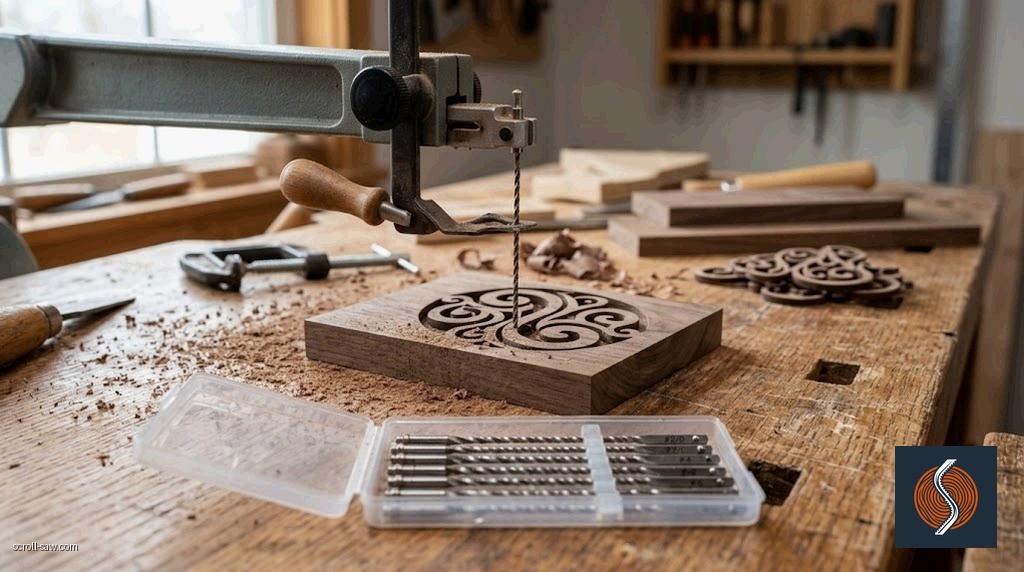
Choosing Pin End Spiral Scroll Saw Blades for Clean Curves and Controlled Feed
You just finished a complex clock face pattern with a standard blade, and your wrist aches from rotating the workpiece what felt like a hundred times. The curves came out fine, but the process was slow and tiring. Next time, you want something that lets you follow the lines without all the turning. That is where pin end spiral scroll saw blades come in, and choosing the right one makes the difference between clean curves and a mess.
Pin end spiral scroll saw blades combine two features: spiral teeth that cut in all 360 degrees, and pin-end mounting that drops quickly into compatible blade holders. The spiral teeth let you cut in any direction without rotating the workpiece, and the pins make installation fast. They come in a range of teeth per inch (TPI) and blade widths to match different materials and pattern complexities.
The direct answer: choose a pin end spiral blade with 20 to 30 TPI for most woodworking, match the blade width to your tightest curve radius, feed the workpiece gently to control the kerf, and check the cut edges for smoothness and accuracy. Pin-end spiral blades are a specialty option that trades precision for cutting freedom, so they are best for patterns with lots of tight, multi-directional curves rather than straight lines or sharp corners.
Why Pin-End Spiral Blades Exist
The combination solves a real problem. Spiral blades give you cutting freedom, but plain-end spiral blades require careful clamping, and some saws do not accept plain-end blades at all. Pin-end spiral blades bring the benefits of spiral cutting to saws that only use pin-end holders.
I started using pin end spiral blades when I got a saw that only accepted pin-end. I wanted the cutting freedom of spiral but did not want to buy a new saw or adapter. The pin-end spiral blades were the answer. They are not as widely available as plain-end spiral, but the major blade manufacturers make them in several sizes.
The honest drawback: because the pin-end format is less common for spiral blades, your local woodworking store may not stock them. Online retailers carry them, but you may need to order ahead rather than picking them up the day of a project.
Choosing TPI for Pin-End Spiral Blades
TPI selection for pin-end spiral blades follows the same logic as any spiral blade, with one added consideration: the pin-end format limits the range available.
For most scroll saw work in wood:
- 28 to 40 TPI for wood 1/8 inch or thinner. These fine blades produce clean edges on delicate work.
- 20 to 28 TPI for wood 1/8 to 1/2 inch thick. This covers most scroll saw projects.
- 18 to 24 TPI for wood thicker than 1/2 inch. Coarser teeth clear chips better in thick stock.
A 5-inch pin end spiral blade in the 20 to 28 TPI range is a good all-around choice. The 5-inch length fits most standard scroll saws, and the medium TPI handles a range of wood thicknesses. If you can only stock one pin-end spiral blade, this is the one I would pick.
For tighter detail work, a 3-inch pin end spiral blade with higher TPI gives you more control on thin materials. The shorter blade length can limit your saw’s throat depth, so check that the blade length works with your saw before buying.
Blade Width and Minimum Cutting Radius
Blade width on spiral blades determines the minimum cutting radius, the tightest curve the blade can turn. Because spiral teeth protrude in all directions, the effective cutting width is wider than the blade body measurement. A spiral blade listed as 1/8 inch wide may cut a kerf closer to 3/16 inch.
For pin-end spiral blades, the available widths are typically narrower than standard pin-end blades because the spiral tooth pattern is usually applied to thinner blade stock. This is actually an advantage for tight curve work. A narrow spiral blade can turn a very tight radius, sometimes tighter than a standard blade of the same listed width.
The tradeoff is stiffness. A narrow blade in thick material deflects more, and spiral blades already deflect more than flat blades because of the multidirectional cutting force. If your cuts are wandering in thick stock, a wider blade or lower TPI may help.
Feed Rate and Control
Feed rate is the single biggest factor in getting clean curves with pin-end spiral blades. Because the blade cuts in all directions, any pressure you apply becomes a cut. Push too hard to the left and the blade cuts left, whether that is where the line goes or not.
Here is the technique I use:
- Hold the workpiece with both hands, one on each side of the cut line.
- Apply gentle, even pressure forward. Let the blade pull the wood through.
- Steer by shifting pressure between your hands, not by pushing sideways.
- Keep the feed rate slow enough that you can see the blade following the line.
The kerf on a spiral blade runs wider than a flat blade because of the all-around teeth. This means your cut line will be slightly wider than you might expect. If you are used to flat blades, give yourself a few practice cuts to calibrate how much pressure translates into how much sideways movement.
Checking Cut Quality on Pin-End Spiral Blades
After a cut, check these things:
- Edge smoothness: Spiral blades produce slightly rougher surfaces than flat blades. If the surface is too rough, go to a higher TPI.
- Kerf width: Measure the cut width. If it is significantly wider than the blade specification, you are feeding too aggressively or the tension is too low.
- Curve accuracy: Compare the cut line to the pattern. Spiral blades can drift on tight curves if you oversteer. Lighten your feed pressure.
- Tearout: The bottom face may show more tearout than with a reverse-tooth blade because spiral blades do not have a reverse-tooth option.
- Corner crispness: Internal corners will be slightly rounded. This is inherent to spiral blades. If the pattern demands sharp corners, plan to switch to a standard blade for those sections.
Pin-End Spiral vs Plain-End Spiral: A Comparison
| Feature | Pin-End Spiral | Plain-End Spiral |
|---|---|---|
| Installation speed | Fast, drop-in | Slower, requires clamping |
| Blade security | High, pins hold firmly | Depends on clamp quality |
| TPI options available | Fewer | More |
| Blade width options | Fewer | More |
| Best for | Quick work on pin-end saws | Detailed work needing specific sizes |
| Availability | More limited | Wider selection |
If your saw accepts both pin-end and plain-end, plain-end spiral gives you more control over TPI and width. If you are limited to pin-end, the available selection still covers most scroll saw projects.
Common Pitfalls
One mistake I see often: treating a spiral blade like a standard blade for precision work. Spiral blades are freedom tools, not precision tools. If you need a cut that is accurate to the line with a crisp corner, a spiral blade will frustrate you.
Another pitfall is buying only one TPI and expecting it to handle everything. Pin-end spiral blades are available in a limited range, but having two or three TPI options lets you match the blade to the project. A fine blade for thin work and a medium blade for general cutting covers most needs.
Finally, do not skip blade tension. Pin-end blades can mask loose tension because the pins hold the ends even when the blade is not tight enough. A loose spiral blade produces a wider, messier kerf that looks like a rough cut even when the blade is sharp.
The Verdict
Pin end spiral scroll saw blades are a niche tool that earns its place when you have a pin-end-only saw and want the cutting freedom of spiral teeth. They are not as versatile as plain-end spiral blades, and the selection is narrower, but for complex curved patterns on a compatible saw, they save time and reduce hand strain. The tradeoffs in precision and surface finish are the price of cutting freedom.
Here are the takeaways:
- A 5-inch pin end spiral blade in 20 to 28 TPI is the best all-around choice for most projects.
- Feed gently and steer with pressure shifts, not sideways force. Oversteering produces wavy cuts.
- Check the kerf width after each cut. A wider-than-expected kerf means loose tension or aggressive feed.
- Keep standard blades for sharp corners and straight lines. Spiral blades round corners and wander on straight cuts.
- Stock two or three TPI options so you can match the blade to the material and pattern complexity.
FAQ
What are pin end spiral scroll saw blades? They are scroll saw blades with spiral teeth that cut in all directions, mounted with pin-end fittings that drop into compatible saw holders. They combine the cutting freedom of spiral blades with the easy installation of pin-end mounting.
What TPI should I choose for pin end spiral blades? For most woodworking, 20 to 28 TPI is a good range. Thinner wood needs higher TPI for cleaner edges, while thicker stock benefits from lower TPI for better chip clearance. A 5-inch pin end spiral blade in this range handles most projects.
Can pin end spiral blades make tight curves? Yes, spiral blades can turn very tight curves because they cut in all directions. The minimum cutting radius depends on blade width, but spiral blades generally handle tighter curves than standard blades of the same width.
Are pin end spiral blades as accurate as regular blades? No, spiral blades are less precise than standard flat blades. They produce a wider kerf, round corners slightly, and can drift if you apply uneven pressure. They are best for cutting freedom, not surgical accuracy.
How do I install a pin end spiral blade? Drop the pins into the blade holders on your saw, the same way you install any pin-end blade. Because spiral teeth face all directions, you do not need to worry about tooth direction. Tension the blade until it pings clearly when plucked.
Where can I buy pin end spiral scroll saw blades? They are available from online retailers and specialty blade manufacturers like Olson and Pegas. Local woodworking stores may not stock them, so ordering ahead is a good idea.
Do pin end spiral blades work on any scroll saw? They work on any scroll saw that accepts pin-end blades. If your saw only accepts plain-end blades, you need plain-end spiral blades instead. Some saws accept both formats.
References
- Olson Saw Company, spiral blade specifications, olsonsaw.com
- Pegas Tools, pin-end spiral blade product data, pegastools.com
- Scroll Saw Woodworking & Crafts magazine, blade selection articles, scrollsawer.com
- Fine Woodworking magazine, scroll saw blade comparison guides, finewoodworking.com
- OSHA Machine Guarding standards, 29 CFR 1910.212, osha.gov


