
Double Tooth Scroll Saw Blades: Size and Geometry Guide
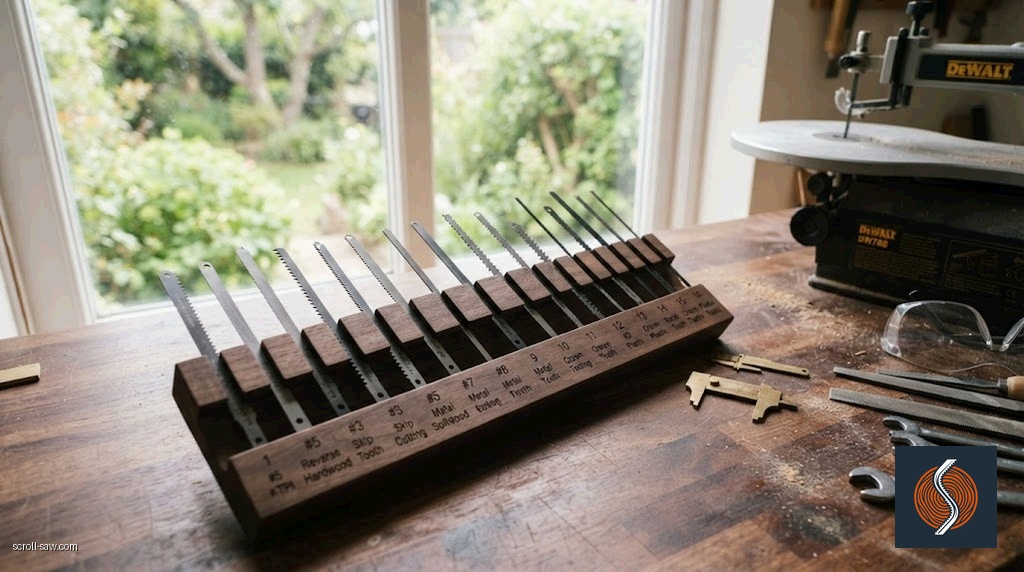
Double Tooth Scroll Saw Blades: Size, Tooth Geometry, and Material Guide
You are halfway through a delicate fretwork piece, the blade snaps, and you grab the first replacement you find in the drawer. Twenty minutes later, the bottom of your workpiece looks like someone dragged it across gravel. That fuzz and tear-out is not your technique. It is the wrong tooth pattern. Double tooth scroll saw blades exist to solve exactly this problem, combining the aggressive chip clearance of a skip-tooth blade with the bottom-cleaning action of a reverse-tooth blade so both faces of your cut come out clean.
A double tooth blade (sometimes called a double-reverse blade) is a scroll-saw blade whose tooth pattern alternates between standard downward-facing teeth and a group of upward-facing reverse teeth, with a skip-style gap built in for chip clearance. The result is a blade that cuts fast like a skip-tooth blade but leaves a cleaner bottom edge because the reverse teeth shear wood fibers on the underside before they can splinter.
If you are choosing between a skip-tooth, a reverse-tooth, and a double tooth blade, the short answer is this: use skip tooth for thick softwoods and fast rough work, use reverse tooth when you need a clean bottom edge on solid wood, and use double tooth when you want both speed and a clean bottom in one pass. The trade-off is that double tooth blades are harder to find in every size and they cost a bit more than standard skip-tooth blades.
What Tooth Geometry Means for Your Cuts
Tooth geometry on a scroll-saw blade is not marketing jargon. It is the physical shape of each tooth, the spacing between them, and the direction they face. Three factors drive your results: teeth per inch (TPI), tooth direction, and chip clearance.
TPI tells you how many teeth fit in one inch of blade length. A blade with 10 TPI cuts aggressively but leaves visible marks. A blade with 20 TPI cuts slowly but leaves a surface that needs almost no sanding. Most scroll work falls between 7 and 28 TPI, and the sweet spot for general fretwork in hardwood is around 12 to 18 TPI.
Tooth direction is where the double tooth pattern earns its name. Standard skip-tooth blades have all teeth pointing downward, so the cutting happens on the downstroke. The upstroke does nothing but pull fibers upward, which is what causes bottom-side tear-out. Reverse-tooth blades solve this by having a section of teeth at the bottom of the blade that point upward, so the upstroke shears those fibers clean. A double tooth blade takes this further by spacing the reverse teeth throughout the blade, not just at the bottom, and adding skip-style gaps between tooth groups for chip clearance.
Chip clearance is the open space between teeth that gives sawdust a place to go. Without enough clearance, dust packs into the kerf, heat builds up, and the blade wanders. Skip-tooth blades have generous gaps, which is why they cut fast. Double tooth blades keep those gaps but add reverse teeth into the pattern, so you get chip clearance and bottom cleaning at the same time.
Skip Tooth vs. Reverse Tooth vs. Double Tooth Scroll Saw Blades
The three most common tooth patterns you will encounter are skip tooth, reverse tooth, and double tooth (double reverse). Each has a specific job.
Skip-tooth blades have a gap between every tooth. They cut fast, run cool, and handle thick stock well. The drawback is obvious: the bottom of your cut will fuzz, sometimes badly, especially in porous woods like cedar or pine. If you are cutting 1-inch-thick pine for a toy or a sign, a skip-tooth blade is fine because you can sand the back. If you are cutting thin hardwood for inlay or jewelry, skip tooth will frustrate you.
Reverse-tooth blades have a block of upward-facing teeth at the bottom of the blade, usually covering the lowest 8 to 10 teeth, with standard downward teeth above that. The reverse section cleans the bottom edge on every upstroke. The drawback is that the reverse teeth can grab the workpiece on the upstroke, making the saw feel jerky if you are not used to it. Also, reverse-tooth blades leave a clean bottom but a slightly rougher top, because the downward teeth are doing most of the cutting without the benefit of the reverse section.
Double tooth blades spread the reverse teeth across the full blade, not just at the bottom, and they keep skip-style gaps for chip clearance. The result is the best of both: fast cutting, good chip clearance, and a clean bottom. The drawback is availability. Not every manufacturer makes double tooth blades in every size, and you may need to order them from specialty suppliers rather than picking them up at a local hardware store.
Blade Size: Width, Thickness, and the Universal Number System
Scroll-saw blades are sized using a universal blade number system that runs from #2/0 (the finest) up to #12 (the coarsest). The number corresponds to blade width and thickness, which in turn determines what the blade can do.
Blade width controls your minimum cutting radius. A narrow blade (say, a #2/0 with a width around 0.012 inches) can turn a tight corner with a radius under 1/8 inch. A wider blade (a #9 with a width around 0.024 inches) needs a much larger radius and will fight you on tight curves. For fretwork with inside corners, you want a narrow blade. For straight cuts or gentle curves in thick stock, a wider blade is more stable and cuts straighter.
Blade thickness affects kerf width. A thicker blade removes more material, which means a wider kerf and more visible gaps in your work. For intarsia and marquetry where pieces need to fit together tightly, a thin blade with a narrow kerf is essential. The trade-off is that thin blades break more easily and dull faster.
Here is a quick comparison of common sizes and what they suit:
| Blade Number | Approx. Width | Best For | Minimum Radius |
|---|---|---|---|
| #2/0 | 0.012 in | Fine fretwork, thin veneers | Under 1/8 in |
| #2 | 0.014 in | General fretwork, hardwood | Around 1/8 in |
| #5 | 0.018 in | Medium fretwork, toys | Around 1/4 in |
| #7 | 0.020 in | Thick stock, signs | Around 3/8 in |
| #9 | 0.024 in | Straight cuts, softwoods | Around 1/2 in |
These are approximate values. Actual dimensions vary by manufacturer, and the universal number system is a guideline, not a strict standard. Olson and Flying Dutchman both publish spec sheets with exact dimensions for every blade they make, and you should check those before buying if you need precision.
Plain End vs. Pin End: What Fits Your Saw
Double tooth scroll saw blades come in two mounting styles: plain end and pin end. Your saw determines which one you can use.
Plain-end blades have flat, featureless ends that clamp into blade holders on both ends of the saw arm. They are the standard for quality scroll saws from DeWalt, Delta, Hegner, and others. Plain-end blades come in every size and tooth pattern, including double tooth, and they allow you to thread the blade through a pilot hole for interior cuts.
Pin-end blades have a small crosspin at each end that seats into a notch in the blade holder. They are found on older saws and entry-level models. Pin-end blades are thicker (typically 0.030 inches or more) and only available in coarser sizes, usually #5 and up. You cannot thread a pin-end blade through a small pilot hole, so interior cuts require a different approach: you must drill a large enough hole for the pin to pass through, which limits how small your entry holes can be.
If your saw accepts plain-end blades, use them. You get access to the full range of sizes and tooth patterns, including fine double tooth blades for detailed work. If your saw only takes pin-end blades, your options are limited, and you may not find double tooth blades at all. Some saws accept both styles, which gives you the most flexibility.
Choosing TPI for Your Material
The material you cut should drive your TPI choice, not the other way around.
Hardwoods like maple, cherry, and walnut have dense, interlocking grain. They need a higher TPI to cut cleanly. A #2 or #3 blade with 18 to 28 TPI will give you a smooth cut with minimal tear-out. If you try to use a coarse skip-tooth blade in hard maple, the teeth will grab and the blade will wander, leaving a rough, wide kerf.
Softwoods like pine and cedar are more forgiving. A #5 or #7 skip-tooth blade with 7 to 12 TPI will cut fast and clean enough for most projects. Double tooth blades in these sizes are a good upgrade if you want a clean bottom without sacrificing speed.
Plywood and MDF are tricky because they have glue lines. The glue dulls blades faster than wood does, and the layered construction means tear-out can happen between layers. A reverse-tooth or double tooth blade helps here because the reverse teeth shear the bottom layer before it splinters. Use a medium TPI (12 to 18) for a balance of speed and finish.
Non-ferrous metals like copper and brass need a very fine blade (28+ TPI) and slow feed rate. You would not use a double tooth blade for metal, but the same principles of chip clearance and tooth direction apply. The reverse teeth on a double tooth blade are designed for wood fibers, not metal chips.
Tooth Direction and Feed Rate
Tooth direction affects how the blade feels in use. On a standard skip-tooth blade, all cutting happens on the downstroke. The saw pulls the workpiece down against the table, which is stable and predictable. On a reverse-tooth blade, the upstroke also cuts, which means the saw pushes the workpiece up on every stroke. This can feel like the blade is trying to lift your work, and it takes practice to control.
Double tooth blades have a more balanced feel because the reverse teeth are distributed across the blade, not concentrated at the bottom. The upstroke cutting is less aggressive than a pure reverse-tooth blade, so the workpiece does not jump as much. Still, if you are used to skip-tooth blades, expect a short learning period.
Feed rate is how fast you push the workpiece into the blade. With a double tooth blade, you can feed faster than with a pure reverse-tooth blade because the skip-style gaps clear chips efficiently. But feeding too fast will still break blades, especially in the finer sizes. Let the blade cut at its own pace and apply only enough pressure to keep it cutting. If you hear the blade straining or see it deflecting sideways, you are pushing too hard.
Modified Geometry and Crown Tooth Blades
Two newer tooth patterns deserve mention because they compete with double tooth blades for certain jobs.
Modified-geometry blades have teeth that are ground at an angle rather than straight across. This creates a shearing action that leaves a smoother surface than a standard tooth. They are excellent for hardwoods and acrylics where surface finish matters. The drawback is that they are expensive and not widely available.
Crown-tooth blades have teeth that face both directions in a repeating pattern, similar to double tooth but with a different tooth shape. They cut on both strokes and leave a very clean surface on both faces. Some scrollers prefer crown-tooth blades over double tooth for fine work because the finish is slightly better. The trade-off is that crown-tooth blades cut more slowly and are harder to find.
If you are happy with double tooth blades, there is no strong reason to switch. But if you are doing production work where finish quality directly affects your time, it is worth testing a modified-geometry or crown-tooth blade against your current setup.
Maintaining Your Blades
Scroll-saw blades are consumable. They dull, they break, and they are meant to be replaced. But you can extend their life with a few habits.
First, let the blade do the work. Forcing a dull blade through hard wood generates heat, which softens the temper of the steel and makes the blade dull even faster. If the blade is not cutting, replace it.
Second, use the right tension. A blade that is too loose will wander and break from fatigue. A blade that is too tight will snap under the stress of cutting. Most scroll saws have a tension lever or knob. Set it so the blade produces a clear ping when plucked, like a guitar string, not a dull thud.
Third, keep your work clean. Sawdust between the workpiece and the table acts like sandpaper on the blade. A quick brush between cuts keeps the cutting area clear.
Safety Considerations
Scroll saws are among the safer power tools in a woodshop, but they still deserve respect. The blade is exposed and moving fast, and small workpieces can kick or rotate if you lose your grip.
Wear eye protection. Scroll-saw blades can break, and a broken piece of hardened steel traveling at speed will find your eye if you are not wearing safety glasses. This is not optional.
Keep your fingers to the side of the blade, not directly in line with it. Use a hold-down or a push stick for small pieces. The Occupational Safety and Health Administration (OSHA) requires machine guarding on power tools, and while scroll saws have limited guarding by design, you should use whatever hold-downs and guards your saw includes.
If you are cutting small pieces that could fly off the table, clamp them or use double-sided tape to hold them to a sacrificial backing board. A small piece caught between the blade and the table can become a projectile.
Final Verdict on Double Tooth Scroll Saw Blades
Double tooth scroll saw blades give you the chip clearance of a skip-tooth blade and the bottom-cleaning action of a reverse-tooth blade in one package. They are the right choice when you want a clean cut on both faces of your work without making two passes or sanding the back. The trade-offs are real: they are harder to find, slightly more expensive, and the upstroke cutting takes getting used to. But for anyone doing fretwork, intarsia, or any project where both faces of the cut matter, they are worth the effort to source.
Three takeaways: match your TPI to your material (higher for hardwood, lower for softwood), use the narrowest blade your design allows for tight radius cuts, and always let the blade cut at its own pace rather than forcing it. If you do those three things, your double tooth scroll saw blades will last longer and your cuts will look better.
FAQ
What are double tooth scroll saw blades? Double tooth scroll saw blades combine skip-tooth spacing (gaps between teeth for chip clearance) with reverse-tooth direction (some teeth pointing upward to clean the bottom edge). They cut fast and leave a clean surface on both faces of the workpiece.
What is the difference between skip tooth and reverse tooth scroll saw blades? Skip-tooth blades have gaps between every tooth for fast cutting and good chip clearance, but they leave fuzz on the bottom of the cut. Reverse-tooth blades have a section of upward-facing teeth that clean the bottom edge, but they cut more slowly and can feel jerky because the upstroke also cuts.
What TPI should I use for hardwood? For dense hardwoods like maple and cherry, use a blade with 18 to 28 TPI. The fine teeth cut cleanly without grabbing the grain. For softer hardwoods like poplar, 12 to 18 TPI is usually enough.
Can I use double tooth blades on any scroll saw? Double tooth blades are available in plain-end style for most quality scroll saws. If your saw only accepts pin-end blades, you may not find double tooth blades because pin-end blades are typically limited to coarser sizes and fewer tooth patterns.
How tight should I tension a scroll saw blade? Tension the blade so it produces a clear, high-pitched ping when plucked, similar to a guitar string. If it sounds dull or flat, it is too loose. If it feels like it might snap from tension alone, it is too tight.
Do double tooth blades last longer than skip tooth blades? Not necessarily. Blade life depends more on the material you cut, your feed rate, and your tension than on the tooth pattern. Double tooth blades distribute wear across more cutting surfaces, which can help, but they also do more work per stroke, which can generate more heat.
What is the minimum cutting radius for a #5 blade? A #5 scroll saw blade, with a width around 0.018 inches, can typically cut a minimum radius of about 1/4 inch. Tighter curves require a narrower blade like a #2 or #2/0.
Are Flying Dutchman double tooth blades better than Olson? Both manufacturers produce quality blades. Flying Dutchman is known for a wider selection of specialty tooth patterns, while Olson is widely available and consistent. The best choice depends on the specific size and pattern you need and what is available from your supplier.
References
- Occupational Safety and Health Administration (OSHA). Machine Guarding Standards. osha.gov
- Olson Products. Scroll saw blade specifications and product catalog.
- Flying Dutchman (BTM LLC). Scroll saw blade product line.
- Scroll Saw Woodworking and Crafts. scrollsawer.com
- Fine Woodworking. finewoodworking.com


