
Dremel Table Scroll Saw Specs: Getting Them Right
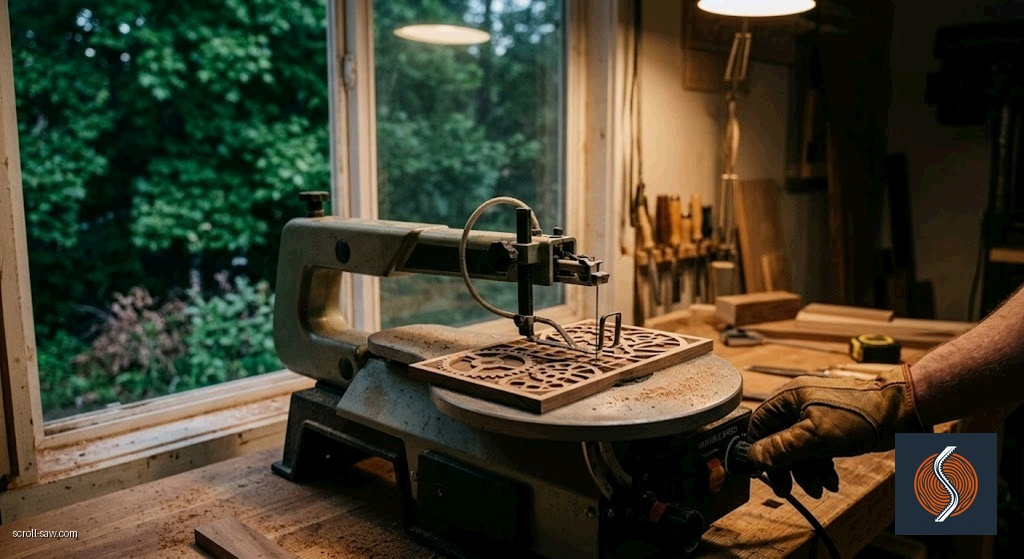
Getting the Dremel Table Scroll Saw Specification Right
You are cutting a beveled edge on a piece of walnut, and halfway through the cut the angle shifts. Not because you bumped the table, but because the bevel lock is not holding. The cut face is now off by three degrees, the piece is ruined, and you are staring at the table adjustment lever wondering when it got this sloppy. This is a specification problem, not a technique problem. The table on your scroll saw either holds its angle or it does not, and if it does not, no amount of careful feeding will save your work.
A Dremel table scroll saw is a scroll saw where the work table is the primary cutting surface, supporting the material while the blade moves through it. The MS20-01 Moto-Saw functions as a table scroll saw in stationary mode, clamped to a bench with the work table facing up. Older Dremel models like the 1672 and 1830 also function as table scroll saws with larger, fixed work tables. The specifications that matter are table size, bevel range, throat depth, blade stroke, and speed control.
The short answer: the table should be large enough for your typical workpiece, the bevel lock should hold without slipping, and the blade stroke should be long enough to clear sawdust from the kerf. If any of these specs are wrong for your work, the saw will fight you on every cut.
Table Size and Working Area
Table size determines how large a workpiece you can support during a cut. A small table forces you to balance the material with one hand while guiding the cut with the other, which is a recipe for wandering cuts and broken blades.
The MS20-01 Moto-Saw has a compact work table designed for small projects: fretwork, model parts, small signs, and decorative inlay. If you are cutting large plaques or long scrollwork panels, the table is too small and you will need to support the overhang with rollers or sawhorses.
Older Dremel table scroll saws like the 1830 have larger cast tables that handle bigger workpieces more naturally. The trade-off is weight and footprint. A bigger table takes up more bench space and is harder to move.
The table surface should be smooth and flat. A warped or dinged table causes the workpiece to rock, which changes the blade entry angle and produces uneven cuts. If you are buying a used Dremel table scroll saw, bring a straightedge and check the table for flatness.
Bevel and Angle Adjustment Range
Bevel capacity is the range of angles the table can tilt for angled cuts. Most scroll saws tilt the table rather than the blade, so the bevel range is a table specification.
A typical scroll saw bevel range is 0 to 45 degrees left, with some models tilting both directions. The key spec is not the range itself but the bevel lock: the mechanism that holds the table at the chosen angle. A bevel lock that slips under load is worse than no bevel capacity at all, because it ruins cuts mid-stroke.
On the MS20-01, the table angle adjustment is part of the stationary mode setup. The mechanism is simple, which is both a strength and a weakness. Simple means fewer parts to fail, but it also means less positive locking. If you cut a lot of bevels, check the bevel lock before buying.
For older Dremel models, the table angle adjustment part may be a lever, a knob, or a bolt. If you are replacing a worn angle adjustment, the part needs to match your specific model. Dremel changed designs between models, so a 1672 angle lock will not fit an 1830.
Table Insert and Blade Clearance
The table insert is the small plate that sits in the table around the blade hole. It prevents small workpieces from falling through the gap and supports the material right next to the cut. A missing or wrong-size insert causes thin material to catch and tear.
On the MS20-01, the table insert is part of the work table design. If it gets damaged or lost, you need a replacement that matches the Moto-Saw’s table opening. Generic inserts rarely fit because the opening shape and mounting method vary by manufacturer.
Blade clearance through the table is another spec to check. The hole in the insert should be slightly larger than the blade but not so large that thin stock drops through. If you switch between blade sizes (MS51 to MS53, for example), the insert hole needs to accommodate the widest blade or you need separate inserts for each.
Throat Depth and Cut Capacity
Throat depth is the distance from the blade to the back of the throat (the vertical frame), and it determines the maximum width of workpiece you can cut. A scroll saw with 16-inch throat depth can cut a 16-inch wide board (roughly, depending on how you measure).
The MS20-01 Moto-Saw has a limited throat depth compared to full-size scroll saws. This is the trade-off for its compact size and handheld capability. If your projects involve wide panels, the Moto-Saw’s throat will frustrate you.
Older Dremel 16-inch scroll saws (the 1680 and 1695) have a 16-inch throat, which handles most hobbyist and small-shop projects. If you need more throat, you are looking at larger saws from other manufacturers.
Throat depth is a hard limit. You cannot work around it. If your workpiece is wider than the throat, you cannot cut it on that saw without cutting it down to size first.
Speed Range and Variable Speed Control
Variable speed lets you match blade speed to material. Slow speeds for thin plastic (to prevent melting), medium speeds for hardwood, and faster speeds for softwood. A single-speed saw forces you to adapt your feed rate to compensate, which works for some materials but not others.
The MS20-01 includes variable speed, which is one of its better specifications. The speed dial is on the body of the tool, and you can adjust it while the saw is running. This matters because you often need to slow down mid-cut when you hit a hard spot or change direction.
Older Dremel scroll saws vary. The 1680 is a 16-inch variable speed model, while some older models are single-speed. If you are shopping for a used Dremel table scroll saw, variable speed is a spec worth paying for.
The MS20-01 as a Table Scroll Saw
The MS20-01 Moto-Saw is an unusual product because it works as both a table scroll saw (stationary mode) and a handheld coping saw (handheld mode). The detachable coping function is clever, but it means the table is not the primary design focus the way it is on a dedicated scroll saw.
In stationary mode, you clamp the base to a workbench with the base clamp, attach the parallel guide, and use it like a benchtop scroll saw. The work table is functional but small. The auto-tensioning mechanism and Quick Change lever make blade swaps easy, which is a real advantage when you are switching between MS51, MS52, and MS53 blades for different cuts.
The limitation is capacity. The Moto-Saw is a small saw for small work. If your projects are large, this is not the right tool, regardless of how convenient the blade changes are.
My Verdict on Dremel Table Scroll Saw Specs
The specifications that matter most are the ones you cannot fix: throat depth and table size. Everything else (bevel lock, insert, speed) can be worked around or upgraded, but a saw with a small throat will always have a small throat.
If you are buying a Dremel table scroll saw, start by measuring the largest workpiece you expect to cut. If it fits within the MS20-01’s capacity, the Moto-Saw is a solid choice with easy blade changes and variable speed. If it does not fit, look for an older Dremel 16-inch model (1680, 1695) or a different brand entirely.
Check the bevel lock before anything else. A bevel lock that slips is the most common table-related failure, and it ruins more workpieces than any other spec issue. If the lock is worn on a used saw, negotiate the price down or walk away.
FAQ
What is the table size on a Dremel MS20-01 Moto-Saw? The MS20-01 has a compact work table designed for small projects like fretwork, model parts, and decorative cuts. It is smaller than the tables on full-size benchtop scroll saws, which limits the size of workpieces it can support.
Can the Dremel scroll saw table bevel for angled cuts? Yes, the MS20-01 table has angle adjustment for beveled cuts. The range and lock mechanism vary by model. Check that the bevel lock holds firmly under load, because a slipping lock ruins angled cuts.
What is a scroll saw table insert and do I need one? The table insert is a small plate around the blade hole that supports thin material and prevents it from dropping through. A missing insert causes thin stock to catch and tear. Replacement inserts must match your specific Dremel model’s table opening.
How do I replace the table angle adjustment on a Dremel scroll saw? The angle adjustment part varies by model. On the MS20-01, it is part of the stationary mode assembly. On older models like the 1672 or 1830, it may be a separate lever or knob. Contact Dremel for the correct replacement part for your model.
What throat depth do I need on a Dremel table scroll saw? Throat depth determines the maximum workpiece width. The MS20-01 has a limited throat for small projects. Dremel 16-inch models (1680, 1695) offer a 16-inch throat for larger work. Measure your typical workpiece before buying.
Does the Dremel MS20-01 have variable speed? Yes, the MS20-01 Moto-Saw includes variable speed control. The speed dial is on the tool body and can be adjusted while the saw is running, which lets you match speed to material mid-project.
Can I use the Dremel Moto-Saw as a dedicated table scroll saw? Yes, in stationary mode the MS20-01 functions as a table scroll saw. Clamp it to a workbench with the base clamp, attach the parallel guide, and use it for scroll cutting wood, plastic, and laminate. The limitation is its compact table and throat size.
What should I check when buying a used Dremel table scroll saw? Check table flatness, bevel lock tightness, insert condition, throat depth, and variable speed function. Bring a straightedge to check the table for warping. Test the bevel lock by tilting the table and pushing on it firmly.
References
- Dremel. MS20-01 Moto-Saw Product Specifications. dremel.com.
- Dremel. Scroll Saw Owner’s Manuals (1672, 1830, 1680, 1695). dremel.com.
- Occupational Safety and Health Administration. Woodworking Machinery Safety. osha.gov.
- Consumer Product Safety Commission. Power Tool Specifications and Safety. cpsc.gov.


