
Harbor Freight Scroll Saw Stand: Specs That Matter
Getting the Harbor Freight Scroll Saw Stand Specification Right
I bought a Harbor Freight scroll saw on a Saturday morning, bolted it to a folding table in my basement, and spent the afternoon trying to cut a simple jigsaw puzzle for my kid. The saw bounced. The table bounced. The puzzle pieces came out with edges that looked like they had been chewed. The saw was not the problem. The folding table was.
A Harbor Freight scroll saw stand is the piece that sits between the saw and the floor, and if it is wrong, nothing else matters. The saw itself is a capable budget tool, but it needs a stable base to cut clean. The stand specification, meaning the height, weight, footprint, and vibration damping, determines whether the saw works or walks.
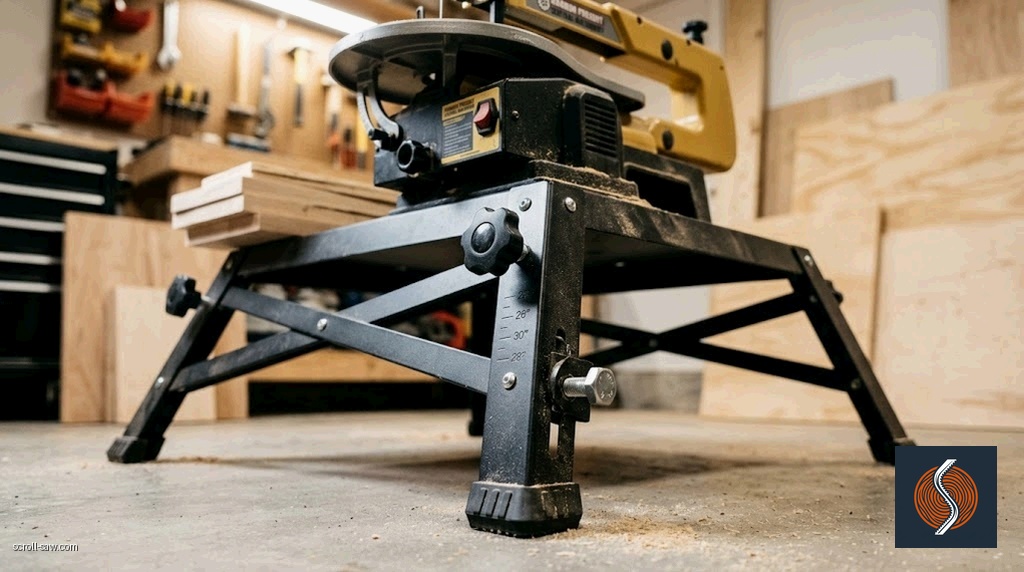
The Harbor Freight scroll saw stand is a metal frame designed to support the scroll saw at working height and provide enough mass to absorb the reciprocating motion of the saw. Not all Harbor Freight scroll saws include a stand, and the stands that are available vary in quality and design. Understanding the specifications helps you decide whether to buy the factory stand, build your own, or mount the saw on an existing bench.
The Specifications That Actually Matter
When you look at a scroll saw stand Harbor Freight listing, the specs that matter are height, footprint, weight capacity, and material. Everything else is secondary.
Height matters because scroll sawing is a standing task for most people. The cutting table should sit at about the level of your forearm when you stand with elbows at 90 degrees. For most adults, that is 40 to 45 inches. If the stand puts the table too low, you bend over and your back pays for it. Too high, and you cannot see the cut line clearly.
Footprint matters because a narrow stand tips. The stand should be at least as wide as the saw’s base, and ideally wider. A stand with a footprint of 18 by 18 inches or larger is stable. Anything narrower will rock when you push the workpiece against the blade.
Weight capacity matters because the stand needs to hold the saw plus the downward pressure you apply during cutting. Most scroll saws weigh 30 to 50 pounds. Add your cutting pressure, maybe 10 to 15 pounds, and the stand needs to handle 65 pounds without flexing. Most factory stands are rated well above this, but lightweight folding stands are not.
Material matters because steel absorbs vibration better than aluminum. A steel tube stand is heavier and dampens the saw’s reciprocating motion. An aluminum stand is lighter but transmits more vibration. For a scroll saw, heavier is better.
What Comes in the Box
The scroll saw at Harbor Freight may or may not include a stand. Some models come as a bare saw that you mount on your own bench. Others include a stand as part of the package. The product listing should specify, but if it does not, assume the stand is not included.
When a stand is included, it typically arrives as a kit of steel tubing, hardware, and rubber feet that you assemble with basic hand tools. Assembly takes about 30 to 45 minutes. The instructions are usually adequate, and the hardware is standard metric bolts and washers.
The quality of the factory stand is functional but not impressive. The tubing is thin-wall steel, the welds are adequate, and the hardware is basic. It will hold the saw and work fine for most users. It is not a premium product, and it will not last decades of heavy use, but it does the job.
Vibration: The Real Test of Any Scroll Saw Stand
If you read Harbor Freight scroll saw reviews, the most common complaint about the stand is vibration. The saw itself vibrates because of the reciprocating arm, and the factory stand is light enough that the vibration is noticeable.
Here is what helps, in order of effectiveness:
First, add weight. A sandbag or concrete block on the lower shelf adds mass that dampens vibration. This is the single most effective change you can make, and it costs almost nothing.
Second, use rubber isolation pads under the feet. Rubber pads between the stand feet and the floor absorb vibration that would otherwise transmit to the floor and back to the saw. Cut pieces of old inner tube or buy rubber furniture pads.
Third, check the level. An uneven floor makes the stand rock, which amplifies vibration. Use shims under the feet to get the stand solid on all four corners before you bolt the saw down.
Fourth, tighten everything. Loose bolts in the stand frame create rattles and allow the frame to flex. Go through every bolt after assembly and again after the first few hours of use.
Building Your Own Stand: Worth the Effort?
If the factory stand is not available or you want something better, building your own stand is a good option. A simple stand from 2x4 lumber, sized to your height and wide enough to be stable, will outperform the factory stand in every way except portability.
The key dimensions for a DIY stand are: height matched to your body, footprint at least 20 by 20 inches, and a top plate of 3/4-inch plywood that the saw bolts to. Add a lower shelf for weight storage. Use through-bolts, not just screws, at the joints. The result is a heavy, stable base that does not vibrate, does not walk, and puts the table exactly where you want it.
The tradeoff is time. Building a stand takes an afternoon, and you need basic woodworking tools. If you value your time at any meaningful rate, the factory stand is cheaper. But if you enjoy the build and want a custom result, the DIY stand is the better product.
Mounting the Saw: Bolt Pattern and Hardware
Whether you use the factory stand or a custom build, the saw needs to be bolted down. A scroll saw that is not bolted to its stand will shift during cutting, which ruins accuracy and can be dangerous.
The bolt pattern on most Harbor Freight scroll saws is four bolts in a rectangular pattern. Check your saw’s base for the exact hole spacing before drilling your stand top. Use grade 5 bolts, not the lightweight hardware that sometimes comes with the saw. The bolts should go through the stand top with washers and nuts on the underside, not just into threaded inserts in the wood.
Leave enough clearance around the saw for the lower blade clamp area. You need to access this area for blade changes, and if the stand top is too large it can block your reach. A 2-inch margin around the saw base is enough.
Who Should Buy the Factory Stand vs Build Their Own?
Buy the factory stand if you want to be cutting wood the same day you buy the saw, if you do not have woodworking tools, or if you need to move the saw periodically. The factory stand is adequate for most users and it is designed to fit the saw.
Build your own if you have a specific height requirement, if you want maximum stability, or if the factory stand is not available for your model. A wooden stand is heavier, more stable, and can be sized exactly to your body and workspace.
Skip the stand entirely if you have a heavy workbench at the right height. Bolt the saw directly to the bench. This is the most stable option of all, because a good workbench has far more mass than any stand.
Conclusion
The Harbor Freight scroll saw stand specification that matters most is stability. Height, footprint, weight, and material are the four specs that determine whether your saw cuts clean or chatters. The factory stand is functional but light. Add weight and rubber pads to make it work well. If you want better, build a wooden stand sized to your body. Bolt the saw down every time. A scroll saw that is not firmly mounted is a saw that will not cut to its potential, no matter how good the blade is.
FAQ
Does the Harbor Freight scroll saw come with a stand? Some models include a stand and others do not. Check the product listing to confirm. If the listing does not mention a stand, assume it is not included.
Can I use the Harbor Freight scroll saw without a stand? Yes, you can bolt it directly to a sturdy workbench. The bench needs to be heavy and solid, with the top at a comfortable working height. A lightweight table will vibrate and may walk during use.
How tall should a scroll saw stand be? The cutting table should sit at about the level of your forearm when you stand with your elbows at 90 degrees. For most adults, this is 40 to 45 inches from the floor.
How do I reduce vibration on my scroll saw stand? Add weight to the lower shelf, use rubber isolation pads under the feet, make sure the stand is level on the floor, and tighten all hardware. Adding weight is the single most effective change.
Can I build my own stand for a Harbor Freight scroll saw? Yes. A stand built from 2x4 lumber, sized to your height and at least 20 by 20 inches in footprint, will outperform the factory stand. Use through-bolts at the joints and a 3/4-inch plywood top plate for mounting the saw.
What is the bolt pattern for mounting the saw? Most Harbor Freight scroll saws use four bolts in a rectangular pattern on the base. Check your specific saw’s base for the exact hole spacing before drilling your stand top.
Is the Harbor Freight scroll saw stand worth buying? If you do not have a suitable workbench, the factory stand is worth buying. It is functional and gets the saw to working height. Add weight and rubber pads to improve its performance. If you have woodworking skills, a DIY stand is a better option.
References
- Occupational Safety and Health Administration. Woodworking machine safety standards. https://www.osha.gov
- Harbor Freight Tools. Scroll saw product specifications and owner manuals. https://www.harborfreight.com
- Scroll Saw Woodworking and Crafts Magazine. Scroll saw setup and technique articles. https://www.scrollsawer.com


