
Hegner Scroll Saw Stand: Get the Specs Right
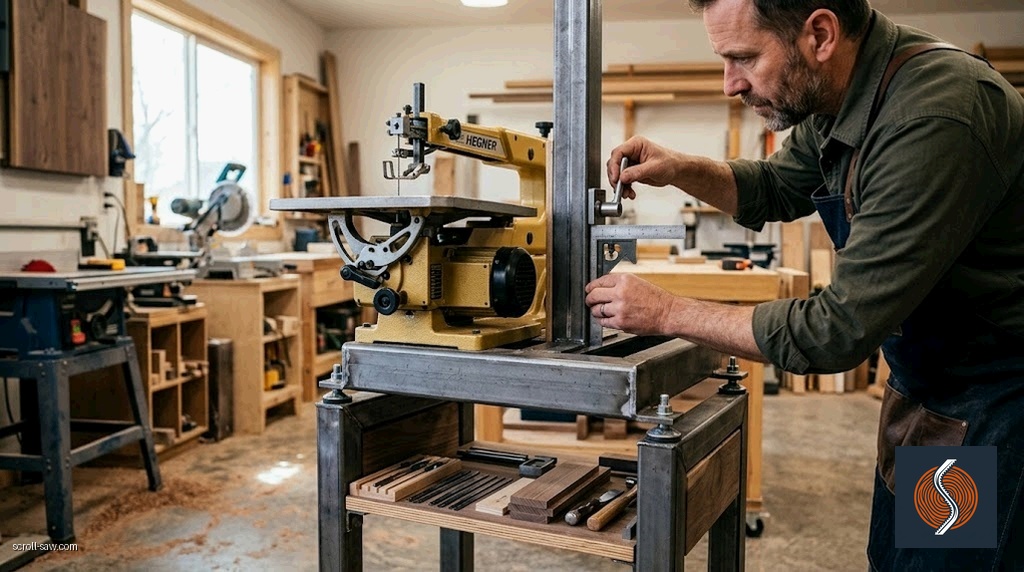
Getting the Hegner Scroll Saw Stand Specification Right
My Hegner 18V was sitting on a workbench that was two inches too tall, and I was hunching over every cut, my back aching after twenty minutes, my hand control suffering because my wrist was bent at a bad angle. I kept thinking I could adjust to it. After a week of ruined cuts and sore shoulders, I built a stand at the right height, and the difference was immediate. My cuts were steadier, my back stopped hurting, and I could cut for hours instead of minutes. The Hegner scroll saw stand is not an accessory. It is the foundation that determines whether you can cut well or just cut.
A Hegner scroll saw stand is the base that supports the saw at a comfortable working height and provides the stability that precision cutting requires. Hegner offers stands designed for their saws, and getting the specification right means matching the stand to your Hegner model, choosing the right height for your body and workspace, and making sure the stand is rigid enough to prevent vibration from affecting your cuts.
If you are setting up a Hegner for the first time or replacing a stand that is not working, the three things that matter are model compatibility, working height, and stability. Get those right and everything else follows.
Why the Stand Matters More Than You Think
Scroll saw cutting is a finesse activity. You are feeding stock into a blade with your hands, controlling the direction and speed of the cut with finger pressure measured in ounces. Any vibration, wobble, or movement in the stand transfers directly to the blade and the cut line.
A stand that rocks on the floor sends every footstep in the shop through the saw. A stand that is too light for the saw will vibrate with the motor, and that vibration shows up as chatter marks on the cut surface. A stand that is the wrong height forces you to cut with poor posture, which reduces hand control and makes you tire quickly.
I have seen people put a Hegner on a folding table, on a kitchen counter, on a pair of sawhorses with a plank across them. Every one of those setups produced worse cuts than the same saw on a proper stand. The Hegner is a precision tool, and it deserves a solid foundation.
Hegner Stand Options and Model Compatibility
Hegner offers stands designed for their saws, and the compatibility depends on the model. Here is what I know about the options:
Standard Hegner stand. Hegner makes a stand designed for the 18-series and 22-series saws. This is the factory stand that matches the saw’s footprint and mounting points. It is built from steel tubing and has a wide footprint for stability. If you have an 18S, 18V, or 22V, this is the stand Hegner designed for your saw.
Hegner short scroll saw stand. Hegner also offers a shorter stand for woodworkers who prefer a lower working height or who want to sit while cutting. The short scroll saw stand for Hegner saws is designed for the same models as the standard stand but with shorter legs. Some scroll sawyers prefer a lower stand because sitting gives them better hand control for fine work. If you do long sessions of fretwork, the short stand may be the better choice.
14-series compatibility. The Hegner 14E and 14V are smaller and lighter than the 18 and 22 series. They may use a different stand or the same stand with different mounting hardware. Check the parts list for your specific model before ordering a stand. The 14-series saws are small enough that some people mount them on a sturdy bench instead of a stand, but the bench needs to be rigid and the saw needs to be bolted down.
Polymax compatibility. The Polymax is the heaviest Hegner and may require a specific stand rated for its weight. Do not assume a stand built for an 18V will handle a Polymax without checking the specifications.
Before you order, check the model plate on your saw and confirm the stand compatibility with the parts list or a Hegner dealer. Ordering the wrong stand means returning it or modifying it, and neither option is fun.
Getting the Height Right
Working height is the single most important specification on a scroll saw stand, and it is the one most people get wrong. The right height depends on your body and how you like to work.
For standing work, the saw table should be at about the height of your forearm when you stand with your elbows at your sides and your forearms parallel to the floor. This puts your wrists in a neutral position when you are feeding stock, which gives you the best hand control and the least fatigue. For most people, that is between 36 and 42 inches from the floor to the saw table.
For sitting work, the saw table should be at about elbow height when you are seated. This is typically 28 to 32 inches from the floor. A Hegner short scroll saw stand is designed for this range. Sitting while cutting gives you better control for fine work, but you need a chair at the right height and good lighting.
The mistake I see most often is people putting the saw at whatever height the workbench happens to be. If your bench is 45 inches and your ideal height is 38 inches, you will be reaching up and straining for every cut. Build or buy a stand that puts the saw at the right height for your body, not the other way around.
Here is a simple test: set the saw on your stand or bench and stand in front of it. Rest your forearms on the table. If your elbows are bent at about 90 degrees and your shoulders are relaxed, the height is right. If you are reaching up, the stand is too tall. If you are bending over, it is too short.
Stability and Vibration Control
A stand that wobbles or vibrates will ruin your cuts. Here is what to look for in a stable stand:
Footprint. The stand should have a footprint at least as wide as the saw’s base, preferably wider. A wider footprint is more stable and resists tipping when you push stock through the blade. Narrow stands feel tippy and make you hold back on feed pressure, which causes burning.
Weight. A heavy stand absorbs vibration better than a light one. Steel tube stands are good. Adding weight to the stand, by filling the tubes with sand or bolting the stand to the floor, makes it even better. A light stand that bounces with the motor will give you chatter marks on every cut.
Floor contact. The stand should sit flat on the floor with all four feet touching. If the floor is uneven, use adjustable feet to level the stand. A stand that rocks on three feet will transmit every wobble to the saw. Shim the feet if you have to, but get all four contacting the floor.
Saw mounting. Bolt the saw to the stand. A saw that sits loose on the stand can shift during cuts, especially when you are feeding thick stock. Use the mounting holes in the saw base and bolt it down with hardware that fits. This is a simple step that many people skip, and it makes a real difference in stability.
Vibration isolation. If your floor is concrete and your stand transmits vibration to the floor and back, consider putting rubber pads under the stand feet. This breaks the vibration path between the stand and the floor and can reduce chatter. A piece of old conveyor belt or a rubber mat under each foot works well.
Short Stand vs Regular Stand: Which Is Right for You?
The choice between a short stand and a regular stand comes down to how you work:
Choose the regular stand if you prefer to stand while cutting, if you move around the saw to check angles and layouts, or if you do a mix of cutting and other shop tasks at the same bench height. Standing gives you more mobility and lets you lean in for close work.
Choose the short stand if you do long sessions of fine scrollwork, if you prefer to sit while cutting, or if you have a bad back and standing for long periods is painful. Sitting at the right height gives you better fine motor control for intricate cuts, and you can work longer without fatigue.
I use both. I have my Hegner 18V on a regular stand for general work and rough cutting, and I have a second saw on a short stand for fretwork and portrait cutting. If you can only have one, think about what you do most. If you are doing production fretwork, the short stand and a good chair will save your back and improve your cuts. If you are doing a mix of projects, the regular stand gives you more flexibility.
What to Check on a Used Hegner Stand
If you are buying a used Hegner scroll saw on a stand, inspect the stand before you buy:
- Check all welds for cracks. Steel tube stands can crack at the welds if they have been moved or abused. A cracked weld is a safety issue and will get worse over time.
- Check the feet for wear or damage. Adjustable feet that are stripped or frozen cannot be used to level the stand.
- Check the mounting surface for flatness. If the top of the stand is bent or warped, the saw will not sit flat and the table will not be level.
- Check for rust and corrosion. Surface rust is cosmetic, but deep rust that has thinned the tube walls is structural. If the stand feels light or flexes when you push on it, the tubes may be corroded from the inside.
- Check that the stand is the right one for the saw. A Hegner saw sitting on a generic stand may work, but it may not be as stable as the correct Hegner stand.
A used Hegner scroll saw for sale may come with or without a stand. If it comes with the original Hegner stand, that is a bonus, but inspect it carefully. If it comes with a homemade or generic stand, evaluate whether that stand is stable enough for precision work. Sometimes it is, sometimes it is not.
Building Your Own Stand
If you cannot find the right Hegner stand or you want a custom height, building your own is a reasonable option. Here is what I would do:
Use 2-inch steel tubing or heavy lumber (2x6 or larger) for the frame. The footprint should be at least 24 by 24 inches for an 18-series saw, wider for a 22V. The legs should be cross-braced to prevent racking. Bolt the saw to the top with hardware through the saw’s mounting holes.
If you are building from wood, use through-bolts at all joints, not screws. A wood stand that is screwed together will rack and wobble. Through-bolts with washers and nuts make a rigid frame that will not loosen over time.
Finish the stand with something that is easy to clean. Sawdust gets everywhere, and a sealed surface wipes down faster than bare wood. A coat of polyurethane or paint is enough.
Conclusion
The Hegner scroll saw stand is the foundation of your cutting setup. Match the stand to your Hegner model, set the height so your forearms are parallel to the table, bolt the saw down, and make sure the stand is rigid and level. Whether you choose a regular stand for standing work or a short stand for seated fretwork, the right stand will improve your cuts and extend your cutting sessions. A Hegner saw on a wobbly bench is a precision tool on a shaky foundation. Give it a solid base, and it will return the favor with cleaner cuts and better control.
FAQ
What stand do I need for a Hegner scroll saw? Hegner offers stands designed for their saws. The standard stand fits the 18-series and 22-series saws. A short stand is also available for seated work. Check the parts list for your specific model to confirm compatibility before ordering.
What height should my Hegner scroll saw stand be? For standing work, the saw table should be at forearm height when your elbows are at your sides, typically 36 to 42 inches. For seated work, the table should be at elbow height when sitting, typically 28 to 32 inches. A Hegner short scroll saw stand is designed for the lower range.
Can I use my Hegner scroll saw without a stand? You can mount a Hegner on a sturdy workbench, but the bench must be rigid and the saw must be bolted down. A wobbly bench will transmit vibration to the saw and affect cut quality. A purpose-built stand is generally more stable.
What is the difference between a Hegner short stand and a regular stand? The short stand has shorter legs for seated cutting, which gives better hand control for fine fretwork. The regular stand is taller for standing work, which offers more mobility around the saw. Both are designed for the same Hegner models.
How do I stop my Hegner scroll saw stand from vibrating? Bolt the saw to the stand, ensure all four feet are contacting the floor, add weight to the stand such as sand in the tubes, and place rubber pads under the feet to isolate vibration from the floor. A wide, heavy stand absorbs vibration better than a narrow, light one.
Can I build my own stand for a Hegner scroll saw? Yes. Use steel tubing or heavy lumber with through-bolted joints, cross-brace the legs, and make the footprint at least 24 by 24 inches for an 18-series saw. Bolt the saw to the top and ensure the stand is level and rigid.
What should I check when buying a used Hegner scroll saw on a stand? Inspect the welds for cracks, check the feet for adjustment, verify the mounting surface is flat, look for structural rust, and confirm the stand is the correct one for the saw model. A damaged stand is a safety issue and will affect cut quality.
Does the Hegner Polymax need a specific stand? The Polymax is the heaviest Hegner and may require a stand rated for its weight. Do not assume a stand built for the 18V will work for the Polymax. Check the parts list or contact a Hegner dealer to confirm compatibility.
References
- Hegner manufacturer owner manuals and parts lists for stand specifications and model compatibility
- Hegner Universal Precision Saw reference documentation for stand mounting and setup
- Woodworking shop setup guides on scroll saw ergonomics and working height
- Fine Woodworking and Wood Magazine reference articles on workshop bench and stand construction


