
Hegner Scroll Saw Bellows: Measure Before You Order
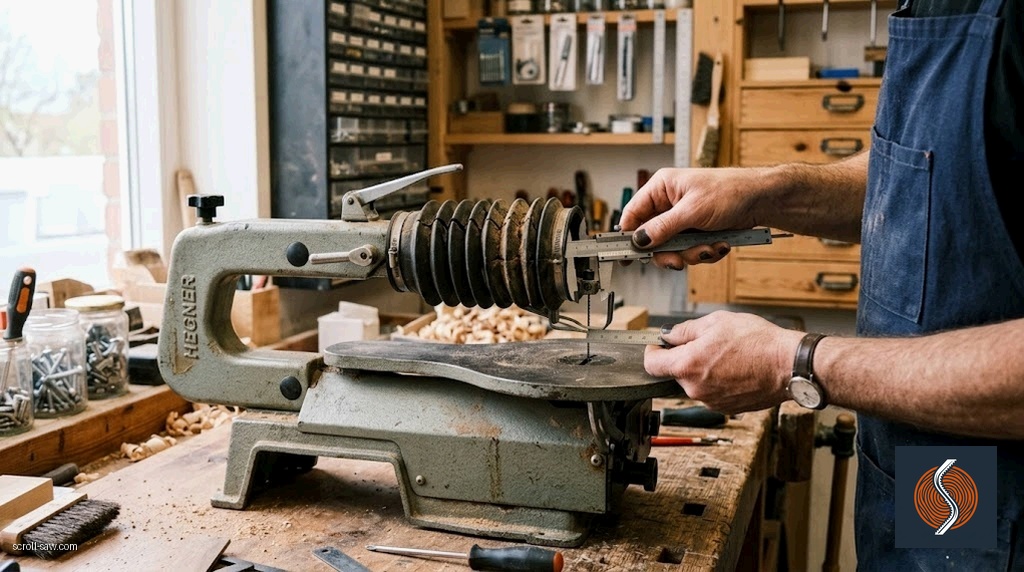
Hegner Scroll Saw Bellows: What to Measure Before You Order
I was halfway through a compound cut in a piece of walnut when I realized I could not see the line anymore. Sawdust had piled up on the cut path and buried my pencil mark. I blew it away with my lips, kept cutting, and ten seconds later the dust was back. The bellows on my Hegner 18V had cracked along the bottom fold, and the dust blower had gone from a steady stream of air to a weak wheeze. That is the thing about Hegner scroll saw bellows: you do not think about them until they stop working, and when they stop working, every cut gets harder.
Hegner scroll saw bellows are the rubber dust blower components that connect the upper arm to the lower air tube on Hegner scroll saws. As the upper arm moves up and down, the bellows compress and expand, pumping air through a nozzle that blows sawdust away from the blade and cut line. When they crack or harden with age, the blower stops moving air, and you are left cutting blind. Ordering the right replacement means measuring your old bellows and knowing your saw model, because Hegner has made several saws over the years and the bellows are not all the same.
If your dust blower has gone weak or stopped entirely, the bellows are the first thing to check. Measure before you order, and you will get the right part without a second trip to the mailbox.
Why the Bellows Matter More Than You Think
The dust blower on a scroll saw is not a luxury feature. When you are cutting a fine line in hardwood, the sawdust from the downstroke lands right on the cut path. Without a working blower, you cannot see where the blade meets the line. You end up cutting by feel, which means you drift, you overshoot curves, and you ruin pieces you have spent an hour preparing.
The bellows are the pump that drives the whole system. On a Hegner, the upper arm motion compresses the bellows on the downstroke, pushing air through the tube and out the nozzle above the blade. On the upstroke, the bellows expand and draw air back in. It is a simple, elegant system with no motor and no fan. Just rubber and air.
The problem is that rubber does not last forever. Heat from the saw, ozone in the air, vibration, and simple age all harden the rubber until it cracks. Once a crack opens, the bellows cannot hold pressure, and the air output drops to almost nothing. You can hear it: a working bellows makes a firm puff on every downstroke. A cracked one makes a soft, flat sound, like someone breathing through a straw with a hole in it.
Identifying Your Hegner Model
Before you measure anything, you need to know which Hegner you have. Hegner has made several models, and the bellows differ between them. The main models are:
- Hegner 14E: the basic single-speed model, smaller throat depth
- Hegner 14V: same size as the 14E with variable speed
- Hegner 18S: larger throat, single speed
- Hegner 18V: larger throat, variable speed
- Hegner 22V: the largest Hegner, variable speed
- Hegner Polymax: the top-of-line model with the most features
The model plate is usually on the back or bottom of the saw. It will have the model name, and possibly a serial number. Write this down before you start measuring. If the model plate is missing or unreadable, you can identify the saw by throat depth: the 14-series has a smaller throat, the 18-series is larger, and the 22-series is the biggest.
The reason model identification matters is that the upper arm travel differs between models. The 18 and 22 series have a longer stroke than the 14 series, which means the bellows need to stretch farther. A bellows that is too short will tear on the first stroke. One that is too long will not compress enough to pump air effectively.
What to Measure Before You Order Hegner Scroll Saw Bellows
Here is the part that saves you from ordering the wrong part. You need four measurements.
Extended length. With the upper arm at the top of its stroke, measure from the top mounting point to the bottom mounting point. This is the maximum stretch of the bellows. Use a ruler or tape measure and measure to the nearest millimeter. If the bellows are still attached, this is easy. If they have already been removed, measure the distance between the two mounting points with the arm raised.
Compressed length. Lower the arm to the bottom of its stroke and measure the same distance. This is the minimum compression. The difference between extended and compressed length tells you the stroke the bellows need to accommodate. If you order bellows with the wrong stroke range, they will either tear from overstretching or fail to pump because they cannot compress fully.
Diameter. Measure the outside diameter of the bellows at the widest point, which is usually the middle fold. Also measure the diameter of the mounting openings at the top and bottom. The mounting openings need to fit over the air tube connections on the upper arm and lower tube. If the openings are too small, they will not seat. Too large, and they will leak air around the connection.
Mounting style. Look at how the bellows attach to the upper and lower air tubes. Some Hegner models use a push-on fit where the bellows stretch over a nipple on the tube. Others use a clamp or screw fitting. Take a photo of the mounting points before you remove the old bellows, so you have a reference for how the new ones go on.
Common Failure Signs
You do not always need to see a crack to know the bellows are failing. Here are the signs I watch for:
- Weak or no airflow from the blower nozzle. Hold a piece of paper near the nozzle and run the saw. The paper should flutter on every downstroke. If it barely moves, the bellows are done.
- Visible cracks or splits in the rubber folds. Even a hairline crack will leak air under pressure.
- The bellows feel hard and stiff when you squeeze them. New bellows are flexible and spring back immediately. Old ones stay compressed when you squeeze and slowly return.
- The blower works intermittently. If air comes and goes as the saw runs, there may be a partial crack that opens and closes with the arm position.
- Sawdust accumulating on the cut line during cuts that used to stay clear.
If you see any of these signs, order replacement bellows. Trying to patch cracked rubber with tape or glue is a temporary fix that will fail within a session or two, and you will be back to cutting blind.
Hegner Model Differences and Bellows Compatibility
The 14-series Hegner saws (14E and 14V) typically use shorter bellows than the 18 and 22 series because the upper arm has a shorter stroke. If you are replacing bellows on a 14E or 14V, measure carefully and confirm the extended length matches your saw’s arm travel.
The 18-series (18S and 18V) and the 22V use longer bellows with more convolutions (the ridges or folds in the rubber) to accommodate the longer arm stroke. The diameter is generally the same across models, but the length and convolution count differ.
The Polymax may use a different dust blower configuration. If you have a Polymax, check the parts list or troubleshooting chart in your owner manual before ordering. The Polymax has features that the other models do not, and assuming the bellows are the same as the 18V could get you the wrong part.
If you are buying a used Hegner scroll saw, check the bellows before you buy. A saw that has been sitting unused for years may have bellows that are hard and cracked even if they have not been used much. Rubber degrades with time, not just use. A used Hegner with good bellows is a better buy than one with bellows that need replacing, unless you factor the cost and effort of finding the right parts into your decision.
Installing Replacement Bellows
Once you have the right bellows, installation is simple but takes a bit of care.
First, remove the old bellows. If they are still attached, pull them off the upper and lower mounting points. Take note of how they were oriented, especially if the top and bottom fittings are different sizes.
Clean the mounting points on the upper arm and lower air tube. Old rubber can leave a residue that prevents the new bellows from seating properly. A quick wipe with a rag is usually enough.
Attach the bottom of the new bellows to the lower air tube first. Push or clamp it into place, depending on your mounting style. Then stretch the bellows up and attach the top to the upper arm fitting. The bellows should be slightly compressed at the mid-stroke position, not fully stretched or fully compressed.
Run the saw without cutting and hold a piece of paper near the blower nozzle. The paper should flutter firmly on every downstroke. If it does, the bellows are installed correctly and pumping air.
One thing to watch for: if the new bellows are slightly too long, they may fold or kink at mid-stroke instead of compressing cleanly. A kink will eventually crack, so if you see this, check that you have the right part for your model. A small difference in length can cause a big difference in how the bellows behave over time.
How Long Do Hegner Bellows Last?
That depends on how much you use the saw and where you store it. A saw that runs daily in a heated shop will wear bellows faster than one that sits in a climate-controlled garage and gets used on weekends. Rubber also degrades faster in dry, warm air and in environments with high ozone (near electric motors and power tools).
In my experience, bellows on a regularly used Hegner last about two to three years before they start to crack. A saw that sits unused for five years may have bellows that are just as bad, because the rubber hardens with age regardless of use.
If you are buying a used Hegner scroll saw, budget for replacement bellows even if the current ones look okay. If the saw is more than a few years old, the rubber is aging, and you will get better blower performance with fresh bellows.
Conclusion
Hegner scroll saw bellows are a small part that makes a big difference. When they work, you see your cut line and your cuts stay accurate. When they fail, you cut blind and your work suffers. Before you order replacements, identify your Hegner model from the model plate, measure the extended length, compressed length, and diameter of your old bellows, and note the mounting style. Get those four things right and the new bellows will fit, pump air, and keep your cut line clear for years. Skip the measuring and you will end up with parts that do not fit, a blower that does not work, and another order to place.
FAQ
What are Hegner scroll saw bellows? Hegner scroll saw bellows are rubber dust blower components that connect the upper arm to the lower air tube. They pump air to blow sawdust away from the cut line as the arm moves up and down.
How do I know which bellows fit my Hegner scroll saw? Identify your Hegner model from the model plate on the saw, then measure the extended length, compressed length, diameter, and mounting style of your current bellows. Different Hegner models use different bellows sizes.
How long do Hegner scroll saw bellows last? On a regularly used saw, bellows typically last two to three years before cracking. A saw that sits unused for several years may also need new bellows because rubber hardens with age, not just use.
Can I repair cracked bellows instead of replacing them? Tape or glue patches are temporary fixes that will fail quickly under the repeated compression and expansion of the bellows. Replacing them with the correct part is the only reliable fix.
What are the signs that my Hegner bellows need replacing? Weak or no airflow from the blower nozzle, visible cracks in the rubber, bellows that feel hard and stiff, intermittent blower operation, and sawdust accumulating on the cut line during cuts.
Do all Hegner models use the same bellows? No. The 14-series saws typically use shorter bellows than the 18 and 22 series because the upper arm has a shorter stroke. The Polymax may use a different configuration. Always measure before ordering.
How do I install replacement bellows on a Hegner scroll saw? Remove the old bellows, clean the mounting points, attach the bottom to the lower air tube first, then stretch the bellows up and attach the top to the upper arm fitting. Run the saw and check that air flows from the nozzle.
Where can I find the parts diagram for my Hegner scroll saw? Check the owner manual that came with your saw. The parts list and troubleshooting chart will show the bellows part number and installation details. If you do not have the manual, look for the model plate on the saw to identify your model.
References
- Hegner manufacturer owner manuals and parts lists for bellows specifications and model compatibility
- Hegner Polymax and Universal Precision Saw reference documentation for dust blower system details
- Woodworking tool reference guides on scroll saw dust blower maintenance and repair
- Rubber component specification guides on bellows materials and failure modes


