
Hegner Scroll Saw Blades: Match Blade to Material
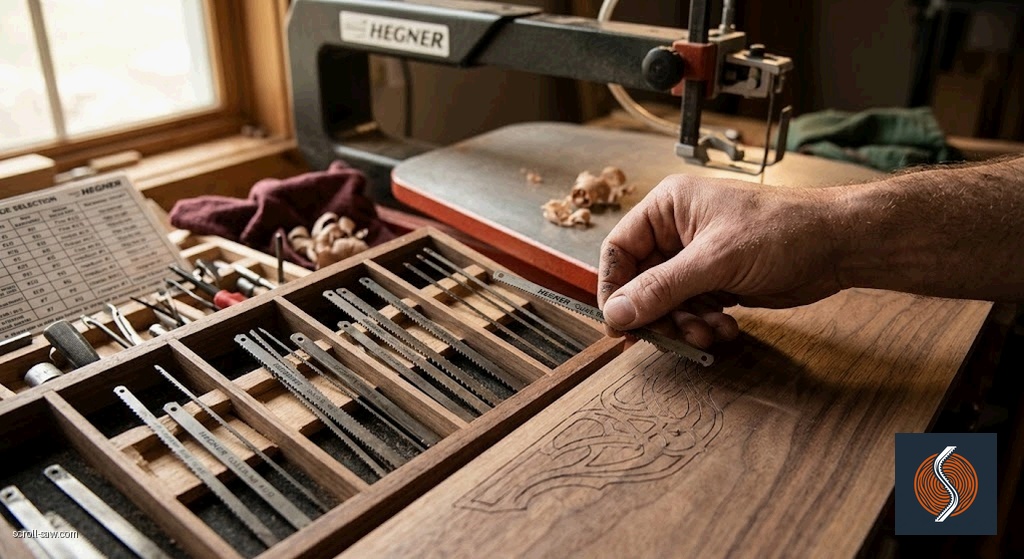
Hegner Scroll Saw Blades: Match Blade Number to Material and Thickness
I ruined a piece of birdseye maple on my Hegner 18V because I was too stubborn to stop and change the blade. I was running a size 2/0 blade in 1/2-inch hardwood, trying to cut a tight inside curve, and the blade was too fine for the stock. It clogged, heated up, burned a black streak along the cut line, and snapped halfway through the turn. That piece of maple had taken me an hour to prep. The blade would have taken thirty seconds to swap. Hegner scroll saw blades are not all the same, and matching the blade number to your material and thickness is the single biggest factor in whether your cuts come out clean or come out ruined.
Hegner scroll saw blades are plain-end scroll saw blades designed to fit the blade clamps on Hegner scroll saws, including the Hegner 14E, 14V, 18S, 18V, 22V, and Polymax. Because Hegner saws use plain-end blades exclusively, you have access to the full range of blade sizes, from the finest fretwork blades to coarse blades for thick stock. The key is knowing which number to reach for and how to pair it with the variable speed on your saw.
If you take one thing from this guide: match the blade number to your material thickness first, then adjust speed to match. Get that sequence right and your cuts will be clean, your blades will last longer, and you will stop blaming the saw for problems that are really blade selection issues.
Understanding Scroll Saw Blade Numbers
Scroll saw blades are numbered, and the number tells you the physical size of the blade. Lower numbers mean finer blades. Higher numbers mean coarser blades. The numbering goes from the finest (size 8/0, 7/0, 6/0, down to 2/0, 0) through the mid range (1, 2, 3, 5) to the coarsest (7, 9, 12).
A size 2/0 blade has maybe 28 teeth per inch and a very thin blade body. It can turn a radius as tight as a pencil point, but it has tiny gullets (the spaces between teeth) that clog quickly in thick stock. A size 7 blade has maybe 10 teeth per inch and a thicker body. It cuts faster and clears chips in thick material, but it cannot turn tight curves and it leaves a wider kerf.
The mistake I see most often is people buying one blade size and using it for everything. That works about as well as using one screwdriver for every screw. You need a range of sizes, and you need to know when to switch.
Matching Hegner Scroll Saw Blades to Material Thickness
Here is the pairing system I use on my Hegner, and it works across all Hegner models because the blade clamps accept the same range of plain-end blade sizes:
Thin stock (1/8 inch or less): size 2/0 or 0. These fine blades have enough teeth per inch to cut thin material without tearing the grain. In stock this thin, a coarse blade will grab and shatter the wood. A size 2/0 turns the tightest curves and leaves the cleanest edge, but it breaks if you push it. A size 0 is slightly more durable and still handles fine fretwork.
Medium thin stock (1/8 to 1/4 inch): size 1 or 2. This is the sweet spot for most scroll saw work. A size 1 or 2 blade has enough teeth for a clean cut in thin to medium material, and the gullets are large enough to clear chips without clogging. If I am doing portrait work or nameplates in 1/4-inch hardwood, a size 2 is my go-to.
Medium stock (1/4 to 1/2 inch): size 3 or 5. As the stock gets thicker, you need bigger gullets to clear the increased volume of sawdust. A size 3 works for 1/4-inch to 3/8-inch hardwood. A size 5 is better for 1/2-inch hardwood, where the chip load is higher and a finer blade will clog and burn.
Thick stock (1/2 to 1 inch): size 7 or 9. In thick hardwood, you need a blade with real chip-clearing capacity. A size 7 has gullets big enough to handle 3/4-inch to 1-inch material without packing. A size 9 is for the thickest stock you would cut on a scroll saw, usually 1-inch hardwood or thick softwood.
Very thick stock (over 1 inch): size 12. At this point you are pushing the limits of scroll saw cutting. A size 12 blade is coarse and fast, but it leaves a rough edge that needs sanding. It is for rough cutting, not fine work.
Pairing Blade Size with Variable Speed
One of the advantages of Hegner V-series saws (14V, 18V, 22V) and the Polymax is variable speed. The Hegner 14E and 18S are single-speed saws, which limits your speed-blade pairing options. On a variable-speed Hegner, you can match the stroke rate to the blade and material, which gives you better cut quality and longer blade life.
The principle is simple: fine blades in thin stock want higher stroke rates. Coarse blades in thick stock want lower stroke rates. A fine blade has many small teeth, and each tooth takes a small bite. At a higher stroke rate, more teeth pass through the cut per second, which keeps the cut clean and the chip load per tooth manageable. A coarse blade has fewer, bigger teeth. At a lower stroke rate, each tooth has time to clear its chip before the next tooth enters the cut.
On my Hegner 18V, I run a size 2/0 blade in 1/8-inch stock at near full speed. When I switch to a size 5 in 1/2-inch hardwood, I drop the speed to about 60 percent. The difference in cut quality is noticeable: at the right speed, the blade self-feeds and the cut line is clean. At the wrong speed, the blade chatters, burns, or stalls.
If you have a single-speed Hegner (14E or 18S), you compensate by adjusting your feed rate. A fine blade in thin stock wants a steady, moderate feed. A coarse blade in thick stock wants a slower feed so you do not overload the teeth. You cannot change the stroke rate, but you can change how fast you push the stock.
Quick-Release Blade Changes on a Hegner
One of the best features of Hegner scroll saws is the quick-release tension system, which makes blade changes fast. Since you will be changing blades more often when you match blade size to material, the quick-release system pays off every time.
To change a blade on a Hegner, flip the quick-release lever on the upper arm. This releases tension and opens the blade clamps. Remove the old blade. Thread the new blade through the workpiece if you are doing an inside cut, with the teeth facing down. Insert the bottom end into the lower blade clamp, then the top end into the upper clamp. Flip the quick-release lever back to apply tension. Pluck the blade to check it is tight enough.
The whole process takes about 30 seconds once you have done it a few times. That speed means you have no excuse for running the wrong blade. If the cut is not going well, stop, change the blade, and try again. It is faster than ruining a piece and starting over.
Blade Availability and Sourcing
Hegner scroll saw blades are plain-end blades, which are the most common type of scroll saw blade worldwide. You are not limited to Hegner-branded blades. Any quality plain-end scroll saw blade of the right size will work in a Hegner saw, as long as it fits the blade clamps.
If you are looking for Hegner scroll saw blades in Australia or the UK, standard plain-end scroll saw blades from brands like Olson, Flying Dutchman, and Pegas are widely available through woodworking suppliers. The blade numbering system is standard across brands, so a size 2 from one manufacturer is roughly equivalent to a size 2 from another.
The Hegner Multimax 18 is one of the most popular Hegner models, and it accepts the same plain-end blades as the rest of the Hegner line. If you are shopping for blades for a Multimax 18, any standard plain-end blade will fit the blade clamps.
One thing to watch: some very cheap blades have inconsistent tooth sets and poor steel quality. They dull quickly, break easily, and cut rough. You do not need the most expensive blades, but buying from a reputable blade manufacturer will save you money in the long run because the blades last longer and cut cleaner.
How to Tell When Your Blade Is Done
A blade that has lost its edge will tell you, if you know what to look for:
- Burning. If the cut starts leaving scorch marks on the wood, the blade is dull and is rubbing instead of cutting. This is the most common sign.
- Increased feed pressure. A sharp blade almost pulls the stock through. When you start having to push, the blade is dull.
- Wandering. A dull blade will not track the line as well as a sharp one. If you are fighting to stay on the line, the blade may be the problem.
- Rough cut surface. A sharp blade leaves a smooth cut that needs minimal sanding. A dull blade leaves a fuzzy, rough surface.
- Sound change. A sharp blade makes a clean, steady cutting sound. A dull blade makes a harsher, more labored sound.
Change the blade at the first sign. Trying to squeeze more life out of a dull blade is false economy. You ruin wood, you get frustrated, and the cut quality drops. Blades are cheap. Wood and time are not.
A Practical Blade Kit for Your Hegner
If you are starting out or rebuilding your blade supply, here is what I would buy:
- One dozen size 2/0 blades for fine fretwork and thin stock
- One dozen size 1 blades for general thin to medium work
- One dozen size 3 blades for medium stock and most hardwood cutting
- Half a dozen size 5 blades for thick hardwood
- Half a dozen size 7 blades for very thick stock
That gives you a range that covers almost any project. Keep them in a labeled organizer near the saw so you can grab the right size without hunting. When a size runs low, reorder that size. Do not wait until you are out of everything.
Conclusion
Matching Hegner scroll saw blades to your material and thickness is not complicated, but it takes discipline. Use fine blades (size 2/0 and 0) for thin stock and tight curves. Use medium blades (size 1 through 5) for the majority of your work. Use coarse blades (size 7 and up) for thick stock. Pair the blade with the right speed on variable-speed Hegner models, and use the quick-release system to change blades the moment a cut is not going well. The Hegner saw is a precision tool, and it deserves a sharp, correctly sized blade for every cut. Get the blade right, and the saw will do the rest.
FAQ
What blades does a Hegner scroll saw use? Hegner scroll saws use plain-end scroll saw blades exclusively. They do not accept pin-end blades. Any quality plain-end blade of the right size will fit the blade clamps on any Hegner model.
What size Hegner scroll saw blade should I use for hardwood? For 1/4-inch to 1/2-inch hardwood, use a size 3 or 5 blade. For 3/4-inch or thicker hardwood, use a size 7 or 9. The larger gullets clear chips efficiently in thick stock and prevent burning.
How do I change the blade on a Hegner scroll saw? Flip the quick-release tension lever on the upper arm to release the blade. Remove the old blade, thread the new one through the workpiece for inside cuts, insert the bottom end into the lower clamp, the top end into the upper clamp, and flip the lever back to apply tension.
Can I use any brand of plain-end blade on my Hegner? Yes. Hegner saws accept standard plain-end scroll saw blades from any manufacturer. The blade numbering system is standard across brands, so a size 2 from one brand is roughly equivalent to a size 2 from another.
Where can I buy Hegner scroll saw blades? Plain-end scroll saw blades are available from woodworking suppliers worldwide. Brands like Olson, Flying Dutchman, and Pegas make quality blades that fit Hegner saws. Look for suppliers in your region, whether in Australia, the UK, or North America.
How do I pair blade size with speed on a variable-speed Hegner? Fine blades in thin stock want higher stroke rates for clean cuts. Coarse blades in thick stock want lower stroke rates so each tooth has time to clear its chip. Start at a moderate speed and adjust based on cut quality.
How do I know when my Hegner scroll saw blade needs replacing? Replace the blade when you see burning on the wood, when feed pressure increases, when the blade wanders off the line, when the cut surface gets rough, or when the cutting sound changes to a harsh, labored tone.
What is the finest blade I can use on a Hegner scroll saw? Hegner saws can handle blades as fine as size 8/0 or 2/0, which are used for intricate fretwork in thin stock. These blades turn very tight curves but break easily if you push too hard or use them in thick material.
References
- Hegner manufacturer owner manuals and parts lists for blade clamp specifications and blade compatibility
- Olson Scroll Saw Blades product pages for blade sizing, tooth geometry, and material recommendations
- Scroll Saw Association reference guides on blade numbering and material thickness matching
- Fine Woodworking and Wood Magazine reference articles on scroll saw blade selection and speed pairing


