
Metal Cutting Scroll Saw Blades: Size, Tooth Geometry, and Material Guide
Metal Cutting Scroll Saw Blades: Size, Tooth Geometry, and Material Guide
The first time you try to cut soft aluminum with a wood blade, you learn three things in about ten seconds. The teeth load up instantly. The blade heats up fast. And the cut goes from clean to ruined before you can react. Metal cutting scroll saw blades are not wood blades with finer teeth. They are a different category of tool, and using the wrong one will cost you material, blades, and patience.
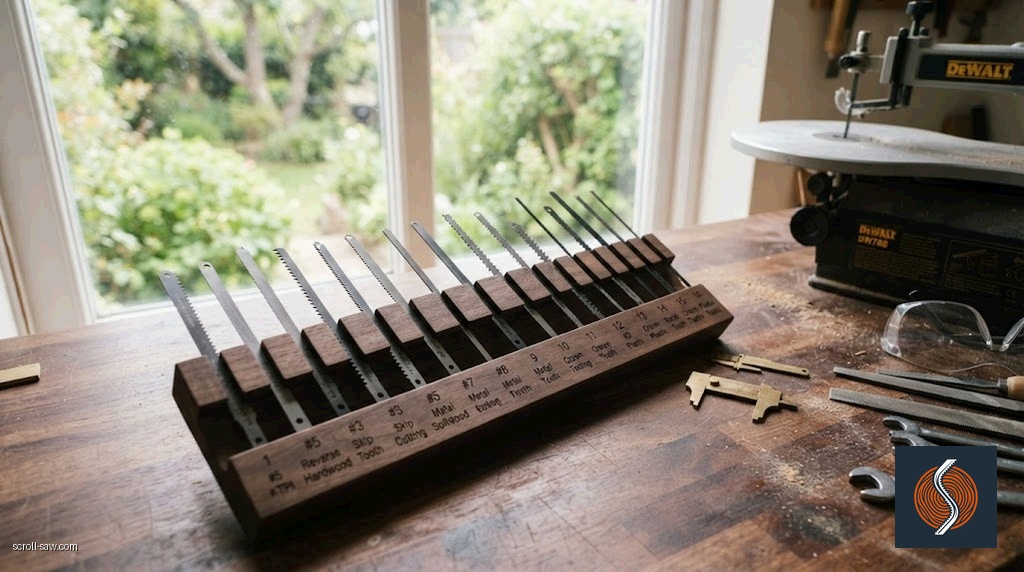
Metal cutting scroll saw blades are blades with fine tooth geometry and harder steel designed to cut non-ferrous metals like aluminum, brass, and copper on a scroll saw. They have a higher teeth per inch (TPI) count than wood blades, a smaller tooth set, and are made from harder steel that holds an edge against metal. Choosing the right one comes down to TPI, tooth geometry, blade material, and how you run the saw.
If you are cutting metal on a scroll saw, the short answer is this: use a blade with 18 to 32 TPI depending on material thickness, slow the saw down to its lowest speed, and use a lubricant on the cut line. That combination will produce clean cuts in thin non-ferrous metal. Get any of those wrong and you will either load the teeth, burn the blade, or shatter the material.
TPI for Metal: Why Finer Is Better
Teeth per inch is the single most important spec for metal cutting. The rule for metal is the opposite of what many woodworkers assume: you want more teeth in contact with the material, not fewer.
For thin metal (up to 1/16 inch), use a blade with 28 to 32 TPI. The fine teeth produce a smooth cut without grabbing the material, which is the main risk when cutting thin metal on a scroll saw. A coarse blade will catch the edge and either bend the workpiece or snap the blade.
For medium thickness (1/16 to 1/8 inch), a blade with 18 to 24 TPI works well. The slightly coarser pitch removes material faster while still keeping enough teeth in contact to prevent grabbing.
For thicker non-ferrous metal (1/8 inch and up), you can drop to 14 to 18 TPI, but you will cut slowly. Scroll saws are not the ideal tool for thick metal. If you are cutting material thicker than 3/16 inch, consider a band saw or a dedicated metal cutting saw instead.
The universal blade number system can help you identify the right blade. Higher blade numbers (number 5 and up) tend to have coarser teeth suitable for thicker metal, while lower numbers (number 2/0 and below) have very fine teeth for thin stock. Not all blade numbers are available in metal-cutting formulations, so check the manufacturer’s specifications.
Tooth Geometry for Metal Cutting
Tooth geometry matters as much as TPI for metal work. The wrong geometry will load the teeth with metal chips and stop cutting.
Skip-tooth blades have large gaps between teeth that provide chip clearance. For metal, chip clearance is critical because metal chips are harder and more abrasive than wood chips. A skip-tooth blade gives those chips somewhere to go, which prevents the blade from clogging and overheating. Skip-tooth is the most common geometry for metal cutting scroll saw blades.
Reverse-tooth blades have reversed teeth at the bottom that cut on the upstroke. For metal, this can help prevent burring on the bottom face of the material, which is a common problem when cutting thin sheet metal. The tradeoff is that reverse-tooth blades cut more slowly and can vibrate more, which is harder to control in metal than in wood.
Crown-tooth blades are a less common geometry that cuts in both directions. They produce a very smooth finish on both faces of the material, which is valuable for decorative metal work. The tradeoff is the slowest cutting speed of any geometry.
Modified-geometry blades, like those used by Pégas, reduce cutting resistance. For metal work, this is a genuine advantage because it lets you feed the workpiece with less pressure, which means more control and less risk of grabbing. If you can find modified-geometry blades in a metal-cutting TPI, they are worth trying.
Spiral blades cut in all directions and are generally not recommended for metal. The 360-degree tooth pattern means too many teeth are in contact with the material at once, which causes overheating and rapid blade wear. Stick with conventional tooth geometries for metal.
Blade Material: What Makes a Metal-Cutting Blade Different
Metal cutting scroll saw blades are made from harder steel than wood blades. The most common materials are high-carbon steel (HCS) and high-speed steel (HSS), or a combination of the two.
High-carbon steel blades are the standard for light metal work. They are inexpensive and hold an edge adequately for thin non-ferrous metals. The tradeoff is that they dull faster than HSS blades when cutting harder metals or running at higher speeds.
High-speed steel blades are harder and hold an edge longer. They are the better choice for brass and harder aluminum alloys. The tradeoff is cost: HSS blades are more expensive than HCS blades. If you are doing production metal cutting, HSS will save you money over time because you will change blades less often.
Bi-metal blades combine a flexible back with hardened teeth. They are the most durable option and resist breaking, which matters when cutting metal because metal puts more stress on the blade than wood. If you are having problems with blades snapping during metal cuts, a bi-metal blade will solve that problem.
Pin-End vs Plain-End Metal Cutting Blades
Metal cutting scroll saw blades come in both pin-end and plain-end styles. The choice depends on your saw, not your material.
Pin-end blades are thicker and have pins at each end that seat into notched clamps. They are easier to install and more durable, which is an advantage for metal work where blade stress is higher. The tradeoff is that pin-end blades are not available in the finest TPI counts. If you need a 32 TPI blade for very thin metal, you will likely need a plain-end blade.
Plain-end blades are flat at both ends and require a chuck head to grip them. They are available in finer TPI counts and thinner profiles, which makes them the better choice for thin metal and fine detail work. The tradeoff is that they require a chuck head that can grip them securely, and they are more prone to slipping under the higher cutting forces of metal work.
If you are looking for 5 inch metal cutting scroll saw blades or 5 pinned metal cutting scroll saw blades, these refer to the blade length and mounting style. Five-inch blades are a common length for pin-end scroll saw blades. Check your saw’s blade length requirement before ordering.
Technique: How to Cut Metal on a Scroll Saw
Cutting metal on a scroll saw requires a different approach than cutting wood. The saw speed, feed rate, and lubrication all matter.
Set the saw to its lowest speed. Metal cutting generates heat, and high speed makes it worse. Slow speed keeps the blade temperature down and extends blade life. If your saw has variable speed control, use it.
Feed the workpiece slowly. Let the blade do the work. If you push too hard, the teeth will load up and the blade will stop cutting. Light, steady pressure is the key. If you feel the blade catching, reduce pressure immediately.
Use a lubricant on the cut line. A thin film of cutting fluid or even a light oil will reduce friction, carry away chips, and extend blade life. This is the step most woodworkers skip when they switch to metal, and it is the one that makes the biggest difference.
Clamp the workpiece firmly. Metal transmits vibration differently than wood, and a loose workpiece will chatter against the blade, producing a rough cut and accelerating blade wear. Use hold-downs or a vise if your saw has them.
Wear eye protection. Metal cutting produces small, sharp chips that can fly off the blade. Safety glasses are not optional for metal cutting. According to OSHA safety standards for metal cutting operations, eye protection and proper machine guarding are required.
Comparing 3 and 5 Blade Packs
Metal cutting scroll saw blades are often sold in packs of 3 or 5. The pack size you choose depends on how much metal cutting you do.
A 3 pack is enough for occasional metal work. If you cut metal a few times a month, three blades will last a while, and you have spares if one breaks. The cost per blade is higher in a 3 pack than in a 5 pack.
A 5 pack is the better value if you cut metal regularly. The cost per blade is lower, and you will go through blades faster than you think when cutting metal. Having five blades on hand means you will not run out mid-project.
The best metal cutting scroll saw blades are the ones that match your material thickness and are made from the right steel. A 3 pack of HSS blades in the right TPI will outperform a 5 pack of HCS blades in the wrong TPI. Match the blade to the material first, then decide on pack size.
The Verdict
Metal cutting scroll saw blades are a specialized tool for a specialized job. The right blade has 18 to 32 TPI, a skip-tooth geometry for chip clearance, and is made from HSS or bi-metal steel for edge retention. Run the saw at low speed, feed slowly, and use lubricant. That combination will produce clean cuts in thin non-ferrous metal.
If you are choosing blades for metal work, start with a 5 pack of HSS skip-tooth blades in 24 to 28 TPI. That covers the most common thicknesses of aluminum and brass. Add a finer blade (32 TPI) for thin sheet metal and a coarser blade (18 TPI) for thicker stock. Do not try to cut ferrous metal on a scroll saw. The blades are not designed for it, and the saw does not have the rigidity for it.
FAQ
Can you cut metal with a scroll saw? Yes, but only non-ferrous metals like aluminum, brass, and copper, and only with blades designed for metal cutting. Ferrous metals (steel, iron) are too hard for scroll saw blades and will damage the blade and the saw.
What TPI do I need for cutting metal on a scroll saw? For thin metal (up to 1/16 inch), use 28 to 32 TPI. For medium thickness (1/16 to 1/8 inch), use 18 to 24 TPI. For thicker non-ferrous metal (1/8 inch and up), use 14 to 18 TPI.
What is the difference between HCS and HSS scroll saw blades? HCS (high-carbon steel) blades are less expensive and work for light metal cutting. HSS (high-speed steel) blades are harder, hold an edge longer, and are better for harder metals or production work. HSS blades cost more but last longer.
Do I need to lubricate when cutting metal on a scroll saw? Yes. A thin film of cutting fluid or light oil on the cut line reduces friction, carries away chips, and extends blade life. Skipping lubricant is the most common reason metal cutting blades fail prematurely.
Can I use spiral blades for metal cutting? No. Spiral blades have too many teeth in contact with the material at once, which causes overheating and rapid wear. Use conventional skip-tooth or reverse-tooth blades for metal.
What speed should I set my scroll saw to for metal cutting? Use the lowest speed setting on your saw. Metal cutting generates heat, and high speed makes it worse. Slow speed keeps the blade cool and extends its life.
Can I cut steel with a scroll saw? No. Scroll saw blades are not designed for ferrous metals. Steel will dull the blade immediately and can damage the saw. Use a band saw with a metal cutting blade or a dedicated metal cutting saw instead.
Are pin-end or plain-end blades better for metal cutting? Pin-end blades are more durable and easier to install, which is an advantage for metal work. Plain-end blades are available in finer TPI counts, which is better for thin metal. Choose based on your saw and material thickness.
References
- Occupational Safety and Health Administration (OSHA), Metal Cutting Safety Standards. osha.gov
- National Institute for Occupational Safety and Health (NIOSH), Metalworking Health and Safety. cdc.gov/niosh
- Fine Woodworking magazine, scroll saw metal cutting techniques. finewoodworking.com
- The Wood Database, metal hardness and working properties. wood-database.com


