
Olson Scroll Saw Blade Selection Chart: Full Guide
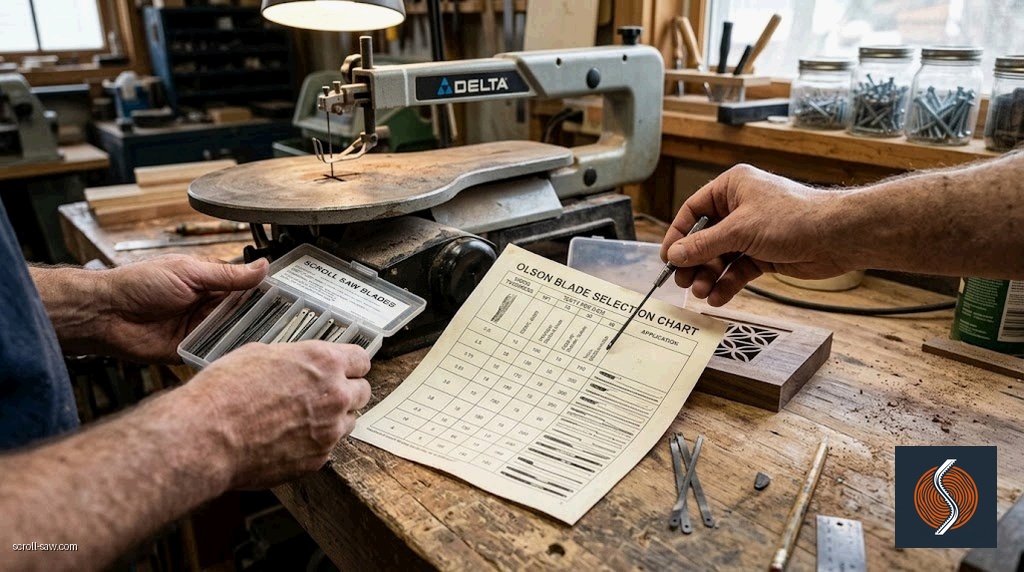
Olson Scroll Saw Blade Selection Chart: Size, Tooth Geometry, and Material Guide
I spent my first year of scroll sawing buying blades the way I bought groceries: grab what looks right, hope it works, and throw it in the cart. The result was a drawer full of blades I never used and a stack of ruined project pieces with burned edges and splintered bottoms. What I needed was a system, not a guess. An Olson scroll saw blade selection chart is that system, and once you understand how to read it, you stop wasting wood and start cutting with confidence.
An Olson scroll saw blade selection chart organizes every blade Olson makes by size, tooth geometry, and material application. Each blade has a number, a TPI rating, a width, a thickness, and a material rating that tells you what it cuts best. The chart is not a suggestion, it is a lookup table. You find your material, find your thickness, and the chart points you to the blade.
The short answer: use the chart to match blade TPI to material thickness (more TPI for thin, less for thick), choose tooth geometry based on the finish you need (skip tooth for speed, reverse tooth for clean bottoms), and confirm the blade width fits your tightest turn radius. Get those three things right and the chart does the rest.
Reading Blade Size on the Chart
Every blade on the Olson chart has three size dimensions: width, thickness, and length. Width determines your turning radius. Thickness determines blade stiffness and kerf width. Length must match your saw’s blade length requirement, which is typically 5 inches for most scroll saws.
Blade width on the chart ranges from about 0.010 inches on a #2/0 blade to 0.030 inches or more on a #12. The relationship is simple: narrower blades turn tighter, wider blades track straighter. If your pattern has interior cuts with curves tighter than a quarter-inch radius, you need a blade that is narrow enough to make that turn without twisting.
Blade thickness ranges from about 0.010 to 0.025 inches. Thicker blades are stiffer and resist bending in thick stock, but they also produce a wider kerf. Thinner blades flex more, which can cause wandering in thick material, but they leave a narrower cut line that is easier to follow on fine patterns.
The chart lists these dimensions for every blade number. When you are choosing between two blades that both seem right, compare the width and thickness. The narrower, thinner blade will turn tighter but may wander in thick stock. The wider, thicker blade will track straighter but will not make tight turns.
Tooth Geometry: Skip, Reverse, and Crown
The chart groups blades by tooth geometry, and each geometry has a specific purpose.
Skip tooth blades have spaces between each tooth that are larger than the teeth themselves. This gives plenty of room for chip clearance, making skip-tooth blades the best choice for thick material where sawdust buildup causes burning. Skip-tooth blades cut aggressively and clear waste fast, but they leave a moderately rough surface that may need sanding.
Reverse tooth blades have a section of teeth at the bottom of the blade that point upward. This means the blade cuts on both the downstroke and the upstroke, producing a cleaner bottom edge. Reverse-tooth blades are the choice for material where both faces are visible, like portrait work or shallow relief carving. The tradeoff is more vibration than a standard skip-tooth blade.
Crown tooth blades have two teeth pointing up followed by two teeth pointing down. This pattern gives a very clean cut on both faces with less vibration than a full reverse-tooth blade. Crown-tooth blades are a good middle ground when you want clean edges but your saw struggles with reverse-tooth vibration.
Standard (or hook) tooth blades have teeth all pointing in one direction with smaller gullets than skip-tooth blades. They cut smoothly and are a good general-purpose choice for medium-thickness material where chip clearance is not a problem.
The chart tells you which geometry each blade uses. The material rating column tells you whether that geometry works for your material, but the geometry choice also depends on your finish requirements.
TPI and Material Thickness: The Core Match
The heart of the Olson scroll saw blade selection chart is the relationship between TPI and material thickness. Here is how to read it.
The chart lists each blade with its TPI. A #2/0 blade has 28 TPI, a #5 has 11.5 to 12.5 TPI, and a #9 has 7 to 11 TPI. The material rating column tells you what thickness range each blade handles, and it is directly tied to TPI.
High TPI blades (18 to 28) are rated for thin material, typically under a quarter inch. The many small teeth take small bites that are appropriate for thin stock, and the small gullets are fine because there is not much waste to clear.
Medium TPI blades (10 to 18) are rated for material between a quarter and half inch. These are the general-purpose blades that most scrollers use most of the time. They balance cut speed with chip clearance and handle the widest range of material thicknesses.
Low TPI blades (7 to 10) are rated for thick material, half inch and above. The large gullets clear big chips from deep cuts, and the aggressive tooth pitch keeps the blade from stalling in thick stock. These blades cut rough but fast.
The mistake most people make with the chart: reading only the blade number and ignoring the TPI. Two blades with the same number can have different TPI ratings depending on tooth geometry. A #5 skip-tooth blade and a #5 reverse-tooth blade may have different TPI, and that changes the material they are rated for. Always check the TPI column, not just the number.
Material Application Ratings
The chart includes a material application or finish rating for each blade. This rating tells you what materials the blade is designed for and what kind of finish it produces.
Some blades are rated for hardwood only, some for softwood, and some for both. Hardwood requires a sharper blade with more TPI because dense material resists cutting and needs smaller bites to avoid burning. Softwood can handle fewer TPI because the material is less dense and the teeth can take bigger bites without stalling.
Some blades are rated for non-ferrous metals, plastic, or bone. These are typically fine-tooth blades with high TPI. If you are cutting material other than wood, check the chart’s material rating to confirm the blade is rated for it. A blade that is not rated for metal will dull quickly and may break.
The finish rating tells you how smooth the cut surface will be. Blades with a high finish rating leave a surface that needs minimal sanding. Blades with a lower finish rating cut faster but leave a rougher surface. The chart helps you balance speed against finish quality.
Tight-Turn Radius and Blade Width
The chart also indicates the minimum turning radius for each blade, either directly or through the blade width. This is the radius of the tightest curve the blade can cut without twisting or binding.
For pattern work with tight interior curves, this is the spec that matters most. A blade that is too wide for your tightest turn will either twist (producing a ragged cut) or break (if you force it). The chart’s blade width tells you the turning radius: narrower blades turn tighter.
If your pattern has curves with a radius smaller than a quarter inch, you need a blade that is 0.015 inches wide or narrower. That means a #2/0, #1, or #2 blade. A #5 blade at 0.018 inches can handle curves down to about a quarter-inch radius. A #9 blade needs at least a half-inch radius to turn cleanly.
The chart does not always list the turning radius directly, but you can calculate it from the blade width. A good rule: the minimum turning radius is roughly 10 times the blade width. A 0.010-inch blade can turn in a 0.1-inch radius. A 0.025-inch blade needs a 0.25-inch radius.
Who Should Use Which Chart Entry
If you are new to scroll sawing, start with a #5 skip-tooth blade for general work and a #2/0 reverse-tooth blade for fine fretwork. Those two entries on the chart cover most beginner projects.
If you are doing intarsia, you want clean edges on both faces of the material. Use a reverse-tooth or crown-tooth blade in the TPI range that matches your material thickness. The chart’s finish rating column points you to the right blade.
If you are cutting thick stock for toys or signs, use a #7 or #9 skip-tooth blade. The aggressive cut and good chip clearance handle thick material without burning. The rougher finish is fine because you will sand the edges anyway.
If you are doing portrait work with many inside cuts in thin stock, use a #2/0 or #1 reverse-tooth blade. The fine TPI handles thin material, the reverse teeth keep the bottom clean, and the narrow width lets you make the tight turns the pattern demands.
The Verdict
The Olson scroll saw blade selection chart works because it takes the guesswork out of blade selection. Find your material thickness, find your TPI, choose your tooth geometry, and check your turning radius. The chart is a tool, and like any tool, it only helps if you use it.
Three takeaways: always check the TPI column, not just the blade number, because the same number can have different TPI in different geometries. Match tooth geometry to your finish needs, not just your material. And confirm the blade width fits your tightest turn before you start cutting, because a blade that cannot make the turn will ruin your project.
FAQ
How do I read an Olson scroll saw blade selection chart? Look up the blade number to find its width, thickness, TPI, and material rating. Match the TPI to your material thickness, choose the tooth geometry for your finish needs, and confirm the blade width fits your tightest turn radius.
What TPI should I use for thick wood? For material half an inch or thicker, use a blade with 7 to 10 TPI. The larger gullets clear chips from deep cuts and prevent burning. A #7 or #9 skip-tooth blade is a good starting point.
What is the difference between skip tooth and reverse tooth on the chart? Skip-tooth blades have large spaces between teeth for chip clearance and cut aggressively. Reverse-tooth blades have upward-pointing teeth at the bottom that cut on the upstroke, producing a cleaner bottom edge with less splintering.
How does blade width affect turning radius? Narrower blades turn tighter. A blade that is 0.010 inches wide can cut curves with a very small radius. A blade that is 0.025 inches wide needs a much wider curve. As a rule, the minimum turning radius is about 10 times the blade width.
Can I use the same Olson blade for hardwood and softwood? Many Olson blades are rated for both, but hardwood generally needs a higher TPI than softwood at the same thickness. Check the chart’s material application rating to confirm the blade is rated for your material.
What does the finish rating on the chart mean? The finish rating indicates how smooth the cut surface will be. Higher finish ratings mean less sanding after the cut. PGT (Precision Ground Tooth) blades typically have higher finish ratings than standard blades.
How do I choose between two blades with the same number? Compare the TPI, tooth geometry, and finish rating. The same blade number can come in skip-tooth, reverse-tooth, or crown-tooth versions with different TPI. Choose based on your material thickness and finish needs.
Are Olson blade charts the same for plain-end and pin-end blades? The chart covers both types, but pin-end blades are available in fewer sizes. The finest blades on the chart are plain-end only. If your saw takes pin-end blades, your chart options are more limited.
References
- Olson Saw Company, blade selection chart and product specifications, olsonsaw.com
- Fine Woodworking, scroll saw blade guide, finewoodworking.com
- Wood Magazine, choosing scroll saw blades, woodmagazine.com
- Scroll Saw Woodworking and Crafts magazine, blade selection reference, scrollsawer.com


