
Pinless Scroll Saw Blades: Match Blade to Material
Pinless Scroll Saw Blades: Match Blade Number to Material and Thickness
I remember the first time I held a pinless blade next to a pinned one. The pinless blade was thinner than a sewing needle, and I could not imagine how it would survive cutting anything. Then I put it in the saw, fed a piece of 1/8 inch walnut into it, and it cut like a laser. That was the day I stopped buying pinned blades for anything except rough work. If you are still using only pinned blades, you are leaving precision on the table, and this guide will help you switch.
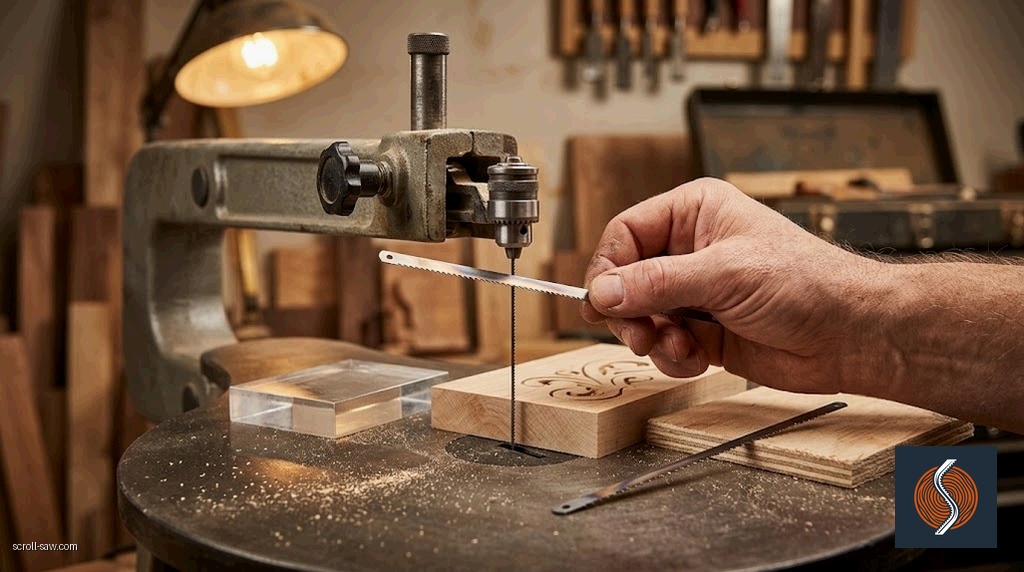
Pinless scroll saw blades, also called plain-end blades, have no pins on either end. They clamp directly into the blade holder of a scroll saw equipped for plain-end blades or into an adapter that converts a pin-end saw. They are available in much finer sizes than pinned blades, which is why nearly every serious scroller uses them.
The short answer: pinless blades give you access to sizes from #2/0 down to #8/0 and beyond, which are the blades you need for fine fretwork, thin stock, and tight curves. Pinned blades bottom out around #5 because the pin requires a minimum blade thickness. If you want to do detailed work, pinless is not optional, it is the only path.
Why Pinless Blades Exist
The pin-end blade was the original scroll saw blade design. Pins on each end drop into slots in the blade holder, making blade changes fast and tool-free. The problem is that the pin diameter sets a floor on how thin the blade can be. You cannot put a pin through a blade that is 0.010 inches thick without the blade crumbling around the pin hole.
Pinless blades solve this by eliminating the pin entirely. The blade ends are flat and clamped between two plates or held in a quick-release chuck. This clamping method works with any blade thickness, which is why plain-end blades are available in sizes that pinned blades cannot touch.
The trade is convenience. Pin-end blades swap in seconds with no tools. Pinless blades require opening the clamp, positioning the blade, tightening it, and checking tension. On saws with quick-release chucks, the process is fast. On older saws with screw clamps, it is slower. Either way, the precision gain is worth the extra few seconds.
The Universal Blade Number System
Scroll saw blades use a universal blade number system that is consistent across manufacturers. A #5 blade has the same nominal width and thickness whether it comes from Pegas, Flying Dutchman, or another maker. The TPI can vary slightly by brand, but the physical dimensions do not.
Here is how the sizes break down:
- #2/0 and smaller: ultra-fine blades for delicate fretwork, thin veneers, and tight curves. Width around 0.022 inches, thickness around 0.010 inches. These are the blades for work where the kerf width matters as much as the cut.
- #1 and #2: fine blades for general fretwork in 1/8 to 1/4 inch stock. Good balance of fineness and durability.
- #3 and #4: medium blades for 1/4 to 1/2 inch stock. The sweet spot for most hobbyist scrolling.
- #5 and #7: larger blades for 1/2 inch and thicker stock. These overlap with the pinned blade range and are where the two formats meet.
- #9 and #12: heavy blades for thick stock (3/4 inch and up) and rough cutting. Available in pinless but less common.
The number tells you the physical size. The tooth geometry (skip-tooth, reverse-tooth, crown-tooth, etc.) is a separate choice. You pick the number for the material thickness and the geometry for the cut quality you need.
Matching Blade Number to Material Thickness
This is the core of blade selection, and it is simpler than people make it. The rule: thinner material needs a smaller blade, thicker material needs a bigger blade. The reason is chip clearance and blade stiffness.
A #2/0 blade in 3/4 inch oak will wander, flex, and possibly break because the blade is too thin to stay straight in a deep kerf. A #7 blade in 1/8 inch walnut will cut like a chainsaw through balsa, leaving a wide kerf and a rough edge because the teeth are too coarse for the material.
Here is my practical matching chart:
1/16 inch and thinner (veneer, thin plywood): Use #2/0 or #1 with 25+ TPI. The material is so thin that a large blade removes too much material per tooth. You need fine teeth taking tiny bites.
1/8 inch (hardwood plywood, thin hardwood): Use #1 or #2 with 20 to 25 TPI. This is the most common fretwork thickness and the range where pinless blades show their biggest advantage over pinned.
1/4 inch (standard hardwood, softwood): Use #3 or #4 with 15 to 20 TPI. The blade has enough stiffness to track straight and the teeth are fine enough for a clean cut.
1/2 inch (thick hardwood, softwood): Use #5 or #7 with 12 to 18 TPI. You are in the range where pinned blades also work, but pinless still gives you better blade rigidity and more geometry options.
3/4 inch and up (thick stock): Use #7 or #9 with 7 to 12 TPI. Skip-tooth geometry helps here because the thick material generates heavy chip loads.
Tooth Geometry Choices in Pinless Format
One of the biggest advantages of pinless blades is that every tooth geometry is available in every size. Pinned blades are limited to larger sizes and fewer geometries. With pinless blades, you can get:
Skip-tooth blades in any size. The wider gullet clears chips in thick or gummy material. My default for anything over 1/2 inch.
Reverse-tooth blades in sizes down to #2/0. The reverse teeth on the bottom eliminate bottom-edge tear-out, which matters most in thin stock where the tear-out is visible. If you are cutting 1/8 inch plywood and getting splinters on the bottom, switch to a reverse-tooth pinless blade.
Double-reverse blades in fine sizes. Both ends have reverse teeth for maximum finish quality. The cutting section is shorter, so you go through blades faster, but the finish is the best you can get.
Crown-tooth blades in select sizes. A specialty geometry that some scrollers prefer for specific hardwoods. Worth trying if you cut a lot of one species.
Modified-geometry blades for metal and plastics. These have tooth profiles tuned for non-wood materials. Available in the fine sizes that pinned blades cannot offer.
Spiral blades in pinless format. These cut in all directions and are useful for thick material where you cannot rotate the workpiece. The kerf is wider and the finish is rough, but for certain projects they are the only option.
Using Pinless Blades in a Pin-End Saw
If your scroll saw only accepts pin-end blades, you are not locked out of the pinless world. Pinless blades in scroll saw adapter kits let you use plain-end blades on a pin-end saw. The adapter clamps into the pin-end holder and provides a plain-end clamp for the blade.
Adapters work but they have limitations. The clamp adds height to the blade holder, which can reduce the maximum cutting thickness. The adapter clamp is not always as rigid as a native plain-end holder, which can cause blade flex in tight cuts. And some adapters vibrate more than native holders, which affects cut quality.
If you are serious about scrolling and your saw only takes pinned blades, the best long-term move is to buy a saw with native plain-end holders. The difference in control and cut quality is noticeable. But an adapter will get you started with pinless blades for a fraction of the cost of a new saw.
Tooth Direction and Installation
Tooth direction is the same for pinless and pinned blades: teeth point down, cutting on the upstroke. With pinless blades, it is easier to install a blade backward because there are no pins to orient. Always check tooth direction by running your finger gently down the blade. If it catches, the teeth are pointing the right way.
Tension matters more with pinless blades because the clamp is the only thing holding the blade. A loose pinless blade will flex, wander, and break. A properly tensioned pinless blade rings when you pluck it. If you pluck the blade and hear a dull thud, tighten it. If you hear a high ping, you are good.
Blade Quality and Sourcing
The best pinless scroll saw blades come from a small number of manufacturers. Pegas and Flying Dutchman are the two most recommended brands among experienced scrollers. Both produce blades in the full range of sizes and geometries.
Cheaper pinless blades, including some imported from China, are available at lower cost. The quality varies. Some are perfectly serviceable for practice and rough work. Others have inconsistent tooth geometry that produces uneven cuts. If you are doing production work or fine fretwork, the cost difference between premium and budget blades is small relative to the time and material you are investing in each piece.
My recommendation: buy premium blades (Pegas or Flying Dutchman) for your best work and keep a pack of budget blades for practice cuts and testing patterns. You will feel the difference the first time you switch from a budget blade to a premium one in the same size.
My Verdict
Pinless blades are not a luxury. They are the standard for anyone who wants to do more than rough cutting on a scroll saw. The range of sizes, the variety of tooth geometries, and the precision of the clamp make them the right choice for the majority of scroll work.
Here is what I would tell you:
- If your saw takes plain-end blades, start with #2, #3, and #5 in skip-tooth. Those three sizes cover most projects.
- Add reverse-tooth blades in #2 and #3 for thin plywood work where bottom tear-out is a problem.
- If your saw only takes pinned blades, buy an adapter and try pinless blades before you decide whether to upgrade your saw.
- Buy from Pegas or Flying Dutchman for your best work. The difference in cut quality and blade life is real.
Pinless blades opened up a world of precision I did not know existed when I was cutting with pinned blades only. Once you try them, you will not go back for anything except the roughest work.
FAQ
What are pinless scroll saw blades? Pinless scroll saw blades, also called plain-end blades, have no pins on either end. They clamp directly into the blade holder of a compatible scroll saw. They are available in finer sizes than pinned blades, making them the standard for detailed scroll work.
Can I use pinless blades in a pin-end scroll saw? Yes, with an adapter. Pinless blades in scroll saw adapter kits clamp into the pin-end holder and provide a plain-end clamp for the blade. Adapters work but may reduce maximum cutting thickness and can be less rigid than a native plain-end holder.
What size pinless blade should I use? Match the blade number to your material thickness. For 1/8 inch stock, use #1 or #2. For 1/4 inch, use #3 or #4. For 1/2 inch, use #5 or #7. For 3/4 inch and up, use #7 or #9. Thinner material needs smaller blades with more TPI.
What is the best scroll saw for pinless blades? Any scroll saw with native plain-end blade holders will give you the best results with pinless blades. Saws with quick-release chucks make blade changes fast. Look for a saw with a rigid clamp that holds the blade securely without vibration.
Are pinless blades better than pinned blades? For fine and detailed work, yes. Pinless blades are available in smaller sizes and more tooth geometries than pinned blades. For rough cutting in thick stock, pinned blades are convenient and adequate. Most serious scrollers use pinless for everything except rough work.
What is the universal blade number system? The universal blade number system assigns a number to each blade size based on width and thickness. A #5 blade has the same dimensions regardless of manufacturer. The TPI can vary slightly by brand, but the physical size is consistent.
Do pinless blades come in reverse-tooth geometry? Yes, pinless blades are available in reverse-tooth, double-reverse, skip-tooth, crown-tooth, spiral, and modified-geometry profiles. This variety is one of the main advantages of pinless over pinned blades, which have fewer geometry options.
How tight should I tension a pinless blade? A properly tensioned pinless blade should ring when you pluck it. If you hear a dull thud, the blade is too loose and will flex and wander. If the blade is too tight, it can snap in tight curves. Aim for a firm ping, not a slack thud.
Where should I buy pinless scroll saw blades? Pegas and Flying Dutchman are the most recommended brands for pinless blades. Both offer the full range of sizes and geometries. Budget blades from other sources can work for practice but may have inconsistent tooth geometry that affects cut quality.
Can I cut metal with pinless scroll saw blades? Yes, pinless metal-cutting blades are available in fine sizes (down to #3/0 and smaller) that pinned blades cannot match. These blades have hardened teeth and high TPI for cutting thin aluminum, brass, and copper.
References
- Olson Saw Company, Plain-End Scroll Saw Blade Guide, olsonsaw.com
- Pegas (Grobet) Pinless Blade Specifications, pegas-saw-blades.com
- Flying Dutchman Plain-End Blade Product Information, mikesworkshop.com
- Scroll Saw Woodworking and Crafts Magazine, Blade Selection and Tensioning, scrollsawer.com
- Suffolk Machinery (Timber Wolf) Blade Size Guide, suffolkmachinery.com


