
Pinned Scroll Saw Blades: Size, Tooth, Material Guide
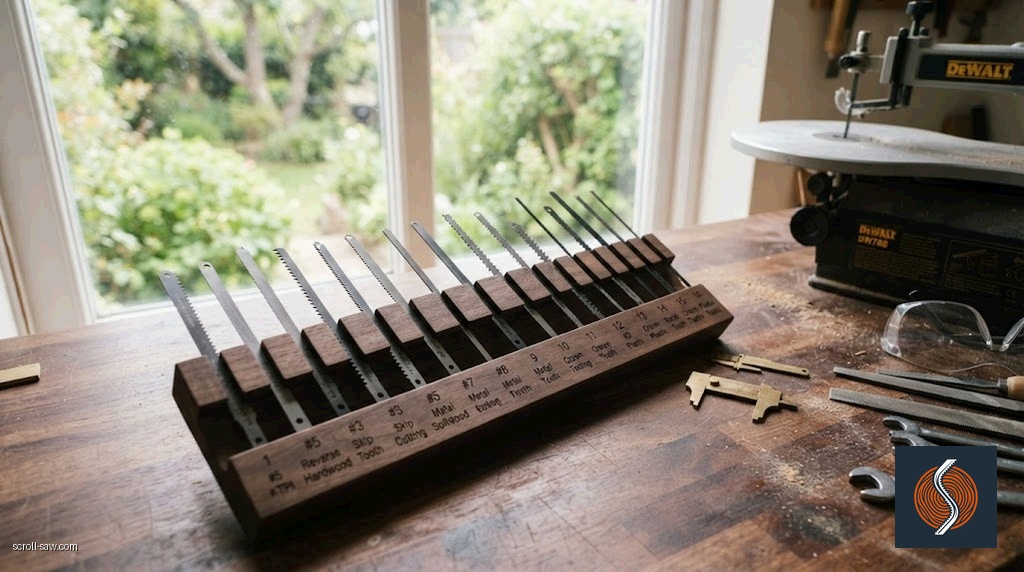
Pinned Scroll Saw Blades: Size, Tooth Geometry, and Material Guide
My first scroll saw came with a pack of pinned blades and a blade holder that would not accept anything else. For the first year, I did not know pinless blades existed. I cut everything from thin plywood to 2-inch oak with the same #5 pinned blade, and I wondered why my fretwork looked rough and my tight curves kept breaking. The blade was not wrong for the saw. It was wrong for the work. Pinned scroll saw blades have a specific range of things they do well, and if you understand that range, they are a perfectly good tool. If you do not, you will blame the blade for problems that are really about mismatch.
Pinned scroll saw blades, also called pin-end blades, have small metal pins molded into each end that drop into slots in the blade holder. They are the easiest blades to install and remove, requiring no tools and no clamping. They are available in a limited range of sizes compared to pinless blades, which is both their main limitation and the thing that makes them simple to use.
The short answer: pinned blades are best for thick stock (1/2 inch and up), rough cutting, and beginners who want fast blade changes without fiddling with clamps. They are not the right choice for fine fretwork, thin veneers, or tight curves under 1/4 inch radius. Knowing where pinned blades excel and where they fall short is the whole game.
How Pinned Blades Work
The pin-end system is mechanically simple. Each end of the blade has a pin, typically around 0.090 inches in diameter, that sits in a slot in the blade holder. You drop the pin in, apply tension with the saw’s tensioning lever, and the blade is ready to cut. No screws, no clamps, no alignment.
The advantage is speed. You can swap a pinned blade in under ten seconds. For rough work where you change blades often, or for beginners who are still learning to tension blades properly, this is a real benefit. The disadvantage is that the pin diameter sets a floor on blade thickness. You cannot make a pin-end blade thinner than the pin can support, which is why pinned blades start at about #5 and go up from there.
The pin also adds width to the blade end, which means the blade cannot pass through a small pilot hole in the workpiece. For interior cuts, you have to thread the blade through the hole before installing it, and the hole must be large enough for the pin to pass through. With pinless blades, the hole only needs to be large enough for the blade itself, which is much smaller.
Available Sizes
Pinned scroll saw blades are available in a narrower range than pinless blades. The most common sizes are:
#5 pinned blades: The smallest standard pinned blade. Width around 0.070 inches, thickness around 0.030 inches. TPI typically 12 to 18 depending on geometry. Good for 1/4 to 1/2 inch wood. This is the blade most entry-level saws ship with.
#7 pinned blades: A medium-large blade. Width around 0.090 inches, thickness around 0.035 inches. TPI 10 to 15. Good for 1/2 to 3/4 inch wood. Cuts faster than a #5 but leaves a wider kerf.
#9 pinned blades: A large blade for thick stock. Width around 0.110 inches, thickness around 0.040 inches. TPI 7 to 12. Good for 3/4 inch and thicker wood. The blade for rough cutting and fast straight cuts.
#12 pinned blades: The largest common pinned blade. For very thick stock and aggressive cutting. Leaves a wide kerf and a rough finish. Not for detail work.
Some manufacturers offer pinned blades in smaller sizes (#3 and even #2), but these are less common and the pin-to-blade ratio makes them fragile. If you need a #3 or smaller, pinless is the better format.
Tooth Geometries Available in Pinned Format
Pinned blades come in fewer tooth geometries than pinless blades because the larger sizes limit what makes sense. Here are the main options:
Standard (regular) tooth: The most common pinned blade. Teeth are closely spaced for a smooth finish. Good for general wood cutting in the 1/4 to 1/2 inch range. The default blade on most entry-level saws.
Skip-tooth blades: Wider gullet spacing for chip clearance. Better for thick wood (1/2 inch and up) where standard blades clog and burn. A pinned skip-tooth blade in #7 is an excellent choice for 3/4 inch hardwood. The finish is slightly rougher than standard tooth but the cut is cooler and faster.
Reverse-tooth blades: Available in pinned format in larger sizes. The reverse teeth on the bottom reduce tear-out on the bottom face. Useful for thick plywood where the bottom veneer tends to splinter. Less common in pinned format than in pinless but worth seeking out for plywood work.
Spiral blades: Available in pinned format and popular with some scrollers. Spiral pinned scroll saw blades cut in all directions, which is useful for thick material where you cannot rotate the workpiece. The kerf is wider and the finish is rough, but for certain projects (thick signs, large relief cuts) they save time. The 134mm pinned scroll saw blade is a common European size that fits many imported saws.
Double-reverse and crown-tooth blades: Rarely available in pinned format because these geometries are most useful in the fine sizes that pinned blades cannot offer. If you find them, they are worth trying, but do not expect a wide selection.
Material Guide for Pinned Blades
Because pinned blades are larger, they are best suited for materials that benefit from a bigger, stiffer blade.
Hardwood (oak, maple, walnut) 1/2 to 1 inch: This is where pinned blades shine. A #7 skip-tooth pinned blade cuts 3/4 inch oak without burning, tracks straight, and holds up well. The blade stiffness from the larger thickness means less flex and more accurate cuts in thick stock.
Softwood (pine, cedar, poplar) 1/2 to 2 inches: Pinned blades handle thick softwood easily. A #9 standard-tooth blade cuts 2-inch pine at a good rate. For softwood, standard tooth is fine because softwood does not generate the chip load that hardwood does.
Plywood 1/2 to 3/4 inch: Use a reverse-tooth pinned blade if you can find one. The reverse teeth prevent bottom veneer tear-out, which is the main problem with cutting plywood on a scroll saw. If you cannot find a reverse-tooth pinned blade, use a standard tooth and accept some bottom tear-out that you will sand away.
MDF and particle board: Pinned blades work well on MDF, which is abrasive and dulls blades quickly. Use a skip-tooth blade for chip clearance. Expect short blade life because MDF is hard on blades regardless of type.
Soft metals (aluminum, brass) in medium gauge: A #5 pinned skip-tooth blade with 18+ TPI can cut 20-gauge aluminum and thin brass. You need cutting wax and slow feed. Pinned blades are not ideal for metal because the finest metal-cutting blades are pinless, but for occasional soft metal work, a pinned blade will do the job.
Thin stock (under 1/4 inch): Pinned blades are not the right choice. The smallest pinned blade (#5) is too coarse for thin material. You will get a rough cut and a wide kerf. Switch to pinless blades for thin work.
Pinned vs. Non-Pinned Blades
The comparison between pinned and non-pinned (pinless) blades comes down to three factors: size range, convenience, and precision.
Size range: Pinless blades win by a wide margin. They are available from #8/0 up to #12, covering every possible project. Pinned blades cover #5 to #12, which is roughly the top half of the range. If you only cut thick stock, pinned blades have you covered. If you do any fine work, you need pinless.
Convenience: Pinned blades win. Blade changes take seconds with no tools. For beginners learning to scroll, or for production work where you swap blades often, the speed and simplicity of pinned blades is a real advantage. Some scrollers keep a pin-end saw for rough work and a plain-end saw for fine work.
Precision: Pinless blades win. The clamp on a plain-end holder holds the blade more rigidly than a pin in a slot, which means less flex and more accurate cuts. The finer sizes available in pinless format allow tighter curves and narrower kerfs. For anything where accuracy matters more than speed, pinless is the better choice.
If your saw only takes pinned blades, you can use an adapter to run pinless blades. The adapter clamps into the pin-end holder and provides a plain-end clamp. It works, but it adds height and can vibrate. For occasional fine work, an adapter is fine. For regular fine work, a saw with native plain-end holders is the better investment.
Choosing the Right Pinned Blade
Here is my practical recommendation for building a pinned blade kit:
- #5 standard tooth, 15 TPI. Your general-purpose blade for 1/4 to 1/2 inch wood. The blade your saw probably came with, and for good reason.
- #7 skip-tooth, 10 TPI. Your thick-wood blade for 1/2 to 3/4 inch hardwood. The skip-tooth geometry prevents burning in dense material.
- #9 skip-tooth, 7 TPI. Your rough-cutting blade for thick stock and fast straight cuts. Not for curves.
- #5 reverse-tooth, 15 TPI. Your plywood blade. The reverse teeth save the bottom veneer.
Those four blades cover the range where pinned blades are the right tool. If you need finer work than a #5 can deliver, it is time to look at pinless blades.
My Verdict
Pinned blades are not inferior to pinless blades. They are a different tool for a different job. For thick stock, rough cutting, and fast blade changes, they are the better choice. For fine fretwork, thin material, and tight curves, they are the wrong choice. The mistake is not using pinned blades. The mistake is using pinned blades for work they were never designed to do.
Here are the takeaways:
- Pinned blades start at #5 and go up. If your project needs a #3 or smaller, you need pinless blades.
- Skip-tooth geometry in a #7 pinned blade is the best single blade for thick hardwood. It cuts cool, fast, and clean enough to sand.
- For plywood, seek out a reverse-tooth pinned blade. The bottom-tear-out prevention is worth the effort of finding one.
- If your saw only takes pinned blades and you want to do fine work, buy an adapter. It is a cheap way to access the pinless world without buying a new saw.
Pinned blades will stay in my blade box for thick stock and rough work. They are fast, simple, and reliable for the jobs they are built for. Use them for those jobs, and use something else for everything else.
FAQ
What are pinned scroll saw blades? Pinned scroll saw blades have small metal pins on each end that drop into slots in the blade holder. They allow tool-free, fast blade changes and are available in sizes from about #5 to #12. They are best for thick stock and rough cutting.
What sizes do pinned scroll saw blades come in? The most common sizes are #5, #7, #9, and #12. Some manufacturers offer smaller sizes (#3) but these are less common. The pin diameter sets a minimum blade thickness, which limits how small pinned blades can be made.
Can I cut thin material with pinned blades? Pinned blades are not ideal for thin material under 1/4 inch. The smallest standard pinned blade (#5) is too coarse for thin stock and will leave a rough cut with a wide kerf. For thin material, use pinless (plain-end) blades in a smaller size.
What is the difference between pinned and pinless scroll saw blades? Pinned blades have pins on each end for quick, tool-free changes but are limited to larger sizes. Pinless (plain-end) blades clamp directly into the holder and are available in much finer sizes for detailed work. Pinned is convenient, pinless is precise.
Can I use pinless blades in a saw that only takes pinned blades? Yes, with an adapter. A pinless blade adapter clamps into the pin-end holder and provides a plain-end clamp. Adapters work but can add height, reduce rigidity, and vibrate more than a native plain-end holder.
Are spiral pinned scroll saw blades available? Yes, spiral blades are available in pinned format. They cut in all directions, which is useful for thick material where you cannot rotate the workpiece. The kerf is wider and the finish is rough, but they save time on certain projects.
What pinned blade should I use for thick hardwood? A #7 skip-tooth pinned blade with 10 TPI is the best choice for 1/2 to 3/4 inch hardwood. The skip-tooth geometry provides chip clearance that prevents burning, and the blade stiffness from the larger size keeps the cut straight.
Do pinned blades work for cutting metal? Pinned blades can cut soft metals like aluminum and brass in medium gauge. Use a #5 skip-tooth blade with 18+ TPI, cutting wax, and slow feed. For thin sheet metal, pinless metal-cutting blades in finer sizes are the better choice.
How do I install a pinned scroll saw blade? Drop the pins on each end into the slots in the blade holder, then apply tension with the saw’s tensioning lever. Ensure teeth point down toward the table so the blade cuts on the upstroke. The process takes seconds and requires no tools.
Are pinned blades good for beginners? Yes. The tool-free blade changes make pinned blades beginner-friendly. Beginners can swap blades quickly to experiment with different sizes and geometries without struggling with clamps and tensioning. Most entry-level scroll saws use pinned blades for this reason.
References
- Olson Saw Company, Pin-End Scroll Saw Blade Guide, olsonsaw.com
- Pegas (Grobet) Pinned Blade Specifications, pegas-saw-blades.com
- Flying Dutchman Pin-End Blade Product Information, mikesworkshop.com
- Scroll Saw Woodworking and Crafts Magazine, Pinned vs. Pinless Blade Selection, scrollsawer.com
- Suffolk Machinery (Timber Wolf) Blade Size and Material Guide, suffolkmachinery.com


