
Reverse Tooth Scroll Saw Blades: Size & Geometry Guide
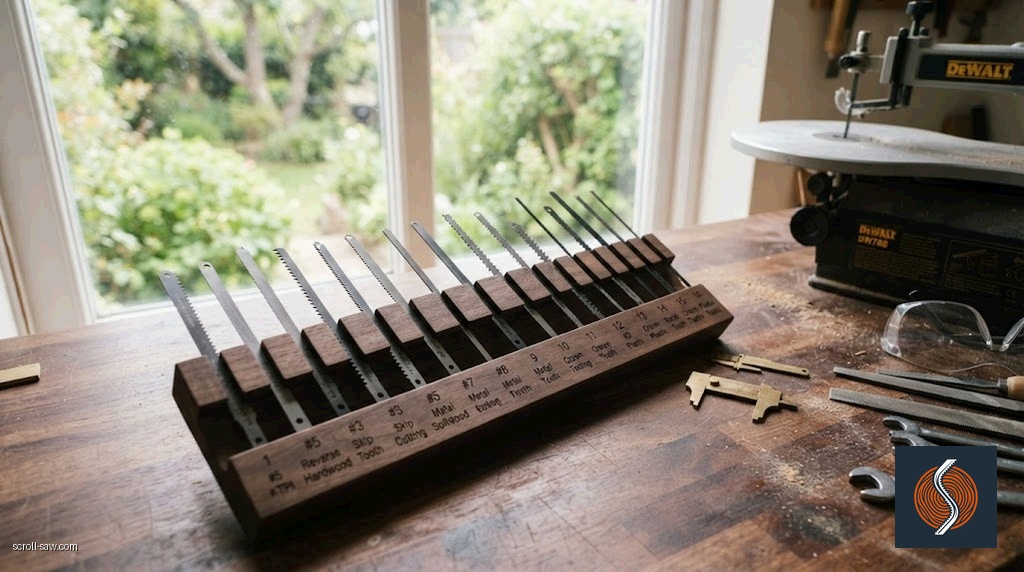
Reverse Tooth Scroll Saw Blades: Size, Tooth Geometry, and Material Guide
The first time I cut a delicate fretwork pattern on a piece of cherry, the top looked clean. The bottom looked like something had chewed through it. Splinters hanging off every curve, fuzz rising from every tight turn. I flipped the piece over and stared at it for a long time before I understood what had happened. The blade was doing its job on the downstroke, but on the upstroke, it was lifting fibers and tearing them out. That was the day I switched to reverse tooth scroll saw blades, and the difference was immediate.
Reverse tooth scroll saw blades are blades where most of the teeth point downward (the normal direction for a scroll saw), but a small section near the bottom of the blade has teeth pointing upward. Those upward-facing teeth cut on the upstroke, shearing the fibers on the underside of the wood before the main downward teeth complete the cut. The result is a cleaner bottom surface and dramatically less tearout.
If you have ever wondered what are reverse tooth scroll saw blades for, the answer is simple: they exist to give you a clean cut on both sides of the workpiece, not just the top. For anyone doing fretwork, intarsia, or fine inlay work where both faces of the wood are visible, they are not a luxury. They are the difference between a piece you can sell and one you have to sand for an extra hour.
How Reverse Tooth Geometry Actually Works
A standard scroll saw blade cuts on the downstroke only. The teeth all point down, and the blade pushes chips and dust downward through the kerf. This works fine for the top surface, but the bottom surface takes a beating. As the teeth exit the wood on the downstroke, they can lift and tear fibers, especially in porous woods like pine or woods with strong grain direction like oak.
A reverse tooth blade flips the direction of the last set of teeth, usually the bottom third or quarter of the blade. When the blade moves down, those reversed teeth are not cutting. When the blade moves up, they slice through the fibers on the underside first, creating a clean exit point. Then the main downward teeth cut through the rest of the material. The bottom of the cut comes out smooth.
The tradeoff is real, though. Those reversed teeth create upward force on the upstroke, which means the workpiece wants to lift. If your saw does not have good hold-down pressure, or if you are cutting very thin material, the wood can bounce. You need to press down more deliberately and keep your feed rate controlled. Some scrollers find this annoying. I find it a fair price for a clean bottom.
There is also a variation called the double-reverse blade. Instead of reversed teeth only at the bottom, a double-reverse blade has reversed teeth at both the top and bottom of the blade. This gives you clean cuts on both the top and bottom surfaces. The tradeoff is even more upward and downward force, and the blade can feel like it is fighting you in thicker stock. I would only recommend double-reverse blades for thin material where surface quality matters more than cutting speed.
Blade Sizes and Universal Numbers
Reverse tooth scroll saw blades come in the same universal numbering system as standard blades. The numbers run from small to large, and each number corresponds to a specific combination of blade width, blade thickness, and teeth per inch (TPI).
A size 2/0 reverse tooth blade is one of the smallest you can buy. It is extremely fine, with a high TPI, and it is built for the most delicate work: intricate fretwork, thin veneers, jewelry boxes. The kerf is narrow, which means your minimum cutting radius can be very tight. But the blade is fragile. If you push too hard or try to cut thick stock, it will snap.
A size 3 is a middle-ground blade. Scroll saw 3 reverse tooth blades are probably the most popular size among hobbyists because they handle a wide range of materials without being too aggressive or too fragile. They work well in 1/4 inch to 1/2 inch hardwood, and they leave a clean kerf that does not require much sanding. If you are starting out and want one blade to try, a size 3 reverse tooth is where I would point you.
A size 7 is getting into heavier territory. If you look at 7 flying dutchman reverse tooth scroll saw blades, you will see a thicker, wider blade with fewer teeth per inch. It cuts faster and handles thicker stock, up to about 1 inch. The minimum cutting radius is wider, so you cannot make the same tight turns as with a size 3. But for cutting thicker boards where you still want a clean bottom, a size 7 reverse tooth does the job.
The general rule: smaller numbers for thin material and tight curves, larger numbers for thicker material and straighter cuts. The universal blade number tells you the overall size, but you should always check the specific TPI and blade width from the manufacturer, because those can vary slightly between brands.
Pin-End vs Plain-End Reverse Tooth Blades
Scroll saws accept one of two blade end types: pin-end or plain-end. Your saw determines which you can use, though some saws accept both.
Pin-end blades have small pins molded into each end that lock into the blade clamps. They are easy to install and remove, which makes them popular with beginners and on entry-level saws. You can find 5 pin end reverse tooth scroll saw blades from several manufacturers. The limitation is that pin-end blades are generally available in fewer sizes and tooth configurations than plain-end blades. The pins also prevent you from threading the blade through a small starter hole for interior cuts, which is a real problem for fretwork.
Plain-end blades are smooth on both ends and clamp directly into the blade holders. They come in a much wider range of sizes and tooth geometries, including the full range of reverse tooth options. For interior cuts, you can release one end of the blade, thread it through a drilled hole in your workpiece, and re-clamp it. This is the standard approach for fretwork and any project with interior patterns.
If your saw only takes pin-end blades, your reverse tooth options are more limited but still available. If your saw takes plain-end blades, you have access to the full range of sizes and brands.
Brands Worth Considering
Flying dutchman reverse tooth scroll saw blades are among the most discussed in scroll saw forums, and for good reason. Made by B.L. Woodcrafters, Flying Dutchman blades are known for consistent tooth geometry and good steel quality. They come in a wide range of sizes, from 2/0 up through 12, and they offer both reverse tooth and double-reverse configurations. Many experienced scrollers consider them the benchmark for value and performance. If you search for the best blades for scroll saw reverse tooth forums, Flying Dutchman comes up again and again.
Olson is another well-established manufacturer. Their reverse tooth blades are widely available and come in both pin-end and plain-end formats. Olson blades tend to be slightly stiffer than Flying Dutchman, which some people prefer for straight cuts and others find too aggressive in tight curves.
Pegas, made by Niqua, is a third option worth knowing. Pegas blades are known for holding their edge longer than most, which means fewer blade changes during a long project. They are more expensive per blade, but if you are cutting a lot of hardwood, the longer life can offset the cost.
I would not recommend buying no-name bulk blades for anything you care about. The steel quality varies, the tooth set is inconsistent, and you will spend more time fighting the blade than cutting with it. The difference between a quality blade and a cheap one is small enough that it is not worth the frustration.
Installing Reverse Tooth Blades in Scroll Saw
Installing reverse tooth blades in scroll saw follows the same process as any other blade, but you need to pay attention to tooth direction. The majority of the teeth should point downward, toward the table. The reversed section should be at the bottom of the blade, between the table and the lower clamp.
If you install the blade upside down, the majority of teeth will point up, and you will get aggressive upward cutting with terrible tearout on the top. The saw will also try to lift the workpiece on every downstroke, which is dangerous and produces terrible results. Always check tooth direction before tightening the clamps.
For plain-end blades, make sure both ends are seated fully in the clamps and that the clamps are tight. A blade that slips mid-cut can damage your workpiece or break. For pin-end blades, make sure the pins are fully seated in the receiver slots.
Tension the blade until it produces a clean ping when plucked, like a guitar string. Too loose and the blade will wander in curves. Too tight and it will snap on the first tight turn. This is a feel you develop over time, but a good starting point is to tighten until the blade does not deflect more than about 1/8 inch when pressed sideways with moderate finger pressure.
Matching Reverse Tooth Scroll Saw Blades to Your Material
The blade size you choose should match both the material thickness and the wood species. Here is how I think about it.
For thin material (1/8 inch or less): use a size 2/0 or 1. These thin blades have high TPI and produce very little tearout even without reverse teeth, but a reverse tooth in this size gives you an especially clean cut. This is the range for veneers, thin plywood, and delicate marquetry.
For medium material (1/4 inch to 1/2 inch): use a size 3 or 5. This is the sweet spot for reverse tooth blades. The size 3 handles most hardwoods well, and the size 5 gives you a bit more aggression for denser species like maple or cherry. Both sizes have enough reversed teeth to make a visible difference on the bottom surface.
For thick material (3/4 inch to 1 inch): use a size 7 or 9. At this thickness, the reversed teeth have more work to do, and you will notice more upward force on the upstroke. Keep your feed rate slow and let the blade do the cutting. If you push too hard, the blade will bow and the cut will not be square.
For very thick material (over 1 inch): reverse tooth blades become less effective. The reversed section only covers the bottom portion of the blade, and in thick stock, the reversed teeth may not reach the bottom of the cut. In this range, a standard skip-tooth blade with good chip clearance may actually perform better. You can sand the bottom afterward.
Reverse Tooth vs Other Blade Types
Reverse tooth blades are one of several tooth geometries available for scroll saws. Understanding how they compare helps you pick the right blade for the job.
Skip-tooth blades have a gap between each tooth, which gives better chip clearance. They cut faster and run cooler than standard blades, but they do nothing for bottom tearout. If you are cutting thick stock where tearout is less of a concern, a skip-tooth blade may be more efficient.
Spiral blades have teeth pointing in all directions, so you can cut in any direction without turning the workpiece. They are useful for certain techniques but produce a wider kerf and a rougher surface on both sides. A spiral blade will never give you the clean finish of a reverse tooth blade.
Crown-tooth blades have a unique tooth pattern that is supposed to cut on both the upstroke and downstroke throughout the entire blade. They are less common and can be harder to find, but some scrollers prefer them for certain materials. The finish quality is good, but the blade tends to wear faster than a reverse tooth.
Modified-geometry blades are a newer category that tweaks tooth angles and set patterns for specific purposes. Some are designed for faster cutting, others for smoother finishes. If you have a specific problem you are trying to solve, it is worth experimenting with these, but reverse tooth remains the most reliable solution for bottom tearout.
Common Mistakes and How to Avoid Them
The most common mistake I see with reverse tooth blades is running the saw too fast. Because the reversed teeth create extra cutting action on the upstroke, a high stroke rate can cause the blade to overheat and lose its temper. If you smell burning wood or see scorch marks in the kerf, slow down. Most hardwoods cut best at medium speed settings.
The second mistake is feeding too fast. The reversed teeth need time to do their work on the upstroke. If you push the workpiece through too quickly, the teeth cannot clear the chips, and you get a rough cut and potential blade breakage. Let the blade set the pace.
The third mistake is using a blade that is too large for the work. A size 7 reverse tooth blade in 1/8 inch material will leave a wide kerf, struggle with tight curves, and produce more tearout than a smaller blade would. Match the blade to the material, not the other way around.
Conclusion
Reverse tooth scroll saw blades are the single biggest upgrade you can make to your scroll saw work if bottom surface quality matters to you. They are not a magic solution for every problem, and they come with tradeoffs: more upward force, the need for controlled feed rates, and slightly more attention during installation. But for fretwork, intarsia, and any project where both faces of the wood are visible, they turn a frustrating problem into a non-issue.
If you are just starting out, buy a pack of size 3 reverse tooth blades in plain-end format (assuming your saw takes them). That one purchase will teach you more about surface quality than any other upgrade. From there, experiment with sizes 2/0 and 5 to see how the geometry changes with thickness and TPI. And if you find a brand you like, whether that is Flying Dutchman, Olson, or Pegas, stick with it. Consistency in your blades means consistency in your results.
FAQ
What are reverse tooth scroll saw blades used for? Reverse tooth scroll saw blades are used to reduce tearout and splintering on the bottom surface of the workpiece. The reversed teeth at the bottom of the blade cut upward on the upstroke, shearing fibers clean before the main downward teeth complete the cut.
Do reverse tooth blades fit all scroll saws? They fit any scroll saw that accepts the corresponding end type, either pin-end or plain-end. Check your saw’s blade clamp type before buying. Plain-end reverse tooth blades are available in the widest range of sizes.
What size reverse tooth blade should I start with? A size 3 reverse tooth blade is the best starting point for most hobbyists. It handles a wide range of material thicknesses, produces a clean cut, and is forgiving enough for beginners learning feed rate and tension.
Do reverse tooth blades cut slower than standard blades? They can feel slightly slower because the reversed teeth create resistance on the upstroke. In practice, the difference is small if you use the correct speed and feed rate. The time you save in sanding more than makes up for any difference in cutting speed.
Can I use reverse tooth blades for thick stock? Reverse tooth blades work well up to about 1 inch thick. Beyond that, the reversed teeth may not reach the bottom of the cut, and a skip-tooth blade with good chip clearance may perform better.
Are Flying Dutchman reverse tooth blades worth it? Flying Dutchman blades are widely regarded as a top value option. They offer consistent tooth geometry, good steel quality, and a wide range of sizes. Many experienced scrollers use them as their everyday blade.
How do I know which direction to install a reverse tooth blade? The majority of the teeth should point downward, toward the table. The reversed section should be at the bottom of the blade. If most teeth point up, the blade is installed upside down and will produce poor results.
What is the difference between reverse tooth and double-reverse blades? Reverse tooth blades have reversed teeth only at the bottom. Double-reverse blades have reversed teeth at both the top and bottom, producing clean cuts on both surfaces. Double-reverse blades create more force in both directions and are best for thin material.
References
- B.L. Woodcrafters (Flying Dutchman Blades), manufacturer specifications and blade size charts. https://www.flyingdutchmanblades.com
- Olson Saw Company, scroll saw blade product specifications and tooth geometry documentation. https://www.olson-saw.com
- Pegas Blades by Niqua, blade specifications and application guides. https://www.pegasblades.com
- U.S. Consumer Product Safety Commission, power tool safety guidelines. https://www.cpsc.gov


