
Scroll Saw Blades for Hardwood: A Blade-to-Material Matrix
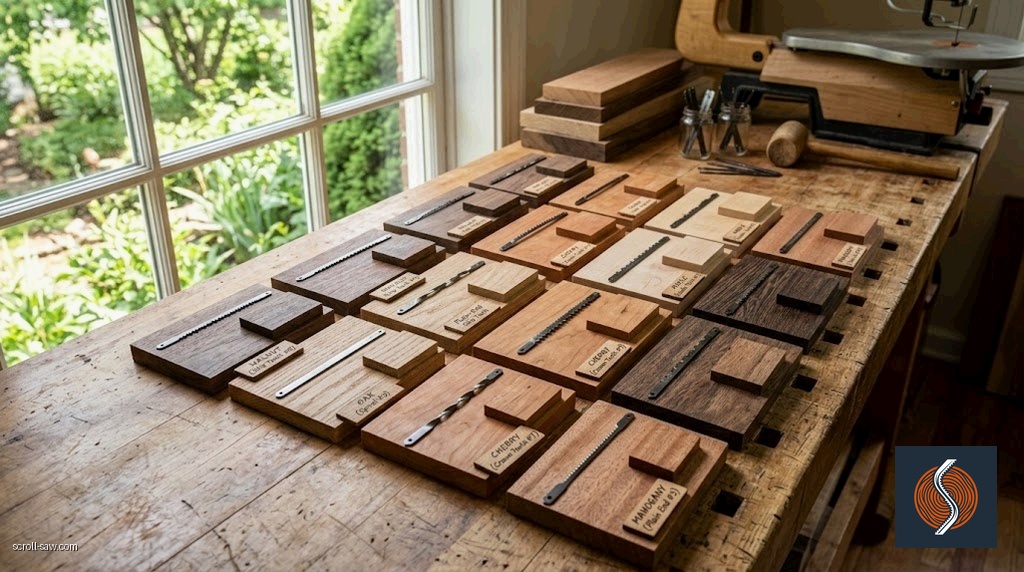
Scroll Saw Blades for Hardwood: A Blade-to-Material Matrix
Hardwood is where scroll saw blade selection stops being casual. Softwood forgives a mismatched blade; hardwood does not. The wrong TPI burns the kerf. The wrong tooth geometry stalls the cut. The wrong blade size lets the blade drift under load. This guide walks through the full hardwood blade matrix so you can pick correctly the first time.
The matrix covers oak, maple, cherry, walnut, birch, ash, and other common hobby hardwoods. Extremely dense or exotic species (bubinga, ebony, wenge) sit at the harder end of the same ranges.
The blade-to-hardwood matrix
Recommended blade size, tooth geometry, and specific product for common combinations of hardwood species and thickness:
| Species | 1/8 in | 1/4 in | 1/2 in | 3/4 in | 1 in |
|---|---|---|---|---|---|
| Oak (red or white) | #3 reverse tooth | #5 reverse tooth | #5 or #7 PGT | #7 or #9 PGT | #9 or #12 skip |
| Maple (hard) | #3 reverse tooth | #5 reverse tooth | #7 PGT | #9 PGT | #9 skip |
| Cherry | #3 reverse tooth | #5 reverse tooth | #5 or #7 PGT | #7 PGT | #9 PGT |
| Walnut | #3 reverse tooth | #5 reverse tooth | #7 skip | #7 or #9 PGT | #9 skip |
| Birch | #2/0 or #3 reverse | #5 reverse tooth | #5 or #7 PGT | #7 PGT | #9 skip |
| Ash | #3 reverse tooth | #5 reverse tooth | #7 PGT | #9 skip | #9 or #12 skip |
| Bubinga, ebony | #5 reverse tooth | #5 or #7 PGT | #7 PGT | #9 PGT | #12 skip |
How to use the matrix
Find your species row and thickness column. The recommendation is the starting point. Adjust as follows:
-
If the cut is a straight-line rip cut: use a coarser blade (one size up in the matrix). Skip tooth or hook tooth clears chips faster on rips.
-
If the cut is a tight curve: use a finer blade (one size down). Smaller kerf means tighter radius.
-
If both surfaces will be visible: use a reverse-tooth version of the recommended blade.
-
If only the top surface matters: standard skip-tooth or hook-tooth works and cuts faster.
Recommended blades for the matrix
One pack of each of these covers the entire matrix:
Reverse tooth #5 for thin hardwood detail
The Olson FR42401 reverse tooth #5 is a standard reverse-tooth blade for 1/4 to 1/2 inch hardwood. Standard availability, consistent cut quality.
Drawback: stamped teeth; PGT is cleaner if the finish matters.
Best for: general hardwood work in the 1/4 to 1/2 inch range. Skip if: cut quality on visible surfaces is the priority (buy Pégas Reverse Skip instead).
PGT double tooth #7 for mid-thick hardwood
The Olson PG497DZ PGT Double Tooth #7RG is the go-to for 1/2 to 3/4 inch hardwood. Milled teeth cut cleaner than stamped, blade life is 2 to 3x longer, tolerates aggressive feed rates.
Drawback: pricier per blade.
Best for: mid-thick hardwood where finish matters. Skip if: budget is very tight (Olson FR41001 is a cheaper stand-in).
PGT double tooth #9 for thick hardwood
The Olson PG499DZ PGT Double Tooth #9RG is the coarser sibling of the #7. Better chip clearance for 3/4 to 1 inch stock, especially in dense species like hard maple and hickory.
Drawback: pricier per blade.
Best for: 3/4 to 1 inch hardwood. Skip if: your work is under 1/2 inch.
Crown tooth #9 for fast cuts in thick hardwood
The Olson CT62900 Crown Tooth 6 TPI is a #9 blade rated for hardwood up to 3/4 inch. Faster cuts than PGT at a slight finish penalty.
Drawback: rougher finish than PGT.
Best for: production cuts where speed matters more than finish. Skip if: the cut edge will be visible under a clear finish.
Pégas Reverse Skip #3r for cleaner finish
The Pégas Reverse Skip #3r is a Swiss-made reverse skip-tooth blade for hardwood 1/4 to 3/4 inch. Cleaner finish than any Olson equivalent, longer blade life.
Drawback: pricier per blade; smaller size range.
Best for: display-quality work in mid-thickness hardwood. Skip if: cost matters more than finish.
Pégas Modified Geometry #12spr for extra-thick hardwood
The Pégas Modified Geometry #12spr is rated by Pégas for wood up to 3 inches thick. The go-to for 1 to 1-1/2 inch hardwood where standard blades stall.
Drawback: pricier; a specialty blade.
Best for: hardwood over 1 inch thick. Skip if: your work fits within standard size 9 range.
Fine reverse tooth for thin hardwood
For 1/8 inch hardwood or thinner, drop to a size #3 reverse tooth blade. Olson makes these in packs, and Pégas has an equivalent in the Modified Geometry line. The Pégas Modified Geometry #1spr works well for thin, detailed hardwood cuts.
Drawback: fine blades break more easily.
Best for: thin hardwood ornaments, ornament letters, small marquetry. Skip if: your work is 1/4 inch or thicker.
Choosing tooth geometry within a size
At any given blade size, three geometry choices come up:
Standard skip tooth. The value option. Adequate for most hardwood work. Slightly rougher finish than PGT.
Reverse tooth. Adds a few reverse teeth at the bottom. Cleans up the underside of the cut. Best when both surfaces will be visible.
PGT (precision-ground tooth) double tooth. Milled teeth in a double pattern. Cleaner finish, longer blade life, faster cutting. Premium price. Best for display work.
Pégas Modified Geometry is Pégas’s equivalent of PGT, with slightly different tooth patterns aimed at reducing burning in dense wood.
Feed rate and speed for hardwood
Saw speed: 80 to 100 percent of top speed for hardwood under 1 inch. Drop to 70 percent for anything over 1 inch to give the blade time to shed heat.
Feed rate: steady, not aggressive. Force just wastes blades. The blade should cut without effort.
Blade tension: high end of the saw’s range for thick hardwood. Loose blades wander under load.
Beeswax: rub the blade with beeswax every few cuts in resinous hardwood (cherry, some walnut). Prevents pitch buildup.
Common hardwood problems
Kerf burns. Too many teeth engaged, feed too slow, or blade dull. Move to coarser TPI, feed steadier, replace blade.
Blade snaps in dense hardwood. Tension too high, feed too aggressive, or blade wrong for the thickness. Reduce tension, slow feed, move to coarser blade.
Cut wanders in the middle of the workpiece. Blade is dull or tension is too low. Replace blade or tighten tension.
Kerf closes behind the blade. Internal tension in the hardwood. Use a wider-kerf blade (hook tooth) or make relief cuts before starting the main cut.
Verdict
For the average hardwood scroller, three PGT blades cover the entire matrix: a PG497DZ #7 for mid-thick, a PG499DZ #9 for thick, and a fine detail blade for thin work. Add Pégas Reverse Skip or Modified Geometry only when finish quality matters more than blade cost. Match TPI to thickness (3 teeth minimum engaged), use reverse tooth when both surfaces are visible, and take cooling breaks on cuts longer than 30 seconds.
FAQ
What are the best scroll saw blades for hardwood? Olson PGT double-tooth blades (PG497DZ for #7, PG499DZ for #9) for finish quality; standard reverse-tooth blades for general work; Pégas Modified Geometry for thickest stock.
What TPI is best for hardwood? Depends on thickness. 15 TPI for 1/8 inch, 12 TPI for 1/4 inch, 10 TPI for 1/2 inch, 6 to 10 TPI for 3/4 inch, 6 TPI for 1 inch.
Do I need a different blade for oak vs cherry? Generally no. The same size and geometry blade works across common hardwood species. Density-adjust the feed rate rather than the blade for exotic species like ebony or bubinga.
How thick of hardwood can a scroll saw cut? Up to about 1-1/2 inches on a hobby saw with a coarse blade. Beyond that, a bandsaw is more practical.
Why does my scroll saw blade burn hardwood? Too many teeth engaged, feed too slow, or blade dull. Move to coarser TPI, feed steadier, or replace the blade.
Should I use skip tooth or reverse tooth for hardwood? Reverse tooth when both surfaces will be visible; skip tooth when only the top surface matters. Reverse tooth cuts slightly slower.
How long does a scroll saw blade last in hardwood? Stamped blades: 30 to 60 minutes of continuous cutting. PGT blades: 60 to 120 minutes. Depends on species and feed rate.
References
-
Olson Saw Company scroll saw blade catalog: olsonsaw.net
-
Pégas Sawblades modified geometry line: pegas-swiss.com
-
USDA Forest Products Lab Wood Handbook (hardwood density reference): fpl.fs.usda.gov
Title tag: Scroll Saw Blades for Hardwood: A Blade-to-Material Matrix Meta description: A matrix for picking scroll saw blades by hardwood species and thickness, plus real PGT, reverse-tooth, and Pégas Modified Geometry picks. Slug: best-scroll-saw-blades-for-hardwood Excerpt: Hardwood scroll saw blade selection depends on species, thickness, and whether both surfaces will be visible. This guide provides a full matrix covering oak, maple, cherry, walnut, and other common hardwoods from 1/8 to 1 inch, plus the specific PGT, reverse-tooth, and Pégas Modified Geometry blades to buy for each combination.


