
Best Plywood for Scroll Saw Projects: Grades and Picks
Best Plywood for Scroll Saw Projects: Grades and Picks
Plywood is the default scroll saw material for a reason. It comes in flat, dimensionally stable sheets, holds fine detail without splitting along a grain line, and takes finishes cleanly. But not every plywood is scroll-saw plywood. The cheap 3-ply sheathing from the big-box discount rack is a different animal from the 13-ply Baltic birch that ornament makers pay a premium for, and the difference shows up the first time you try a fret cut.
This guide walks through the plywood grades that actually cut well on a scroll saw, which ones fit which projects, and where the value line falls between quality and price.
What makes a plywood “scroll saw plywood”
Four features matter:
Ply count. More plies per given thickness means smaller voids and a more consistent structure. Baltic birch 1/4 inch has 5 to 7 plies. Cheap 1/4 inch plywood has 3 plies. Fret work through 3-ply is fragile; through 7-ply it is stable.
Void-free construction. Voids (internal gaps in the plies) are where fret cuts fail. Any Baltic birch, most cabinet-grade hardwood plywood, and select brand marine-grade plywood are void-free. Sheathing and construction plywood are not.
Uniform glue lines. Sanded, uniform glue lines cut cleanly. Rough or uneven glue lines chip and tear.
Consistent face veneers. Both faces should be smooth and free of patches or knots. This matters more for scroll saw work than for cabinet work because the entire cut edge and both faces are usually visible.
A quick shorthand: if the edge of the plywood shows tight, uniform plies with no gaps, it is scroll-saw grade. If you see gaps or one very thick middle layer, it is not.
The scroll saw plywood options
Baltic birch: the workhorse
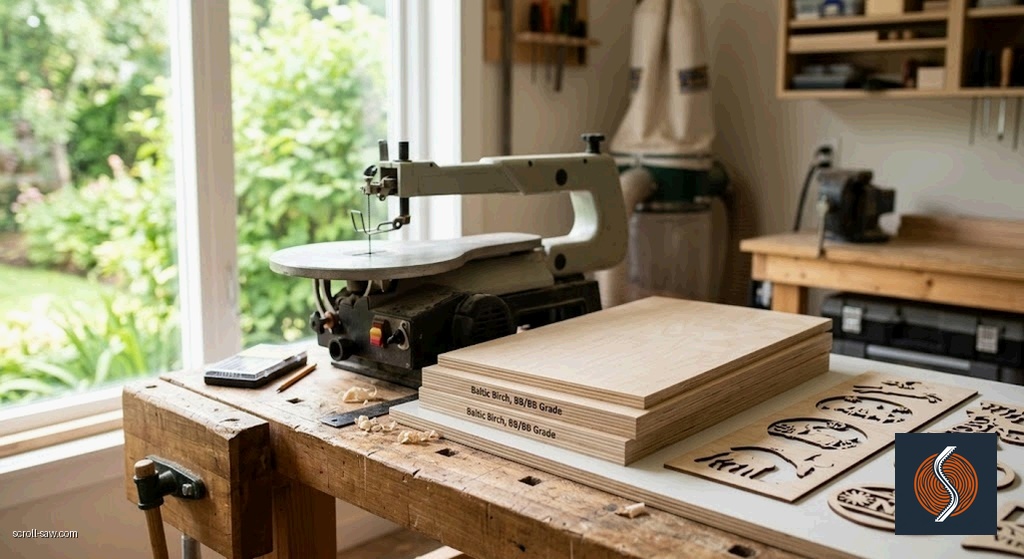
Baltic birch (imported from Russia, Latvia, or Finland historically; increasingly sourced from other regions as trade shifts) is the standard. 5-ply construction at 1/4 inch, 9-ply at 1/2 inch, 13-ply at 3/4 inch. Void-free. Consistent light birch face on both sides. Cuts cleanly at any TPI.
Best for: everything scroll saw. Ornaments, fret work, puzzles, layered art, letters, boxes. Skip if: your project needs a hardwood species face (walnut, cherry). Typical thicknesses stocked: 1/8, 1/4, 3/8, 1/2, 3/4 inch.
Cabinet-grade hardwood plywood
A hardwood veneer face over a birch or poplar core. Common face species: red oak, white oak, maple, cherry, walnut, birch. Slightly thicker than Baltic birch at the same nominal thickness (a nominal 1/4 inch cabinet plywood is actually 0.22 to 0.23 in). Void-free in cabinet grade.
Best for: projects where a specific wood species matters (walnut ornaments, oak letters). Skip if: you need the maximum ply count for fine fret work (Baltic birch is better). Typical thicknesses: 1/4, 1/2, 3/4 inch.
Marine-grade plywood
Higher glue quality (waterproof) with void-free construction. Overkill for indoor scroll saw work; useful for outdoor signs and pieces that will see weather.
Best for: outdoor signs, boat interiors, garden art. Skip if: the piece stays indoors (Baltic birch is cheaper and cuts identically). Typical thicknesses: 1/4, 1/2, 3/4 inch.
Aircraft-grade plywood
Thin, ultra-high-quality plywood used in model aircraft and specialty work. Comes in 1/32, 1/16, and 1/8 inch. Extremely fine plies, void-free, tight tolerances.
Best for: ultra-fine fret work, model construction, layered marquetry. Skip if: thickness over 1/8 inch is needed. Typical thicknesses: 1/64 to 1/8 inch.
Sanded pine plywood (big-box grade)
Standard sanded pine plywood from home centers. 3-ply at 1/4 inch, occasional voids, softer face veneer than birch.
Best for: practice cuts, jigs, throw-away projects. Skip if: the finished piece needs to be attractive. Typical thicknesses: 1/4, 3/8, 1/2, 3/4 inch.
Construction sheathing plywood
Rough construction-grade plywood. Voids common, plies loose, face veneers rough. Not scroll-saw material.
Best for: building shop jigs, sacrificial backers. Skip if: the piece will be visible.
Thickness recommendations by project
Fret work ornaments: 1/8 to 3/16 inch Baltic birch. Thin enough to cut quickly, thick enough to hold fine detail.
Layered art (multiple stacked layers): 1/8 inch Baltic birch or aircraft plywood. Thin layers, thin kerf blades (#2/0 or #3/0), stacks glue-up flat.
Puzzles: 1/4 inch Baltic birch. Thick enough to be substantial, thin enough for tight puzzle cuts.
Letters and signs: 1/4 to 3/8 inch Baltic birch or hardwood cabinet plywood.
Outdoor signs: 1/4 to 1/2 inch marine-grade plywood.
Boxes: 1/4 to 3/8 inch Baltic birch or hardwood cabinet plywood.
Toys: 1/4 to 1/2 inch Baltic birch. Sand thoroughly; check that the plywood is non-toxic (Baltic birch and cabinet grade are generally safe; verify with the supplier for children’s toys).
Where to buy plywood for scroll saw work
Local hardwood dealers: best for Baltic birch and hardwood cabinet plywood. Ask specifically for scroll saw stock; they will know what to show you.
Rockler, Woodcraft, and Hardwood Distributors: consistent Baltic birch and cabinet-grade in scroll-saw thicknesses. Higher price than a hardwood dealer, but reliable.
Amazon: aircraft plywood, small Baltic birch panels, and specialty thin plywood packs.
Home Depot / Lowe’s: big-box pine plywood and occasional hardwood face plywood. Adequate for practice, not premium work.
Avoid: unbranded imported plywood without documented ply count and glue type.
Blades that work well in plywood
Plywood is generally kind to blades. The main issue is the plywood’s abrasive glue lines, which dull blades faster than solid wood.
For 1/8 to 1/4 inch Baltic birch: Olson FR42401 reverse tooth #5 at 14 TPI covers most work.
For 3/8 to 1/2 inch: Olson PG497DZ PGT #7RG.
For 3/4 inch: Olson PG499DZ PGT #9RG.
For fine fret work in 1/8 inch: Flying Dutchman #2/0 six-dozen or Pégas Skip Tooth Size 2/0.
For layered art with omnidirectional curves: Pégas Spiral Size 5.
Common problems with plywood
Underside of cut splinters. Standard skip tooth leaves tear-out on the exit face. Use a reverse-tooth blade, or sandwich the workpiece with a sacrificial thin plywood underneath.
Blade drifts on cheap plywood. Voids or inconsistent glue lines pull the blade off track. Use higher-grade plywood, or accept that the cut will need cleanup.
Glue lines dull the blade fast. Plywood glue is abrasive. Expect blade life 20 to 40 percent shorter than solid wood.
Layers delaminate at the cut edge. Poor glue or excessive heat. Slow the saw slightly and use a cleaner blade.
Plywood warps between cuts. Thin plywood (1/8 inch and thinner) can warp with humidity. Store flat and weighted.
Verdict
For most scroll saw work, Baltic birch is the answer at any thickness from 1/8 to 3/4 inch. For projects that need a specific hardwood face, cabinet-grade hardwood plywood. For outdoor pieces, marine-grade. For ultra-fine fret work in thin material, aircraft plywood. Pair with an Olson FR42401 reverse tooth or Pégas Skip Tooth Size 5 for the workhorse cuts, and expect blade life 20 to 40 percent shorter than in solid wood because plywood glue is abrasive.
FAQ
What is the best plywood for scroll saw projects? Baltic birch. Void-free, high ply count, consistent face veneers, cuts cleanly at any TPI.
Can I use regular plywood on a scroll saw? Yes, but expect voids and cheap face veneers. Fine fret work fails in construction-grade plywood. Baltic birch is worth the price difference.
What thickness plywood is best for ornaments? 1/8 to 3/16 inch Baltic birch for standard ornaments. Thinner (1/16 inch aircraft plywood) for lightweight or layered work.
Is Baltic birch expensive? More than construction plywood, less than solid hardwood. Prices vary by dealer and current supply.
Can I stack multiple layers of plywood to cut at once? Yes. Two or three sheets of 1/8 inch Baltic birch can be stack-cut with a size #5 or #7 skip-tooth blade. Tape the stack tightly before cutting.
Does plywood dull blades faster than solid wood? Yes, roughly 20 to 40 percent faster. Plywood glue is abrasive.
Which plywood cuts cleanest on a scroll saw? Aircraft plywood (very fine plies) or aircraft-grade Baltic birch. Both leave minimal tear-out with a reverse-tooth blade.
References
-
APA (Engineered Wood Association) plywood grading reference: apawood.org
-
Rockler scroll saw plywood selection guide: rockler.com
-
Woodcraft plywood grading and selection: woodcraft.com
Title tag: Best Plywood for Scroll Saw Projects: Grades and Picks Meta description: Baltic birch, cabinet grade, marine, and aircraft plywood compared for scroll saw work. Thickness guidance by project type and blade picks that hold up. Slug: best-plywood-for-scroll-saw-projects Excerpt: Plywood grade matters as much as thickness for scroll saw work. This guide covers Baltic birch, cabinet-grade hardwood, marine, and aircraft plywood, plus thickness recommendations by project and the blades that cut plywood cleanly without excessive blade wear.


