
How to Use a Scroll Saw Without Forcing the Blade
How to Use a Scroll Saw Without Forcing the Blade
The single most common mistake new scroll saw users make is forcing the blade. You push a bit harder because the cut feels slow, then a bit harder still because the line is drifting, and by the third minute the blade has burned the wood, snapped in half, or both. The scroll saw is designed to cut at its own pace, and the operator’s job is to guide, not to power the cut. This guide walks through the technique that keeps the blade doing the work and produces clean cuts start to finish.
What forcing looks like
Before fixing it, recognize it. Forcing shows up as:
-
Visible bowing of the blade during the cut.
-
Sawdust piling up at the front of the cut instead of flowing continuously.
-
Cut edge shows tear-out or chattering.
-
Wood smokes or burns from friction.
-
Blade wanders off the line despite steady hand position.
-
Cut is significantly slower than expected for the material.
-
Blade breaks within the first minute.
Any of these means the operator is applying more feed pressure than the blade can accept.
Why forcing does not speed the cut
A scroll saw blade cuts by tooth engagement. Each tooth wedges into the material, removes a small chip, and moves to the next position. The rate at which chips are removed is limited by:
-
Tooth geometry (fixed for a given blade).
-
Tooth engagement depth (limited by blade thickness).
-
Chip clearance (limited by the space between teeth).
-
SPM (strokes per minute, set by the saw).
Forcing pressure does not change any of these. It just adds heat, friction, and blade flex, all of which hurt the cut.
A properly-sized blade cuts at a natural rate that the operator cannot exceed by pushing harder. Trying to force it wastes the blade and the material.
The right technique: feed as a guide
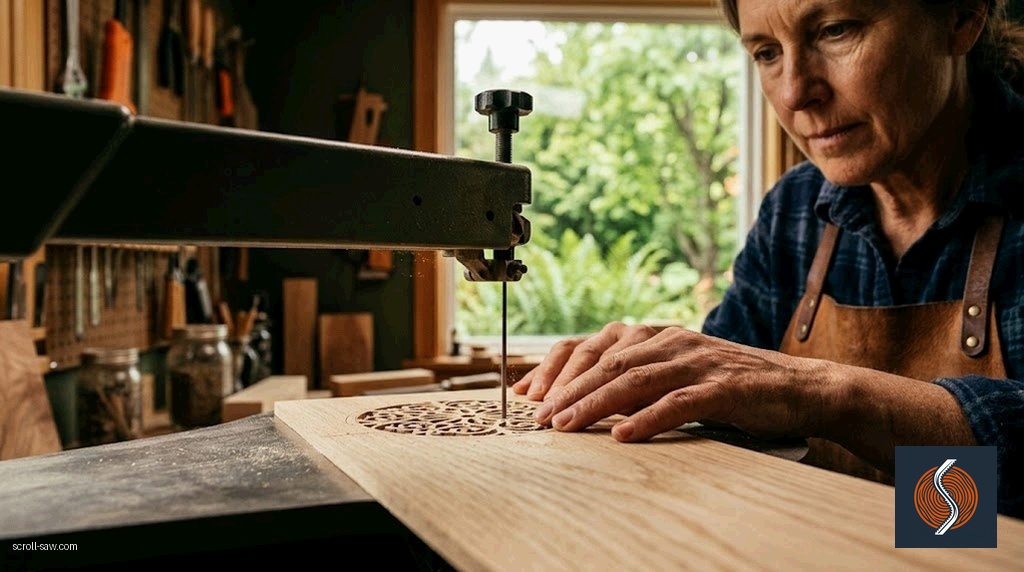
Correct scroll saw feed is a light, steady, two-handed guide. The operator’s hands maintain the cut line direction; the blade cuts at its natural rate.
Both hands on the workpiece
Both hands rest on the workpiece with fingers spread for stability. The workpiece is what you steer; the blade is not.
Hands work as one unit. Uneven pressure between the two hands twists the workpiece and pushes the blade sideways.
Feed direction and rate
Feed the workpiece into the blade in the direction of the cut line. Feed rate should be:
-
Just enough to keep chips flowing continuously.
-
Steady without sudden pushes or pauses.
-
Slow compared to what feels natural at first. Most beginners feed too fast.
A good scroll saw cut in 1/4 inch pine feeds at roughly 4 to 6 inches per minute. In 3/4 inch hardwood, 2 to 3 inches per minute. In 1 inch hardwood, 1 to 2 inches per minute.
Reading the blade
Watch the blade during the cut, not the pencil line. The pencil line is 1/32 inch away from where the cut actually goes; the blade tells the truth.
If the blade is vertical and moving through the material smoothly, the cut is going well. If the blade bows or leans, feed is too aggressive.
Following the line by moving the workpiece
Steering is done by moving the workpiece, not the blade. Turn the workpiece slightly to bring the cut line onto the blade path.
For curves, this rotation is smooth and continuous. The workpiece rotates around the blade; the blade stays approximately vertical.
Setup that supports not-forcing
Several setup elements help by removing the temptation or need to force.
The right blade
Using the correct TPI for the material means the blade cuts freely at moderate feed. Wrong TPI (too fine for the thickness) makes the cut feel slow, which invites forcing.
Refer to a TPI guide before selecting a blade.
Sharp blade
Dull blades cut slowly, which invites forcing. Fresh blades cut at their intended rate; the operator does not have to push.
Replace blades when cuts start feeling slow. Blade cost is a fraction of the material cost.
Correct tension
Proper tension keeps the blade rigid so it cuts at its natural rate. Loose tension lets the blade flex, which makes the cut feel slow and invites forcing.
Pluck the blade; it should produce a clear musical note (roughly middle C for a #5 blade).
Bolt-down saw
A saw that vibrates on a loose bench transmits vibration into the workpiece, which makes cuts feel unstable and invites forcing to “stabilize” the cut. Bolt the saw down solidly.
Waxed table
A lightly waxed table reduces workpiece drag. Less drag means the same feed pressure produces the same cut behavior; no need to force to overcome drag.
Apply paste wax to the table every few sessions.
Appropriate saw speed
Most wood cutting benefits from high SPM (1400 to 1750). Slow SPM in wood makes cuts feel labored and invites forcing.
Variable-speed saws let you match SPM to material; use it.
The full sequence: one cut, start to finish
Step-by-step for a straight cut in 1/2 inch hardwood on a hobby scroll saw:
-
Verify blade. Correct TPI for material (Olson PGT #7 for 1/2 inch hardwood). Sharp. Both ends seated in clamps.
-
Verify tension. Pluck test produces a clear note.
-
Verify saw speed. Set to 1400 to 1600 SPM (top of the wood range).
-
Prepare workpiece. Draw the cut line with a pencil. Position the workpiece on the saw table with the pencil line touching the blade.
-
Position hands. Both hands on the workpiece, spread for stability, thumbs positioned away from the blade path.
-
Start the saw. Confirm it runs smoothly without vibration.
-
Begin cutting. Feed the workpiece into the blade at moderate pressure. Continuous chip flow should appear.
-
Follow the line. Steer the workpiece so the pencil line aligns with the blade’s cutting direction. Both hands move together.
-
Maintain rate. Steady feed without pushing harder or backing off.
-
Reach the end. Feed continues until the blade exits the material. Do not lift the workpiece off the blade while the saw is running.
-
Stop the saw. Then remove the workpiece.
-
Check the cut. Cut edge should be clean. Cut line should match the pencil line closely.
If the cut goes wrong, the answer is almost never “push harder next time.” The answer is almost always “different blade, different tension, or different technique.”
Common temptations to force and how to resist
”The cut is too slow”
Check blade sharpness first. Dull blades cut slowly.
Check TPI. Wrong TPI (too fine) makes cuts feel slow.
Check SPM. Low SPM in wood makes cuts feel slow.
One of these three is almost always the issue. Forcing does not solve any of them.
”The line is drifting”
Check tension. Loose tension causes drift.
Check blade sharpness. Dull blades drift.
Check feed evenness. Uneven two-handed pressure causes drift.
Forcing amplifies drift by pushing the blade sideways.
”The blade sounds wrong”
Check for pitch buildup (resinous woods). Wax the blade.
Check for dull teeth. Replace blade.
Check for wrong TPI. Match to material.
Forcing does not fix any of these.
”I want to finish faster”
Accept the natural pace. Scroll saw work is deliberate; the projects are worth the time. Forcing produces worse cuts that need more cleanup, which does not save time overall.
Recommended saws for good cutting technique
Good technique is easier on saws that behave predictably.
DEWALT DW788 for consistent behavior
The DEWALT DW788 has low vibration and precise variable speed. The saw feels like the blade is doing the work; no reason to force.
Drawback: premium price. Best for: dedicated hobbyists. Skip if: budget-conscious.
WEN 3922 for good hobbyist behavior
The WEN 3922 is well-mannered for hobbyist use. Variable speed and adequate rigidity encourage proper technique.
Drawback: thumb-screw clamps loosen occasionally. Best for: hobbyist learners. Skip if: production or precision.
SKIL 3335-07 for beginners
The SKIL 3335-07 is a common first saw. Fixed-speed limits variety but the saw handles adequately.
Drawback: fixed speed limits material range. Best for: absolute beginners on tight budget. Skip if: variety of materials.
Recommended blades that support natural feed
Fresh blades appropriate for the material make forcing unnecessary. Baseline set:
Olson FR42401 reverse tooth #5. General 1/4 to 3/4 inch wood.
Olson PG497DZ PGT #7. Medium hardwood.
Olson PG499DZ PGT #9. Thick hardwood.
Pégas Modified Geometry #12spr. Very thick stock.
Verdict
Using a scroll saw well means letting the blade do the cutting. Match blade TPI to material, tension the blade correctly, run the saw at appropriate SPM, and feed the workpiece as a light steady guide with both hands. When something feels wrong, the answer is not “push harder.” It is check blade, check tension, check TPI, check SPM. A fresh Olson FR42401 reverse tooth #5 at proper tension in a well-maintained saw cuts cleanly at moderate feed pressure. That is the technique that produces good work and long blade life.
FAQ
What is the biggest mistake beginners make on a scroll saw? Forcing the blade with aggressive feed pressure. The scroll saw cuts at its own pace; forcing produces broken blades and rough cuts.
How do I know if I am pushing too hard? Blade bows, sawdust piles up, cut smokes or burns, blade wanders, cut is much slower than expected, or blade breaks quickly. Any of these means feed pressure is too high.
How do I feed a scroll saw correctly? Both hands on the workpiece, steady moderate feed, follow the pencil line by rotating the workpiece around the blade. Feed just enough to keep chips flowing continuously.
Why does my scroll saw cut feel slow? Usually dull blade, wrong TPI, or low SPM. Forcing does not fix any of these; changing the blade or settings does.
How fast should a scroll saw cut? Roughly 4 to 6 inches per minute in 1/4 inch pine, 2 to 3 inches per minute in 3/4 inch hardwood, 1 to 2 inches per minute in 1 inch hardwood.
Should I push harder if the blade wanders? No. Forcing amplifies wander. Check tension, blade sharpness, and feed evenness instead.
How do I know when to replace a blade? When cuts start feeling slower than expected or edges get rougher than expected. Fresh blades cut freely; dull blades invite forcing.
References
-
Scroll Saw Woodworking & Crafts magazine technique library: scrollsawer.com
-
Olson Saw Company blade fundamentals: olsonsaw.net
-
DEWALT DW788 owner’s manual: dewalt.com
Title tag: How to Use a Scroll Saw Without Forcing the Blade Meta description: Correct scroll saw technique: light two-handed feed, letting the blade cut at its natural rate, and recognizing when forcing is masking a different problem. Slug: how-to-use-a-scroll-saw Excerpt: The most common mistake new scroll saw users make is forcing the blade. This guide walks through the correct technique: light steady two-handed feed, letting the blade cut at its natural rate, recognizing when a slow cut points to a blade or setup issue instead, and setting up the saw for clean cuts start to finish.


