
Bandsaw vs Scroll Saw: Accuracy, Capacity, and Control Compared
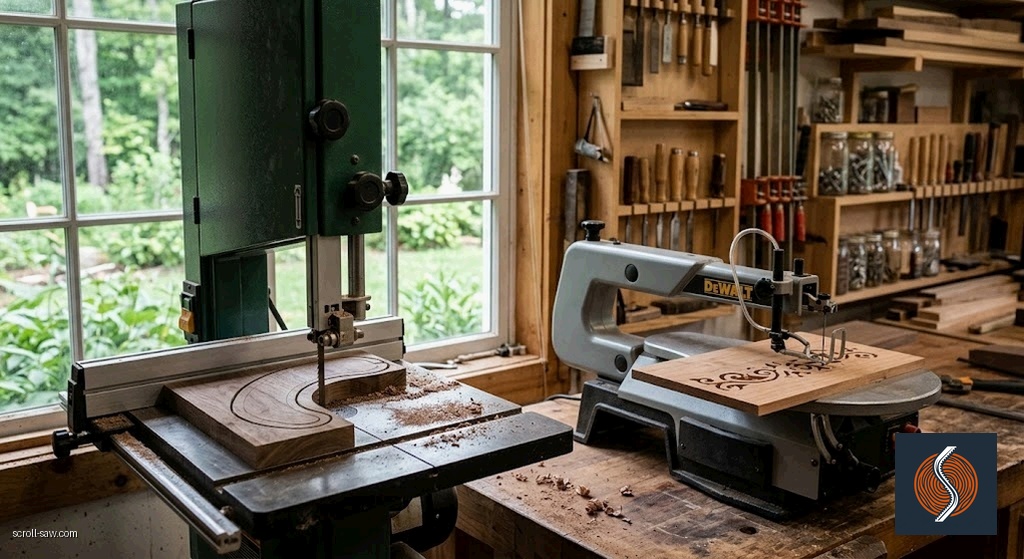
Bandsaw vs Scroll Saw: Accuracy, Capacity, and Control Compared
Stand next to a bandsaw and a scroll saw in the same shop and you might think they are competitors. They are not. They live in the same category the way a chisel and a router live in the same category, which is to say almost none. This piece looks at the three axes that actually matter when you have to choose between them: accuracy on the line, capacity in the stock, and control at the blade.
A bandsaw runs a continuous loop blade past two or three wheels, top to bottom, and cuts through thick stock at speed. A scroll saw reciprocates a short thin blade up and down between two arms and cuts fine curves in thinner material. Same shelf at the store; different jobs on the bench.
The short answer
A scroll saw is more accurate for tight curves and interior cutouts in stock under 2 inches thick. A bandsaw has vastly more capacity for thick stock, resawing, and long freehand curves, and offers more feed-force control for heavy work. If your bench work is decorative and detail-focused, buy the scroll saw. If it is structural or lumber-focused, buy the bandsaw. Overlap between them is narrower than most articles pretend.
Accuracy: what “on the line” means for each tool
Accuracy on a scroll saw means tracking a pencil line to within a fraction of its width for hundreds of inches of curved cut. Blade widths of 0.02 to 0.04 inch let the blade turn radii smaller than a pencil dot. With a good blade and steady feed, a scroll saw follows the line the way a fine-tipped pen follows a ruler.
Accuracy on a bandsaw means holding a straight line or a sweeping curve across a much bigger workpiece. A 1/4-inch bandsaw blade in a properly adjusted saw tracks straight for many feet. What it will not do is turn tight; the same blade will bind on any radius under about 5/8 inch. So both saws are “accurate” but on different tasks.
The key point: accuracy is not a single number. A scroll saw is dramatically more accurate on fretwork; a bandsaw is dramatically more accurate on resawing a 6-inch board into two 3-inch-thick slabs. Pick by task.
Capacity: this is where the bandsaw wins big
A hobby scroll saw’s cut depth is typically 2 inches. Its throat depth (how far a workpiece can extend past the blade) is 16 to 22 inches. Everything about a scroll saw is scaled to thin stock and pattern-book sizes.
A 14-inch bandsaw’s stock resaw capacity is around 6 inches, and with a riser block that extends to about 12 inches. Larger cabinet bandsaws reach 12 to 16 inches natively. Cut depth on a bandsaw is limited only by the space between the table and the upper blade guide, which is often 6 to 12 inches.
If any project you plan involves stock thicker than 2 inches, resawing veneers, or reducing rough lumber, the scroll saw is out of the conversation entirely.
Control: feed force, radius, and stability
Control on a scroll saw is delicate. The workpiece moves under a fixed blade, and you steer with your fingers on the wood, sometimes just a few millimeters from the blade. Feed pressure is measured in grams; too much and the blade deflects, the line drifts, or the blade breaks. That fine control is exactly what fretwork needs.
Control on a bandsaw is muscular. The blade is fixed vertically and the workpiece feeds toward it, usually along a fence or with two hands on the piece. Feed pressure is measured in pounds; the blade is stiff enough to take real force without deflecting. That control is exactly what ripping a 3-inch cherry blank in half needs.
Both tools reward practice. Neither is transferable; a good scroll-saw operator does not automatically make a good bandsaw operator, and vice versa.
Interior cuts, the deciding factor for many users
A scroll saw can be threaded through a drilled starter hole to cut an interior shape without breaking the blade. This single capability is what makes fretwork clocks, name signs, and puzzles possible.
A bandsaw cannot do this. The blade is a continuous welded loop; interior cuts require welding equipment, and no hobbyist welds their own bandsaw blades between cuts. If interior work is part of what you make, the bandsaw is not an alternative to the scroll saw, only a supplement.
Edge finish
A scroll saw leaves a finish that is close to sandable. A #5 skip-tooth blade at 1,300 SPM in cherry gives you an edge you can go straight to 220 grit with. A bandsaw leaves a rougher, more scalloped edge that most makers clean up with a spokeshave, drum sander, or router. Both are fine for their intended jobs, but if the edge is going to be visible without further work, the scroll saw is the shortcut.
Noise, dust, and space
A hobby scroll saw is quiet enough to run late in a shared house. A bandsaw is louder, kicks more chip, and asks for real dust collection above a shop vac. A scroll saw fits under a shelf; a 14-inch bandsaw fits where a bar fridge fits. Practical constraints often decide this before spec sheets do.
Cost
Mid-tier scroll saws and mid-tier hobby bandsaws sit in a similar bracket. The premium tier for each rises steeply. Consumables (blades) are cheap for both, though scroll blades break more often and are treated as disposable, while bandsaw blades are longer-lived and more expensive per blade.
Comparison table
| Factor | Bandsaw | Scroll Saw |
|---|---|---|
| Interior cuts | No | Yes |
| Tight radius (<1/2”) | No | Yes |
| Resaw thick stock | Yes (6-12”+) | No |
| Straight rips | Yes | No |
| Edge finish | Rougher | Very clean |
| Feed pressure | Pounds | Grams |
| Workpiece size | Large | Small (throat-limited) |
| Noise/dust | Moderate to heavy | Light |
| Best for | Furniture, lumber | Puzzles, fretwork, ornaments |
Who should pick each one
Pick a bandsaw first if you build. Furniture parts, cutting boards, curved chair legs, jewelry-box sides, and any work that starts with rough lumber lives on a bandsaw. If your projects tend to start at a lumber yard rather than a pattern book, the bandsaw is your first cut tool.
Pick a scroll saw first if you draw and cut. Puzzles, fretwork, ornaments, intarsia, signs, and any work with interior detail lives on a scroll saw. If your projects tend to start with a printed pattern rather than a board, the scroll saw is your first cut tool.
Verdict
Bandsaw and scroll saw sound like alternatives; in a real shop they are teammates. The bandsaw handles thickness and length; the scroll saw handles detail and interior cuts. Choose by the kind of project you finish, not by which sounds more versatile. If forced to pick one for a hobby shop, and interior pierced work is anywhere in your projects, pick the scroll saw and know you are giving up thickness. If your work is all structural, pick the bandsaw and know you cannot do fretwork with it. Most serious hobbyists end up owning both because the overlap is thin and the trade-offs are large.
FAQ
Is a bandsaw more accurate than a scroll saw? On straight cuts and long sweeping curves, yes. On tight radii and interior fretwork, no. Accuracy is task-specific between these two tools.
Can a bandsaw make interior cuts? Not without welding the blade after threading it through a starter hole, which is not a workflow available to hobby users. Interior cuts belong to the scroll saw.
How thick can a scroll saw cut? Most benchtop scroll saws cap at 2 inches of cut depth. A few premium models push slightly higher, but 2 inches is the practical ceiling.
Do I need both a bandsaw and a scroll saw? Only if your projects span both structural and decorative work. Many hobbyists own both, but each solves separate problems.
Which is safer, a bandsaw or a scroll saw? A scroll saw is safer for most users. The blade is thin and stops fast; a bandsaw’s blade moves at feet per second and has more momentum. Both are safe with correct setup.
Which is louder? A bandsaw is louder, especially cabinet models at full speed. Scroll saws run at a moderate whir even under load.
References
-
Rikon 10-3061 14-inch Bandsaw Owner’s Manual, resaw capacity
-
DeWalt DW788 Instruction Manual, cut and throat specs
-
Fine Woodworking, tool comparison coverage
-
Wood Magazine, bandsaw and scroll saw archives
Title: Bandsaw vs Scroll Saw: Accuracy, Capacity, and Control Meta description: How a bandsaw and a scroll saw compare on accuracy, thickness capacity, feed control, and interior cuts, so you buy the tool your work needs. Slug: bandsaw-vs-scroll-saw Excerpt: A bandsaw and a scroll saw sound like alternatives but rarely are. Here is how they compare on accuracy, capacity, and control, and which one belongs in your shop for the work you actually do.


