
A Practical Comparison of Band vs Scroll Saw
A Practical Comparison of Band vs Scroll Saw
Every hobbyist who has ever bought a second saw has done this math: the band and the scroll are the two obvious next steps after a jigsaw or a coping saw, and only one is going in the corner this year. The specs read differently. The prices sit in a similar bracket. The reviews confuse the picture with either-or language that pretends they are alternatives.
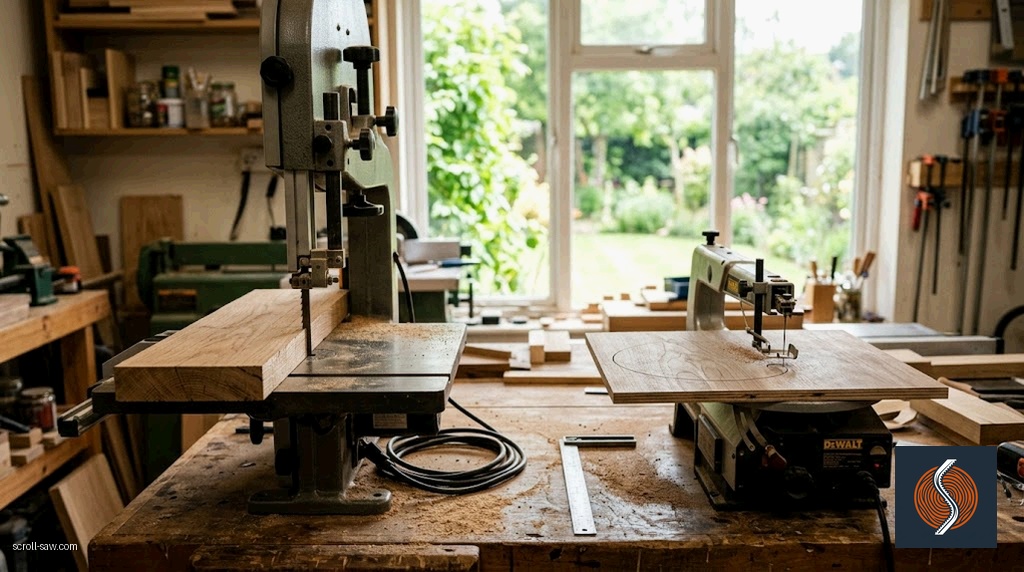
A band saw runs a continuous loop blade around wheels and specializes in thick stock and long curves. A scroll saw reciprocates a short fine blade and specializes in detail and interior cuts in thinner stock. Compared on the axes that matter (project type, thickness, radius, and edge quality), one is not better than the other. One fits your work; the other does not.
The short answer
Buy a band saw if you build furniture, resaw lumber, cut curves in thick stock, or work from rough boards toward finished parts. Buy a scroll saw if you make ornaments, puzzles, fretwork, signs, or anything with interior cutouts in stock under 2 inches. If your work is entirely one or the other, the choice is trivial. If it is genuinely split, own both eventually and buy the more-used tool first.
Project type: the honest first question
Before any spec conversation, ask what you have actually finished in the last twelve months, or what you would finish if you had the right tool. Two shortlists.
Band saw work: chair legs, curved table aprons, cutting boards from rough stock, box lids from resawn stock, bowl blanks split in half, cabriole legs roughed out, small timber breakdown, sculpture blanks, curved bookcase sides.
Scroll saw work: puzzles, ornaments, name signs, intarsia, marquetry, fretwork clocks, silhouette portraits, model parts, small toys, laser-cut alternatives, Christmas decorations, and any pattern with pierced interior detail.
Most people, when they list honestly, land firmly on one side. Split lists are rarer than the internet suggests. Once you see which list is yours, the saw choice is nearly automatic.
Thickness capacity
Band saws win this comparison by a wide margin.
-
Scroll saws: about 2 inches maximum cut depth on most benchtop models.
-
14-inch band saws: 6 inches natively, 12 inches with a riser block.
-
Cabinet band saws (17 to 20 inches): 12 to 16 inches or more.
If any of your work involves resawing (splitting a board face-to-face into thinner slabs) or cutting stock thicker than 2 inches, the scroll saw is out. It does not get halfway there; it does not get any of the way there.
Radius and interior cuts
Scroll saws win this comparison by a wider margin.
-
Scroll saws: radii under 1/16 inch with a spiral blade; interior cuts through starter holes.
-
Band saws: radii down to about 1/4 inch with the narrowest hobby blade; no interior cuts (the blade is a welded loop).
Fretwork, puzzles, and any pattern with pierced holes require a scroll saw. A band saw will not substitute at any capability level.
Edge finish and precision
A scroll saw’s fine blade at 0.02 to 0.04 inch wide leaves an edge close to sandable. A band saw’s wider blade leaves a rougher edge that most makers clean up with a spokeshave, drum sander, or router.
For visible finished edges, especially on decorative work, the scroll saw’s cleaner cut saves cleanup time. For edges that will be routed or joined later, the band saw’s rougher cut is fine and its throughput wins.
Setup and learning curve
A scroll saw is a shallow curve. Three variables (speed, feed, blade choice) and a mediocre setup still produces usable parts.
A band saw is deeper. Blade tension, tracking, guide clearance, blade drift, and body position all matter. A poorly set-up band saw burns wood, cuts off-angle, drifts on straight cuts, and destroys blades quickly. A well set up one is a joy. The gap between the two is bigger than beginners expect.
If shop time is limited and you want to make things, the scroll saw is the shorter path to a finished project. If shop time is abundant and you enjoy tuning tools, the band saw pays back the investment.
Cost, footprint, dust, noise
A benchtop scroll saw sits on a small bench, pulls minimal power, and produces light dust manageable with a shop vac. A hobby band saw needs floor space (roughly 3 feet by 2 feet), a 15-amp circuit, and a real dust collector at the port to keep fine chip out of the shop air.
The scroll saw is quieter and cleaner. The band saw is louder and dirtier. For a shared garage or a small apartment shop, that footprint difference often decides the buy before spec sheets come out.
Comparison table
| Factor | Band Saw | Scroll Saw |
|---|---|---|
| Max cut depth | 6” to 16”+ | ~2” |
| Tightest radius | ~1/4” | Under 1/16” |
| Interior cuts | No | Yes |
| Edge finish | Rougher | Very clean |
| Setup complexity | Moderate | Low |
| Footprint | Floor-standing | Benchtop |
| Dust/noise | Moderate to heavy | Light |
| Best for | Furniture, lumber, thick curves | Puzzles, fretwork, ornaments |
Who should buy each one
Buy a band saw first if your projects tend to start at a lumber yard. If you break down rough stock, build furniture, resaw for veneer, or cut curved parts for boxes and small case work, the band saw is your primary shop cut tool.
Buy a scroll saw first if your projects tend to start with a printed pattern. If you cut ornaments, puzzles, fretwork clocks, name signs, silhouette portraits, or any decorative interior work, the scroll saw is your primary shop cut tool.
Buy both if your list truly spans both categories. Order them by which one you would use most weeks; that becomes the first purchase.
Verdict
A band saw and a scroll saw are not competitors; they are complements. The band saw handles thickness and long curves. The scroll saw handles detail and interior work. A shop that has both can do almost anything under the ceiling of hobby capacity. A shop with one and the wrong one for its projects gets frustrated fast. Do not buy on spec sheet ambition. Buy on the pattern of projects you finish. The more-used tool pays back its bench space in weeks; the less-used one gathers dust regardless of its rating.
FAQ
Is a band saw or scroll saw better for beginners? A scroll saw. Shorter learning curve, cheaper mistakes, and forgiving of setup errors. A band saw rewards discipline and punishes inattention.
Can a band saw make fine detail cuts? Only to about a 1/4-inch radius with the narrowest hobby blade. Anything tighter than that is scroll saw territory.
Can I resaw on a scroll saw? No. Scroll saws are designed for cross-grain and pattern cuts in stock under 2 inches thick. Resawing is band saw work.
Do I need both saws? Only if your projects span both categories. Many hobby shops eventually own both, but each solves distinct problems and neither substitutes for the other.
Which is safer to run? A scroll saw. The blade is thin, low-momentum, and stops fast. A band saw is safe when set up correctly but its blade carries more momentum and demands more attention.
Which lasts longer? Both outlast a hobby lifetime with basic maintenance. Scroll saw blades break more often and are treated as consumables; band saw blades last longer per blade but cost more each.
References
-
Rikon 10-3061 Bandsaw Owner’s Manual, resaw and cut specs
-
DeWalt DW788 Instruction Manual, cut depth and throat specs
-
Fine Woodworking, tool comparison archives
-
Wood Magazine, band and scroll saw reviews
Title: Band vs Scroll Saw: Which One Belongs in Your Shop Meta description: A side-by-side of band saw and scroll saw for capacity, radius, interior cuts, and setup, so you buy the tool your projects actually need. Slug: band-vs-scroll-saw Excerpt: A band saw and a scroll saw are not alternatives; they are complements. Here is how they compare on capacity, radius, edge quality, and setup, and which one earns bench space for the work you already do.


