
A Practical Selection Guide to Scroll Saw Blades for Beginners
A Practical Selection Guide to Scroll Saw Blades for Beginners
The first pack of scroll saw blades most beginners buy is the one that came with the saw. That is fine for the first afternoon and rarely fine for the second. Manufacturer starter packs are usually a handful of undersized blades in a single geometry, and once they dull or snap, the beginner spends a week Googling universal blade numbers, TPI charts, and spiral versus skip-tooth. This guide shortens that week.
A beginner’s first six months on a scroll saw covers 1/4 to 3/4-inch stock in soft wood, plywood, and maybe a first pattern-book fretwork piece. Three blade choices cover 90% of that work, and knowing which one to reach for is the entire game.
The short answer
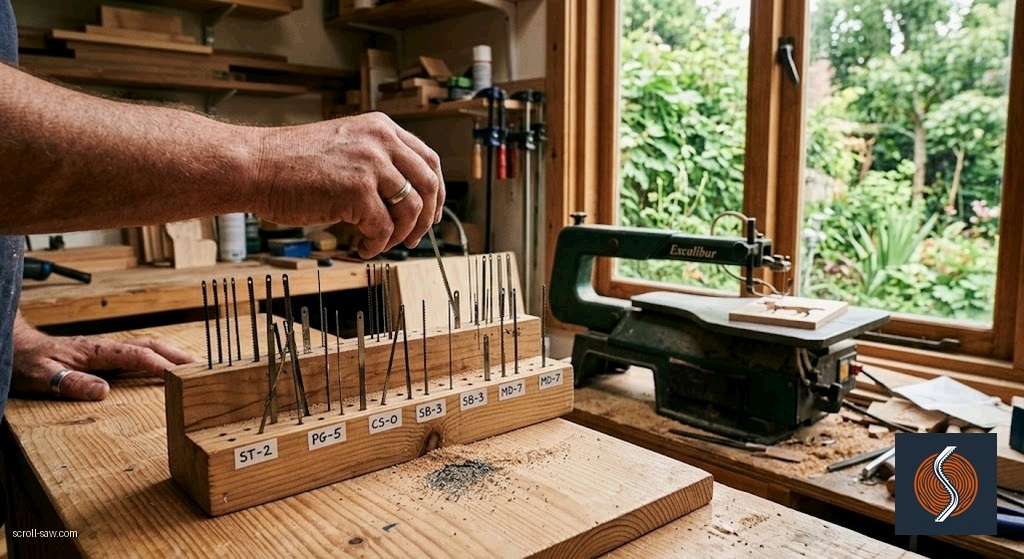
Stock three blades: a #3 skip-tooth for 1/4-inch plywood and thin softwood, a #5 skip-tooth for 1/4 to 3/4-inch general work, and a #5 reverse-tooth for anything with two visible faces. Buy them in pinless (plain-end, 5-inch) format from a real brand like Olson, Flying Dutchman, or Pegas. Skip the pin-end starter pack unless your saw only accepts pin-end blades. Everything else in the blade catalog is a specialty pick you can add later.
Blade number: what those numbers actually mean
Universal blade numbers run from #2/0 (thinnest, finest) to #12 (thickest, coarsest). Higher numbers mean bigger teeth, wider blades, and faster feed at the cost of tighter radius capability.
For beginners:
-
#3: thin plywood, 1/4-inch softwood, delicate detail work.
-
#5: the all-purpose blade for 1/4 to 3/4-inch stock.
-
#7: heavier work in 3/4-inch hardwood or thicker softwood.
Start with #5, add #3 for detail, add #7 later if you outgrow #5 in hardwood.
Tooth geometry: skip-tooth first
-
Skip-tooth: Every other tooth is a gullet. Fast chip clearance, forgiving of feed pressure. The correct default for beginners.
-
Reverse-tooth: The last few teeth face upward, cleaning the exit face on the underside. Great for pieces where both faces are visible.
-
Double-reverse: Alternating up/down teeth. Very clean on both faces. Overkill for a first project but a nice upgrade.
-
Spiral: Teeth wrap 360 degrees so the blade cuts in any direction. Useful once you are comfortable, hazardous for beginners because they cut sideways easily.
-
Crown-tooth and modified-geometry: Specialty blades for specific finishes. Ignore until you can name why you need one.
Start with skip-tooth. Add reverse-tooth as your second blade when you cut your first two-sided piece.
Pin-end vs plain-end blades
-
Plain-end (pinless): Held in the saw’s blade clamps directly. Full aftermarket selection (Olson, Flying Dutchman, Pegas). Standard on most quality saws.
-
Pin-end: Has a small crosspin at each end that seats in a slot. Much smaller selection of sizes and geometries. Common on entry saws.
If your saw accepts both, choose plain-end blades. If your saw is pin-end only, you are working with a narrower blade catalog, and you may want to plan a saw upgrade eventually if you get serious.
TPI, kerf, and radius (a very short primer)
-
TPI (teeth per inch): Higher TPI means finer cuts and slower feed. Most beginner blades sit at 11 to 15 TPI.
-
Kerf: The width of the cut. A #5 skip-tooth cuts about 0.038 inch wide. Kerf matters when you plan tight tolerances.
-
Minimum cutting radius: How tight the blade can turn without binding. #5 turns about 3/16 inch; #3 turns about 1/8 inch; spirals turn on a pinhead.
Match blade to the tightest radius in your pattern. A blade that will not turn your pattern’s inside corner is the wrong blade even if it cuts everything else perfectly.
Where to buy
Olson blades are widely stocked at big-box stores and are the honest baseline. Flying Dutchman blades (from Mike’s Workshop) are the aftermarket favorite among serious scroll saw makers. Pegas blades are a Swiss brand available online with excellent quality. Any of the three outperforms generic blades by a wide margin.
Buy in dozens, not by single blade. A dozen #5 skip-tooth Olson blades is enough for many weekend projects and costs less than the shop time you would spend chasing a discount.
Common beginner blade mistakes
-
Installing the blade upside down. Teeth should point down toward the table (except reverse-tooth designs, whose upper teeth still cut down while the last few face up). If the blade seems to fight the wood, check orientation first.
-
Over-tensioning to prevent breakage. Too much tension breaks blades faster, not slower. Ping the blade with a fingertip; a clear, high note means correct tension.
-
Wrong blade for the material. A #3 in 3/4-inch hardwood will not clear chips fast enough and will snap within a foot. A #7 in 1/4-inch plywood is overkill and will tearout.
-
Feeding too hard. The blade cuts on its own if you let it. Feed pressure is measured in grams, not pounds.
-
Ignoring dull blades. A blade that cuts slower than it did an hour ago is dull. Replace, do not push harder.
Verdict
Three blades and one brand cover your first six months. A #5 skip-tooth, a #3 skip-tooth, and a #5 reverse-tooth in Olson, Flying Dutchman, or Pegas plain-end format. Add sizes and geometries as specific projects require them, not because a specialty catalog promises variety. The single largest quality jump a beginner makes is switching from the starter-pack blades to a real brand’s plain-end blades. Everything after that is refinement.
FAQ
What is the best scroll saw blade for a beginner? A #5 skip-tooth in plain-end format from Olson, Flying Dutchman, or Pegas. It covers 1/4 to 3/4-inch stock in almost every wood a beginner will touch.
Are pin-end blades worse than plain-end blades? Not inherently, but the plain-end selection is much larger. If your saw accepts both, use plain-end.
How do I know when to replace a scroll saw blade? Cut speed drops, or the edge starts to burn at correct SPM, or you hear the tooth pitch change. Any of the three means the blade is done.
How much tension should I put on a blade? Ping the blade with a fingertip. A clear, high, musical note means correct tension. Dull, low notes mean under-tensioned; a very high, screaming note means over-tensioned.
Can I use spiral blades as a beginner? You can, but spirals cut sideways easily and are less forgiving of feed direction changes. Start with skip-tooth and add spirals for specific interior detail work later.
How many blades will I break in the first month? Expect 5 to 15 blades in the first month if you cut regularly. That number drops quickly once tension and feed pressure become instinctive.
References
-
Olson Scroll Saw Blade Selection Chart
-
Flying Dutchman Blade Application Guide
-
Pegas Blade Reference
-
Fine Woodworking, beginner scroll saw coverage
Title: Scroll Saw Blades for Beginners: Three-Blade Starter Meta description: A minimal three-blade starter for scroll saw beginners, with sizes, tooth geometry, and brand recommendations. Slug: scroll-saw-blades-for-beginners Excerpt: Three blades and one brand cover a beginner’s first six months on a scroll saw. Here is which blades to buy, in what format, and why the starter pack is not enough.


