
Blade Runner vs Scroll Saw: Which Tool or Setup Fits the Work?
Blade Runner vs Scroll Saw: Which Tool or Setup Fits the Work?
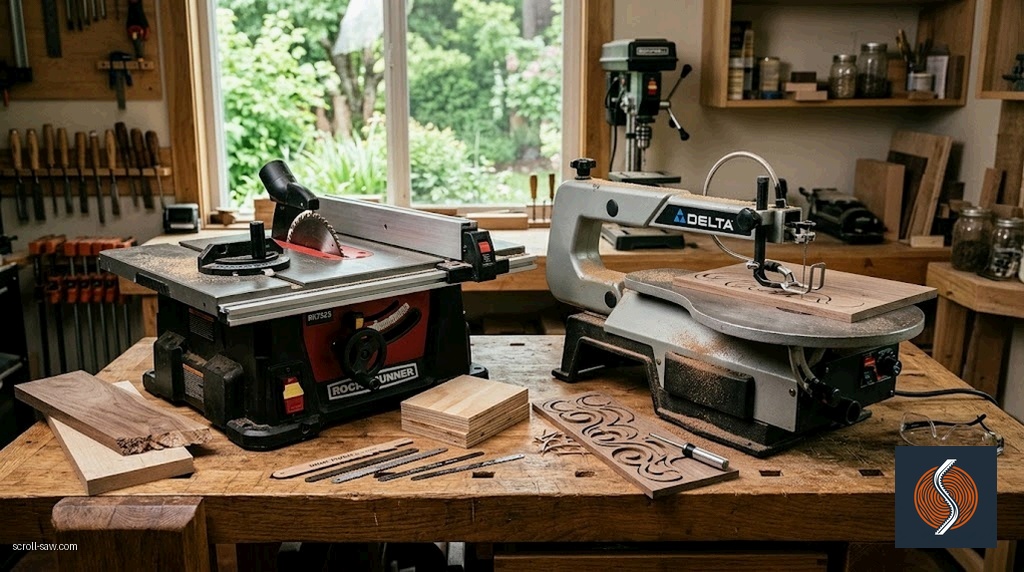
The Rockwell Blade Runner sits in an awkward category. It is not quite a scroll saw, not quite a jigsaw, not quite a table saw, and marketed as if it could replace all three. Anyone considering a Blade Runner as an alternative to a scroll saw needs a clear read on where each one actually shines, because “does what a scroll saw does” and “does what a scroll saw does well” are not the same claim.
A Rockwell Blade Runner (X2 and earlier generations) is a small benchtop jigsaw-style tool with the blade cutting vertically through a table. A scroll saw is a purpose-built precision curve-cutting tool with a fine reciprocating blade held between two arms. They share form factor and price bracket. They do not share strengths.
The short answer
Pick a scroll saw for fine detail, interior cutouts, fretwork, puzzles, and any pattern with radii under 1/2 inch. Pick a Blade Runner for occasional straight rips in thin stock, quick craft cuts, and small workshop portability where a full scroll saw does not earn bench space. If your work is decorative and pattern-driven, the Blade Runner is not a substitute. If your work is casual and mixed, the Blade Runner earns its place for versatility, not precision.
What each tool physically is
The Blade Runner uses standard T-shank jigsaw blades held vertically in a table-mounted mechanism. Blade selection is what you would find at any hardware store for jigsaws: wood-cutting, metal-cutting, ceramic, plastic. The tool reciprocates at a fixed range, and the operator feeds the workpiece across a stationary blade.
A scroll saw uses much finer blades (5-inch plain-end scroll blades from Olson, Flying Dutchman, or Pegas) held between two arms with adjustable tension. The blade is thin enough to turn on a pencil line and clean enough to leave sandable edges.
Radius and edge quality
This is the biggest gap between the two.
-
Blade Runner: T-shank jigsaw blades are 1/4 to 3/8 inch wide, minimum radius about 3/8 inch. Edge quality is jigsaw-quality, meaning rougher than a scroll saw and often with some tearout.
-
Scroll saw: blades 0.02 to 0.04 inch wide, minimum radius under 1/16 inch. Edge quality close to sandable.
For puzzles, fretwork, ornaments, or any pattern with tight interior detail, a Blade Runner physically cannot make the cuts. That is not a matter of skill or setup; the blades themselves will not fit the pattern lines.
Interior cuts
Both tools can start from a drilled hole. On a Blade Runner, drill an oversized starter hole and drop the running blade into it. On a scroll saw, drill a small hole, release the top clamp, thread the blade through, and reclamp.
The scroll saw’s process takes longer per hole but produces much cleaner interior cuts because the blade tracks a fine line. The Blade Runner’s process is faster per hole but the interior cutout is rougher and cannot handle small radii.
Thickness and material
-
Blade Runner: cuts wood up to about 3/4 inch, thin metal up to about 3/8 inch (steel, aluminum), plastic, and ceramic (with the right blade). Blade selection is versatile.
-
Scroll saw: cuts wood up to 2 inches, thin non-ferrous metal up to 1/16 inch, plastic. Blade selection is deep for detail but narrow for material variety.
If you need to cut a ceramic tile or a piece of steel sheet, the Blade Runner is the honest pick. If you need to cut a fretwork clock face, the scroll saw is the only pick.
Precision and vibration
A scroll saw at cruise speed sits still on a bench. A Blade Runner tends to vibrate more, especially at higher SPM, because a jigsaw blade held vertically deflects more than a scroll blade held between two arms. Precision suffers.
For freehand curve work in 1/2 to 3/4-inch stock, the Blade Runner produces a wobbly line unless the operator is very steady. A scroll saw produces a clean line even for beginners.
Blades and consumables
-
Blade Runner: standard T-shank jigsaw blades. Widely available at any hardware store. Blade cost is modest; blade life is long.
-
Scroll saw: 5-inch plain-end scroll blades. Available from specialty sources (Olson, Flying Dutchman, Pegas). Blade cost is very low per blade; blade life is short (scroll blades are disposable).
Both are cheap to feed. The scroll saw wins on cost per cut but requires you to keep a supply on hand.
Comparison table
| Factor | Blade Runner | Scroll Saw |
|---|---|---|
| Tightest radius | ~3/8 inch | Under 1/16 inch |
| Edge quality | Rougher (jigsaw-like) | Very clean |
| Interior cuts | Yes (rough) | Yes (clean) |
| Max wood thickness | ~3/4 inch | ~2 inches |
| Metal, ceramic | Yes with correct blades | Thin non-ferrous only |
| Vibration | Moderate | Low (parallel-arm saws) |
| Blade cost | Moderate per blade | Very low per blade |
| Best for | Occasional versatile cuts | Fine detail and pattern work |
Who should pick each one
Pick a Blade Runner if your cuts are occasional and varied. Straight rips in thin plywood, cuts in tile for a bathroom project, a piece of aluminum flashing, plus some casual craft work. The Blade Runner earns its bench space by covering a wide material range in a small footprint.
Pick a scroll saw if your work is pattern-driven. Puzzles, ornaments, fretwork, name signs, model parts, and any interior detail work. The scroll saw does one job (fine curve cutting) at a level the Blade Runner cannot approach.
Verdict
A Blade Runner is not a small scroll saw. It is a small vertical jigsaw with a table. That is a useful tool in its own right, and for casual mixed-material work in a small shop it earns its price. It is not a substitute for a scroll saw on decorative work. If you have both tools on the shopping list and can only afford one, pick by what you actually cut: pattern work goes to the scroll saw, material variety goes to the Blade Runner. Buying either one hoping it will fill the other’s niche is the fast route to a tool that sits in the corner.
FAQ
Can a Blade Runner replace a scroll saw? For rough craft cuts in thin stock, close enough. For fretwork, puzzles, or any pattern with tight radii, no. The blades themselves will not fit the pattern lines.
Can a Blade Runner cut fretwork? Only wide, open fretwork. Tight interior detail requires scroll saw blades that the Blade Runner does not accept.
Which is better for beginners? Depends on the work. For pattern craft, a scroll saw is easier to learn. For general small-shop cuts, a Blade Runner covers more materials with less skill.
Which is cheaper to feed with blades? A scroll saw, per cut. Scroll blades are cheap and short-lived; jigsaw blades on a Blade Runner are longer-lived but more expensive per blade.
Are Blade Runner blades interchangeable with scroll saw blades? No. Blade Runners take T-shank jigsaw blades; scroll saws take plain-end or pin-end scroll blades. Different geometry, different lengths, different holders.
Which vibrates more? A Blade Runner tends to vibrate more, especially at higher SPM. Scroll saws with parallel-arm designs run notably smoother.
References
-
Rockwell Blade Runner X2 Owner’s Manual, published specs
-
DeWalt DW788 Instruction Manual, published specs
-
Fine Woodworking, tool comparison coverage
-
Popular Mechanics, benchtop tool reviews
Title: Blade Runner vs Scroll Saw: Which Tool Fits Your Work Meta description: How a Rockwell Blade Runner and a scroll saw compare on radius, edge quality, and material versatility, so you buy the tool your work needs. Slug: blade-runner-vs-scroll-saw Excerpt: A Blade Runner is not a small scroll saw. Here is how each tool fits pattern work and material variety, and which one earns bench space for your projects.


