
Choosing Between Scroll Saw Blade Pin vs Plain
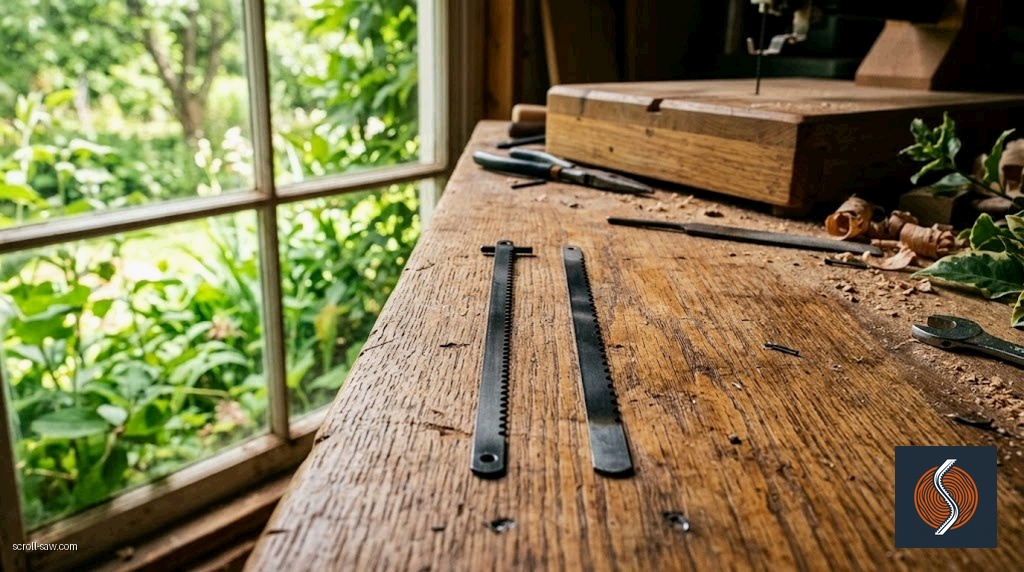
Choosing Between Scroll Saw Blade Pin vs Plain
Open the blade drawer of any long-time scroll saw owner and you will see plain-end blades. Open the box of any beginner saw and you will see pin-end blades. That is not a coincidence, and it is not just tradition. The choice between pin-end and plain-end shapes what kind of work you can do, what patterns you can cut, and how frustrated you get changing blades on interior cuts.
A pin-end scroll saw blade has a small crosspin at each end that seats in a slot on the saw. A plain-end (pinless) blade has flat ends held between two thumbscrew or setscrew clamps. Same overall length (5 inches), different holding system, wildly different consequences for the work you can do.
The short answer
Use plain-end blades if your saw accepts them. The aftermarket selection is much larger, blades are cheaper per unit, and interior piercing (thread the blade through a drilled hole, reclamp, cut) is faster and more reliable. Use pin-end blades only if your saw is pin-end-only, and understand that you are working with a narrower blade catalog and slower interior cuts.
What the pin actually is
A pin-end blade has a small crosspin (about 3/32 inch long) at each end, seated into a slot in the top and bottom of the saw’s blade holders. The pin locates the blade quickly; you just slot it in, no clamping required.
A plain-end blade has flat, plain ends. The saw’s blade clamps grip the flat end with thumbscrews or a hex-key setscrew. Slightly slower to install, but the clamp holds any diameter within the clamp’s range.
Blade selection: pin-end is a narrow world
Most blade manufacturers focus their product lines on plain-end blades because the plain-end market is much bigger. Olson, Flying Dutchman (from Mike’s Workshop), and Pegas all offer deep catalogs of plain-end blades in every size (#2/0 through #12), every tooth geometry (skip-tooth, reverse-tooth, spiral, double-reverse, crown-tooth), and every material (wood, metal, plastic).
Pin-end blade catalogs are much thinner. You will find the common sizes (#5, #7, sometimes #3), skip-tooth geometry, and maybe reverse-tooth. Spiral blades, very fine sizes (#2/0), and specialty geometries are rarely available in pin-end format. For serious scroll saw work, that limitation matters.
Interior piercing: plain-end wins by a mile
Interior cutouts (fretwork, puzzles, name-sign windows) require the blade to be threaded through a drilled starter hole and clamped back into the saw. Two workflows.
-
Plain-end: loosen the top clamp thumbscrew, thread the flat end through the starter hole, retighten. About 15 seconds per interior cut.
-
Pin-end: slide the blade out of both slots, thread it through the starter hole, reseat both pins into their slots. About 30 to 60 seconds per interior cut, more if the pins do not want to reseat.
Over a hundred interior cuts on a fretwork clock face, that difference is measured in hours. Serious pattern work is why plain-end blades won the aftermarket.
Blade change on regular cuts
For a straight-through cut (start at the edge, exit at the edge), pin-end blades win the change-out speed contest. Drop the pins into the slots and you are cutting. Plain-end blades take a few seconds longer to align and clamp.
But regular cuts are only half of most scroll work. Interior cuts are the other half, and the pin-end’s advantage on regular cuts is dwarfed by the plain-end’s advantage on interior cuts.
Cost
Plain-end blades are typically cheaper per blade (bulk packs from Olson or Flying Dutchman run pennies per blade). Pin-end blades cost more per blade because the pin is an extra manufacturing step and the market is smaller.
Over a year of use, the cost difference adds up in favor of plain-end blades.
Which saws accept which
-
Plain-end only: Excalibur, Pegas, most DeWalt DW788 units, Delta 40-694, Hegner. Most current mid-tier and premium saws are plain-end only.
-
Pin-end and plain-end (with adapter): WEN 3921, Skil 3335, Genesis GSS160, most current entry-tier saws. The adapter lets you use plain-end blades with a small clamp accessory.
-
Pin-end only: older Delta and Craftsman entry saws, some current very-low-tier saws. Increasingly rare.
If your saw is listed as pin-end only, check the manual to confirm. Some saws that ship with pin-end blades quietly accept plain-end with a simple accessory.
Universal blade number, both formats
Universal blade numbers (#2/0 to #12) apply to both formats. A #5 skip-tooth pin-end blade and a #5 skip-tooth plain-end blade will cut roughly the same kerf and turn roughly the same radius. The blade itself is the same underneath the mounting difference.
Verdict
Plain-end blades are the modern standard, and the aftermarket selection is where serious scroll saw work happens. If your saw accepts plain-end, use them. If your saw is pin-end only and you are getting serious about scroll work, plan a saw upgrade eventually. Not because pin-end blades are bad (they are not), but because the blade catalog available in pin-end will limit what patterns you can cut. For a beginner cutting simple craft patterns, pin-end is honest. For fretwork, marquetry, and interior-detail work, plain-end is the format the professional catalog was built around.
FAQ
Are plain-end blades better than pin-end? Better is the wrong word. Plain-end blades have a much wider aftermarket selection and are faster on interior cuts. Pin-end blades change out faster on straight-through cuts. For most serious work, plain-end wins.
Can I use plain-end blades in a pin-end saw? Sometimes, with an aftermarket adapter clamp. Check your saw’s manual or the manufacturer’s parts catalog.
Can I use pin-end blades in a plain-end saw? Generally no. The plain-end clamps do not grip the pin ends properly, and the blade will slip.
Are pin-end blades cheaper? No, they are usually more expensive per blade because the pin adds a manufacturing step and the market is smaller.
Do professionals use pin-end blades? Rarely, unless their saw only accepts pin-end. Most professional scroll saw work runs on plain-end blades from Olson, Flying Dutchman, or Pegas.
Is my old saw with pin-end blades still worth using? Yes, for casual craft work. If you get into fretwork or marquetry, plan a saw upgrade that accepts plain-end blades.
References
-
Olson Scroll Saw Blade Selection Chart
-
Flying Dutchman Blade Application Guide
-
Pegas Blade Reference
-
DeWalt DW788 Instruction Manual, blade compatibility
Title: Scroll Saw Blade Pin vs Plain: Which One to Buy Meta description: How pin-end and plain-end scroll saw blades differ on selection, interior cuts, and change-out speed, and which one fits your saw and work. Slug: scroll-saw-blade-pin-vs-plain Excerpt: Pin-end blades change out faster; plain-end blades open up a much bigger aftermarket catalog and speed up interior cuts. Here is how to pick between them.


