
Scroll Saw vs Table Saw: Accuracy, Capacity, and Control Compared
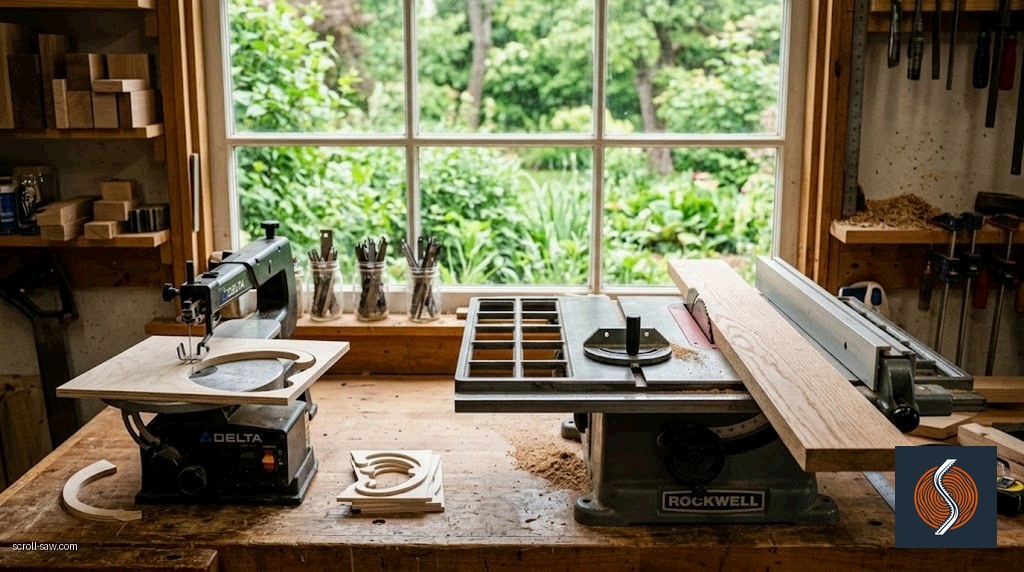
Scroll Saw vs Table Saw: Accuracy, Capacity, and Control Compared
The scroll saw and the table saw both live in a woodworking shop, and beginners occasionally treat them as alternatives. They are not. Comparing them is a little like comparing a scalpel to a chainsaw: both cut wood, and past that, almost nothing about them overlaps. Anyone considering these two tools as either-or is asking the wrong question.
A scroll saw is a benchtop tool with a fine reciprocating blade for curves and detail work in thin stock. A table saw is a stationary tool with a large circular blade for straight rips, crosscuts, and dimensioning lumber. They serve non-overlapping needs, and a real shop usually ends up with both.
The short answer
A scroll saw handles curves, fretwork, puzzles, and interior cuts in stock under 2 inches thick. A table saw handles straight rips, crosscuts, and any dimensioning work in stock up to about 3-1/2 inches thick. If you cut patterns from a book, buy the scroll saw. If you dimension lumber from rough stock, buy the table saw. There is no meaningful overlap, and neither is a substitute for the other.
Cut type: curves vs straight
This is the biggest gap. A scroll saw cuts curves. A blade 0.02 to 0.04 inch wide is designed to turn on a pattern line. It cannot rip a straight line for a foot without wandering, because the blade itself is too narrow to track against a fence.
A table saw cuts straight. A circular blade several inches in diameter, guided by a rip fence or a miter gauge, holds a straight line for many feet. It cannot cut curves at all; the blade is rigid and circular.
If your project is a fretwork clock, no table saw will substitute. If your project is a set of shelf boards ripped to width, no scroll saw will substitute. The two saws do not compete.
Accuracy: task-specific
Accuracy on a scroll saw means holding a pencil line through curves and interior cuts. Blade wander of 1/64 inch is normal and acceptable in most decorative work.
Accuracy on a table saw means holding a straight rip to within a few thousandths across a full board length. Once the fence is set, the blade tracks parallel to it for the full cut.
Both tools are accurate on their tasks. Neither is accurate on the other’s task.
Capacity: table saw wins for thickness and length, scroll saw for tight curves
-
Scroll saw: cut depth ~2 inches, workpiece width limited to throat depth (16 to 22 inches on most benchtop saws), any length that clears the table.
-
Table saw: cut depth up to 3-1/2 inches (10-inch blade), workpiece length unlimited (an outfeed table extends any length), width limited by fence position (typically 24 to 50 inches).
For dimensioning full-size boards, the table saw is the only option. For tight interior detail in a small panel, the scroll saw is the only option.
Safety: both are safe with respect
A scroll saw’s blade is thin, low-momentum, and stops quickly. It is one of the safer power tools in a hobby shop; injuries are typically minor cuts from careless finger placement.
A table saw is one of the more serious tools in a hobby shop. The blade is large, spinning at high RPM, and kickback (the workpiece thrown back at the operator) is a real risk. Safety features (blade guards, riving knives, and on premium saws, blade-arrest technology like SawStop) help but do not remove the need for careful setup and technique.
Do not treat a table saw casually. Do not compare the two on safety without acknowledging that the risk profiles are different by an order of magnitude.
Interior cuts: scroll saw only
Both tools can cut inside a workpiece by starting from a drilled hole (scroll saw) or a plunge cut (table saw). But table saw plunge cuts are unsafe and never recommended; the blade must exit the top of the workpiece for the tool to be used safely. Interior fretwork, puzzles, and pierced patterns are scroll saw territory only.
Space, cost, and workshop context
A benchtop scroll saw needs a sturdy work table and a wall outlet. Total footprint about 2 by 3 feet.
A table saw needs floor space (typically 4 by 6 feet minimum with clearance for infeed and outfeed), often a 240V circuit for cabinet models, and a dust collector for anything more than casual use. Total footprint 15 to 30 square feet.
For apartment or shared-space shops, the scroll saw fits where a chest freezer would fit; the table saw does not.
Comparison table
| Factor | Scroll Saw | Table Saw |
|---|---|---|
| Cut type | Curves, detail | Straight rips, crosscuts |
| Interior cuts | Yes | No (unsafe) |
| Max cut depth | ~2 inches | Up to 3-1/2 inches |
| Max workpiece length | Unlimited (fits on table) | Unlimited (with outfeed) |
| Best for | Puzzles, fretwork, patterns | Dimensioning, ripping, crosscutting |
| Footprint | Benchtop | Floor-standing, large |
| Safety profile | Very safe | Requires respect and care |
| Blade cost | Very low, disposable | Moderate to high, long-lived |
Who should pick each one
Pick a scroll saw if your work is decorative and pattern-driven. Puzzles, ornaments, fretwork clocks, name signs, intarsia. If your idea of a project starts with a printed pattern, this is your tool.
Pick a table saw if your work is structural and dimension-driven. Furniture, cabinets, boxes, shelves, anything that starts with a rough board and needs to be sized. If your idea of a project starts at the lumber yard, this is your tool.
Most serious hobby woodworkers eventually own both, because the two solve completely different problems.
Verdict
Scroll saw and table saw are not competing tools. They live in the same shop the way a screwdriver and a hammer live in the same drawer: fundamentally different, both essential. Buy the one that matches the kind of project you finish. If you draw patterns and cut curves, the scroll saw is your first tool. If you dimension boards and build furniture, the table saw is your first tool. Comparing them on a spec sheet is not useful. Comparing them on your project list is.
FAQ
Can a scroll saw replace a table saw? No. Scroll saws cannot cut straight lines accurately or dimension boards to width. That is table saw work only.
Can a table saw replace a scroll saw? No. Table saws cannot cut curves or interior cutouts. That is scroll saw work only.
Which is safer, a scroll saw or a table saw? A scroll saw is meaningfully safer for most users. Table saws are safe when set up and used correctly but require more care and technique.
Which should I buy first as a beginner? Depends on your projects. Pattern craft work goes with a scroll saw first. Furniture and dimensioning work goes with a table saw first. The two do not overlap.
Do I need both eventually? Most serious hobby woodworkers own both because they solve completely different problems. Neither substitutes for the other.
Which takes more space? A table saw. A scroll saw fits on a benchtop. A cabinet table saw fills a corner of a two-car garage.
References
-
DeWalt DW788 Instruction Manual, published cut specs
-
SawStop Contractor Saw Owner’s Manual, published cut specs
-
Fine Woodworking, table saw and scroll saw coverage archives
-
Wood Magazine, tool selection guides
Title: Scroll Saw vs Table Saw: Non-Overlapping Tools Meta description: A scroll saw and a table saw solve non-overlapping problems. Here is what each does, what neither can do, and which one to buy first. Slug: scroll-saw-vs-table-saw Excerpt: A scroll saw handles curves and pattern work; a table saw handles straight rips and dimensioning. Here is why they never substitute for each other and which one belongs in your shop first.


