
Choosing Wood for Scroll Saw Work: Capacity, Vibration, and Blade-System Checks
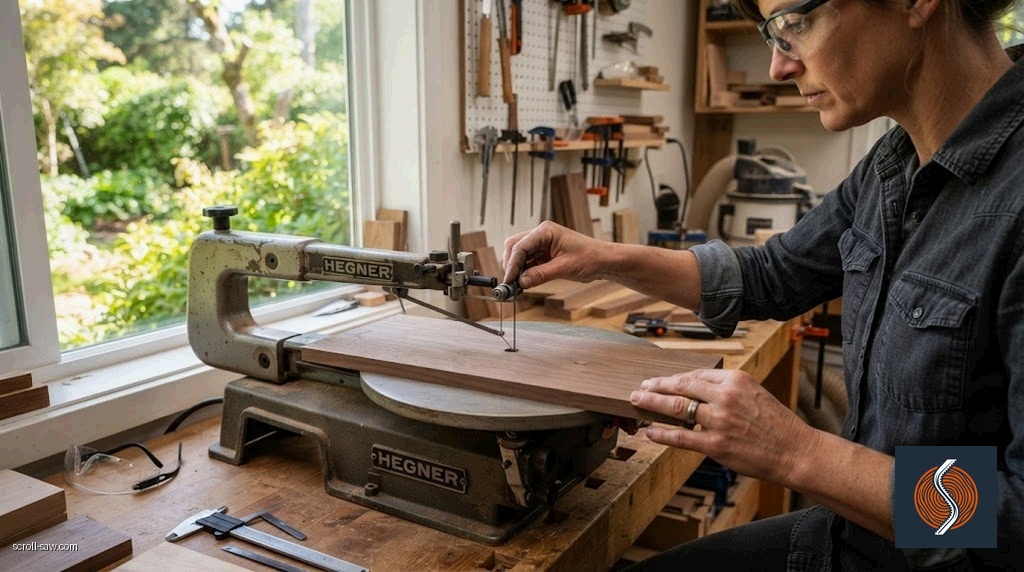
Choosing Wood for Scroll Saw Work: Capacity, Vibration, and Blade-System Checks
Every experienced scroll saw operator has a shortlist of woods they reach for again and again, and it is almost never based on price. It is based on how the wood behaves under the blade at their saw’s specific capacity, vibration profile, and blade-clamp speed. What works on a Hegner with a fresh Pegas blade fails on a WEN with a stock Olsen. This piece is a working shortlist of woods matched to the saw and stock combination you actually have.
Wood for scroll saw work is more than a species choice; it is a match between the wood’s density and grain and your saw’s ability to cut it without vibration or blade wear. Ownership factors: density-to-saw fit, grain interaction with your blade size, and finishing plan.
The short answer
On any saw, Baltic birch plywood is the safest starting point. On mid-tier and premium saws, basswood, cherry, maple, and walnut expand the palette. On entry saws, stay with 1/4 to 1/2-inch Baltic birch and basswood; heavier species overwhelm the vibration profile. Avoid oak, ash, and exotic hardwoods on entry saws for fine detail.
Capacity fit: stock thickness vs saw cut depth
Scroll saw cut depth is typically about 2 inches. Solid stock over 1 inch tests the arm geometry and blade-tension limits of most saws.
-
1/8 to 1/4 inch: any saw. Baltic birch, basswood, thin hardwoods.
-
1/4 to 1/2 inch: any saw. Full solid species range.
-
1/2 to 3/4 inch: mid-tier and above. Hardwood puzzles, name signs.
-
3/4 to 1-1/2 inch: step-up and premium saws. Sculptural cuts.
-
1-1/2 to 2 inch: premium saws only. Rare in scroll saw work.
Match stock thickness to saw class first. Then choose species.
Vibration fit: species density vs saw stability
Dense species (hard maple, oak, walnut, cherry) load the blade more than softer species (basswood, poplar). On parallel-arm and parallel-link saws, that load is absorbed by the arm geometry. On C-arm entry saws, dense species amplify vibration and cause the blade to wander.
On entry saws, stay with softer species (basswood, poplar, Baltic birch plywood). On mid-tier and above, the full range is open.
Blade-system fit: interior cuts vs species density
Interior cuts require rethreading the blade after each pierced hole. On dense species (oak, cherry, walnut), each interior cut also loads the blade more, which shortens blade life. On softer species (basswood, plywood), a blade can survive many interior cuts.
If your saw has fast tool-free clamps and you cut dense species with many interior cuts, budget for premium blades.
Working shortlist by saw class
Entry saw (WEN, Skil, Genesis)
-
Baltic birch plywood 1/8 to 1/2 inch (default).
-
Basswood 1/4 to 1/2 inch (solid species reference).
-
Poplar 1/4 to 1/2 inch (cheap alternative to basswood).
-
Skip: oak, ash, walnut, exotic hardwoods for fine detail.
-
Skip: any stock over 3/4 inch.
Mid-tier saw (DeWalt DW788, older Delta)
-
Baltic birch plywood 1/8 to 3/4 inch.
-
Basswood 1/4 to 1 inch.
-
Cherry 1/4 to 3/4 inch.
-
Maple 1/4 to 1/2 inch.
-
Walnut 1/4 to 1/2 inch.
-
Poplar 1/4 to 3/4 inch.
-
Cautious: oak and ash for name signs only; avoid for fine detail.
Step-up saw (Pegas 21, Excalibur EX-21)
-
Full mid-tier range plus:
-
Cherry, maple, walnut up to 1 inch.
-
Padauk, purpleheart, other moderate-density exotics with premium blades.
-
Continue to skip: ipe, jatoba, extreme-density species for fine detail.
Premium saw (Hegner Multimax)
-
Full step-up range plus:
-
Hard maple, dense exotics, 1 to 2-inch stock possible.
-
Full daily-use professional palette.
Species notes for common projects
Portraits and fine fretwork
Baltic birch plywood 1/4 inch. Alternating grain cancels species-color interference and cuts smoothly at any SPM.
Name signs
Cherry, walnut, or Baltic birch plywood 1/2 inch. Species with visible grain contribute to the finished look; plywood keeps the pattern the star.
Children’s puzzles
Maple, cherry, birch (solid) 1/2 to 3/4 inch. Food-safe finish (mineral oil).
Ornaments
Baltic birch plywood 1/8 to 1/4 inch. Fast to cut, low material cost, uniform stock.
Marquetry inlays
Paper-thin veneers (holly, walnut, maple, ebony). Species chosen for color contrast, not cut behavior.
Sourcing wood for scroll saw work
-
Baltic birch plywood: specialty online suppliers (Ocooch, Woodcraft), some lumberyards. Avoid hardware-store birch plywood (voids).
-
Basswood: hobby lumber suppliers (Ocooch, Rockler), some craft stores.
-
Solid hardwoods: lumberyards, sawmills, occasional online specialty (Cherokee Hardwoods, Bell Forest).
-
Exotic hardwoods: specialty online (Bell Forest, Cook Woods) for small quantities.
-
Scraps: local sawmill or cabinet shop cutoffs. Often free or very cheap.
For most hobby scroll saw work, a small stock of Baltic birch plywood in three thicknesses (1/8, 1/4, 1/2) plus a small stock of basswood and cherry will cover 90% of projects.
Verdict
Wood for scroll saw work is a match between species and saw class. On any saw, Baltic birch plywood is the safe default. On mid-tier and above, basswood, cherry, maple, and walnut expand the range. On entry saws, stay with softer species and thinner stock. On premium saws, the full palette opens. Match wood to saw first, project second, and blade budget third; the rest of the work is easier.
FAQ
What is the best wood for scroll saw work overall? Baltic birch plywood in 1/4 inch. Cuts cleanly, resists tearout, holds fine detail. Any saw handles it.
Can I use hardware-store plywood on a scroll saw? Cheap. It works for practice but has voids that can catch a blade. Use Baltic birch for finished pieces.
What is the best solid wood for scroll saw work? Basswood for the cleanest cut. Cherry, maple, and walnut for finished pieces where grain is desired.
Can I cut oak on a scroll saw? Yes, but avoid for fine detail. Use for name signs and larger shapes where the open grain is a feature.
What wood is best for scroll saw items to sell? Baltic birch plywood for ornaments and name signs; cherry, walnut, and maple for higher-end pieces.
Is thicker or thinner wood easier on a scroll saw? Thinner is easier on any saw. 1/8 to 1/2 inch is the sweet spot for most work. Over 3/4 inch requires a stable saw.
References
-
Fine Woodworking, species and cut quality reference archives
-
USDA Forest Products Laboratory, Wood Handbook
-
Scroll Saw Woodworking & Crafts, material coverage
-
Ocooch Hardwoods, hobby lumber specifications
Title: Best Wood for Scroll Saw Work: Species by Saw Class Meta description: Which woods suit your scroll saw: Baltic birch, basswood, cherry, and more, matched to entry, mid-tier, and premium saw classes. Slug: best-wood-for-scroll-saw-work Excerpt: Wood for scroll saw work is a species-to-saw match. Here is which woods suit each saw class, from entry WEN to premium Hegner.


