
Which Wood Thickness for Scroll Saw Fits Your Projects and Budget?
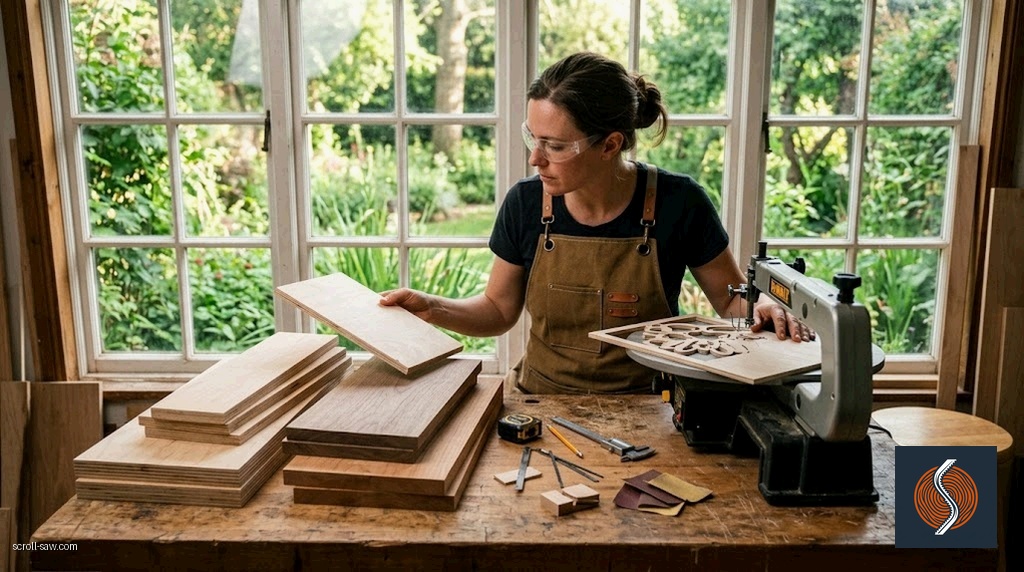
Which Wood Thickness for Scroll Saw Fits Your Projects and Budget?
Ask any experienced scroll saw operator what stock thickness they use most, and they will say 1/4 inch. Ask why, and the answer is layered: 1/4 inch cuts cleanly on any saw, is stiff enough to hold a pattern, thin enough for interior cuts to be fast, and cheap enough to make prototyping practical. Move away from 1/4 inch and every specification tightens. This piece walks the honest thickness ranges for scroll saw work and shows which thickness fits which project type.
Wood thickness for scroll saw work is not one number; it is a spectrum from 1/8 to about 2 inches, and each thickness range serves different project types. Ownership factors: what your saw can cut, what your pattern needs, and how the finished piece will be handled.
The short answer
1/4 inch is the reference thickness for most pattern work. 1/8 inch is for ornaments and layered projects. 1/2 to 3/4 inch is for puzzles and shelf pieces. Over 3/4 inch is for sculptural cuts and requires a mid-tier or better saw. Under 1/16 inch is for veneers and marquetry. Match thickness to project, not to what is on sale.
Thickness 1: 1/8 inch (thin)
Best for: Christmas ornaments, layered scroll saw art, keychain-scale name tags, marquetry backers.
1/8-inch Baltic birch plywood is the ornament-maker’s default. Cuts fast, low material cost, delivers dozens of pieces per hobby session. Solid stock at 1/8 inch is fragile and mostly used as an inlay backer.
On any saw, 1/8 inch is easy. Feed pressure is minimal. Blade choice: #3 or #5 skip-tooth.
Thickness 2: 1/4 inch (reference)
Best for: general pattern work, name signs, portraits, fretwork, most published patterns.
1/4-inch Baltic birch plywood is the working default. Stiff enough to hold a pattern without warping, thin enough for fast interior cuts, cheap enough to prototype.
1/4-inch solid stock (basswood, poplar, cherry) is where solid species start earning their place. Cuts cleanly, takes finish well, delivers heirloom look for name signs.
On any saw, 1/4 inch is comfortable. Blade choice: #5 skip-tooth for general work, #7 for faster cuts in softer stock, #3 for tight detail.
Thickness 3: 3/8 inch (middle ground)
Best for: intermediate pattern work, small shelf pieces, thicker ornaments.
3/8 inch is a step up in stiffness from 1/4 inch and useful when you want more visual presence without moving to 1/2 inch. Baltic birch, basswood, or moderate hardwood works well here.
On any saw, 3/8 inch is comfortable. Slower feed rate than 1/4 inch. Blade choice: #5 or #7.
Thickness 4: 1/2 inch (heavy work)
Best for: children’s puzzles, name signs with dimensional look, shelf pieces, decorative wall pieces.
1/2-inch solid hardwood (maple, cherry, walnut) is the sweet spot for children’s puzzles and heirloom pieces. Stiff, substantial in hand, takes finish beautifully.
On any saw, 1/2 inch is comfortable but slower. Blade choice: #7 or #9 for fast cuts, #5 for tight detail. Interior cuts start to take meaningful time.
Thickness 5: 3/4 inch (thick)
Best for: puzzle bases, dimensional shelf pieces, sculptural cuts, small stools.
3/4-inch stock tests the arm geometry of entry saws and works well on mid-tier and above. Feed rate slows meaningfully. Blade selection matters more.
On entry saws, 3/4 inch is workable but slow and requires patience. On mid-tier and premium saws, 3/4 inch is comfortable. Blade choice: #9 skip-tooth for softer species, #7 for harder.
Thickness 6: 1 to 2 inch (sculptural)
Best for: sculptural cuts, thick puzzle bases, tenon-cheek cuts, occasional specialty work.
At 1 inch and above, scroll saw work becomes specialty. Feed rate is slow, blade wear is fast, interior cuts are impractical. Best on step-up and premium saws.
Blade choice: #9 or #12 skip-tooth. Frequent blade changes.
Thickness 7: veneer (under 1/16 inch)
Best for: marquetry, layered scroll saw art, inlay work.
Veneers under 1/16 inch (typically 1/32 or 1/42 inch) are used for marquetry inlays and multi-species scroll saw art. Cutting technique differs from solid stock: use a fine blade (#2/0 or #1), a zero-clearance insert, and often a packet-cutting jig to stack multiple veneers.
Any saw with a fine blade can cut veneer, but the technique is specialty.
Match thickness to project
-
Christmas ornaments: 1/8 inch Baltic birch plywood.
-
Portraits and fine fretwork: 1/4 inch Baltic birch plywood.
-
Name signs: 1/4 to 1/2 inch Baltic birch or solid hardwood.
-
Children’s puzzles: 1/2 to 3/4 inch solid hardwood.
-
Shelf pieces: 1/2 to 3/4 inch solid hardwood.
-
Marquetry inlays: paper-thin veneers.
-
Sculptural cuts: 1 inch or more, mid-tier saw minimum.
Cost implications of thickness
Thicker stock costs more per project. A 4x8 sheet of 1/4-inch Baltic birch might yield 20 name signs; a sheet of 3/4-inch costs three times as much and yields the same or fewer pieces. For volume craft-fair work, thinner stock is meaningfully cheaper.
For heirloom or gift work, thicker stock is worth the cost for visual presence.
Verdict
Wood thickness for scroll saw work is a spectrum, not a single number, and each thickness range serves specific projects. 1/4 inch is the reference for pattern work. 1/8 inch is the ornament default. 1/2 to 3/4 inch is for puzzles and shelf pieces. Over 3/4 inch requires a mid-tier or better saw and moves into specialty. Match thickness to project, not to what is cheap; the wrong thickness makes every cut harder and every finished piece look off.
FAQ
What thickness of wood is best for scroll saw beginners? 1/4-inch Baltic birch plywood. Forgiving, widely available, and cuts cleanly on any saw.
Can a scroll saw cut 1-inch wood? Yes on mid-tier and premium saws. On entry saws, 1 inch is slow and pushes the vibration limits.
What is the maximum thickness a scroll saw can cut? Most saws cut up to about 2 inches. Beyond that, use a band saw.
Is 1/8-inch plywood too thin for scroll saw? No, it is the standard for ornaments and layered work. Feed carefully to avoid tearout.
Can I stack thin veneers for scroll saw cutting? Yes, packet cutting (stacking multiple veneers with double-sided tape) is a standard marquetry technique. Cut with a fine blade.
What thickness for a scroll saw puzzle? 1/2 to 3/4 inch solid hardwood. Sturdy for a child’s hands, comfortable to grip.
References
-
Fine Woodworking, scroll saw project archives
-
Scroll Saw Woodworking & Crafts, project and material coverage
-
Steve Good Scroll Saw Patterns, project thickness recommendations
-
Baltic Birch Plywood Association, product thickness specifications
Title: Best Wood Thickness for Scroll Saw: Range by Project Meta description: Wood thickness for scroll saw work by project type, from 1/8-inch ornaments to 3/4-inch puzzles, plus what your saw can handle. Slug: best-wood-thickness-for-scroll-saw Excerpt: Wood thickness is a spectrum, not a single number. Here is which thickness fits which scroll saw project, and what each saw class can cut.


