
A Practical Comparison of Coping Saw vs Scroll Saw
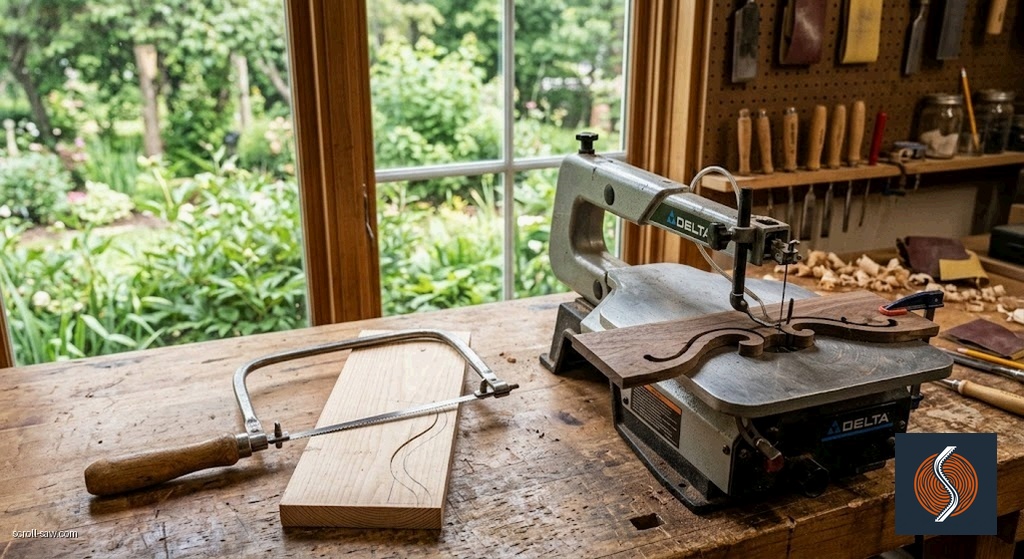
A Practical Comparison of Coping Saw vs Scroll Saw
Ask any old-school woodworker about a coping saw and they will nod. Ask them about a scroll saw and they will also nod. Ask which one you should own, and they will look at your bench and your projects before answering. These two tools cut similar shapes, in similar materials, at wildly different rates and price points. This piece walks the honest comparison between them so you know which one earns bench space first.
A coping saw is a hand tool: a thin blade tensioned in a metal U-frame, driven by your arm. A scroll saw is a power tool: a thin reciprocating blade in a benchtop machine. Both cut curves and interior details in wood, plastic, and thin non-ferrous metal. This is a head-to-head across the axes that matter.
The short answer
A coping saw is right when you cut occasional joints (baseboard copes, chair-seat curves), when you work on-site without power, or when you cut too few curves to justify a benchtop machine. A scroll saw is right when curves and interior cuts are frequent enough that hand-sawing is a bottleneck. Most experienced woodworkers own both.
Speed
A coping saw removes wood at about 1 to 4 inches per minute in soft wood, depending on blade choice and operator technique. A scroll saw removes wood at 20 to 60 inches per minute in the same stock.
For a single baseboard cope (10 to 15 inches of curved cut), a coping saw finishes in three minutes. A pattern with 100 inches of cut takes over an hour by hand and 5 to 10 minutes on a scroll saw. Volume decides.
Precision
A scroll saw’s blade travels vertically in a mechanically controlled path. The cut edge is nearly perfectly square to the top face and very clean. A coping saw’s blade travels wherever the operator’s arm sends it. Edges are workable but require finish sanding.
For visible edges in decorative work, scroll saw wins. For hidden joints (baseboard cope hidden behind trim), coping saw is fine.
Interior cuts
Both tools handle interior cuts through a drilled starter hole. On a coping saw, you thread the blade through the hole, reattach to the frame, tension, and cut. On a scroll saw, you release the top clamp, thread through the hole, reclamp. The operation is similar; the scroll saw is faster and more repeatable.
For a project with dozens of interior cuts (fretwork), scroll saw is vastly faster. For a single interior cut, either tool works.
Portability
Coping saw fits in a toolbox. Runs on nothing. Goes anywhere. Cuts in a hotel room if you have to.
Scroll saw sits on a bench. Requires power. Semi-portable at best. A benchtop scroll saw weighs 30 to 60 pounds and needs a stable surface.
For on-site trim work, coping saw wins by default.
Cost
Coping saw with blades: $15 to $40. That is a lifetime tool for most hobbyists.
Scroll saw: $150 entry, $500 to $700 mid-tier, $1,500+ premium.
The coping saw is nearly free compared to the scroll saw, which matters if scroll saw work is not going to be frequent.
Learning curve
Coping saw skill is real: keeping the blade square to the face, following a line, controlling the tension. Beginners often break blades and stray from the line. Reliable cuts take practice.
Scroll saw is more forgiving. The machine holds the blade square, and the operator feeds the wood. Beginners get clean cuts within an hour of setup.
Comparison table
| Factor | Coping Saw | Scroll Saw |
|---|---|---|
| Form | Hand tool | Benchtop machine |
| Feed rate | 1 to 4 IPM | 20 to 60 IPM |
| Edge quality | Fair (needs sanding) | Very clean |
| Interior cuts | Yes (slow) | Yes (fast) |
| Portability | Very high | Semi |
| Cost | Very low | Moderate to high |
| Learning curve | Real | Gentle |
| Best for | Trim copes, occasional curves | Pattern work, fretwork |
| Blade cost | Very low | Low |
| Volume ceiling | Low | High |
When to reach for each
Coping saw for:
-
Baseboard and trim copes at install
-
One-off interior curves in a hidden location
-
On-site work with no power
-
Occasional decorative cuts (a handful per year)
-
Teaching a child hand-sawing basics
Scroll saw for:
-
Pattern work (portraits, ornaments, fretwork)
-
Any project with more than 20 inches of curved cut
-
Interior cuts that repeat many times per project
-
Craft-fair inventory production
-
Marquetry and inlay work
Which do most woodworkers own
Most serious woodworkers own both. The coping saw stays in the toolbox for trim work; the scroll saw sits on a bench for shop work. They rarely substitute for each other.
If you can only own one and your work involves trim carpentry, coping saw first.
If you can only own one and your work involves decorative or pattern cutting, scroll saw first.
Verdict
Coping saw and scroll saw are complementary tools that share a category and rarely substitute for each other. Coping saw is a nearly free hand tool for occasional curves and on-site trim work. Scroll saw is a moderate-cost power tool for pattern work and volume cutting. Own both if you do both kinds of work. If forced to choose, pick the one that matches your most common project pattern, and expect to eventually own the other.
FAQ
Can a coping saw replace a scroll saw? For occasional cuts, yes. For pattern work at volume, no. The feed rate difference is 20x.
Are coping saw and scroll saw blades interchangeable? No. Coping saw blades are much shorter (about 6-1/2 inches) with pinned ends. Scroll saw blades are 5 inches (standard) with plain or pin ends.
Do professional trim carpenters still use coping saws? Yes, for on-site copes and one-off cuts. Miter saws handle most cuts, but coping remains the standard technique for inside-corner joints.
Is a coping saw good for beginners? Yes, especially as an introduction to hand-sawing curves. Cheap to buy, fast to learn basics, but takes practice for clean cuts.
Can I do fretwork with a coping saw? Yes, but slowly. A modest fretwork project takes 5 to 10x longer by hand than on a scroll saw.
Do I need both? Most serious woodworkers do. The tools rarely substitute for each other and the coping saw is very cheap.
References
-
Fine Woodworking, hand-tool coverage archives
-
Popular Woodworking, coping saw technique reference
-
DeWalt DW788 Instruction Manual
-
Olfa/Olson, blade specifications
Title: Coping Saw vs Scroll Saw: Head-to-Head Comparison Meta description: Coping saw or scroll saw for your work: speed, precision, portability, and cost compared, plus when to reach for each. Slug: coping-saw-vs-scroll-saw Excerpt: Coping saw and scroll saw share a category and rarely substitute for each other. Here is when to reach for each, and why most woodworkers eventually own both.


