
Fret Saw vs Scroll Saw: The Differences That Matter
Fret Saw vs Scroll Saw: The Differences That Matter
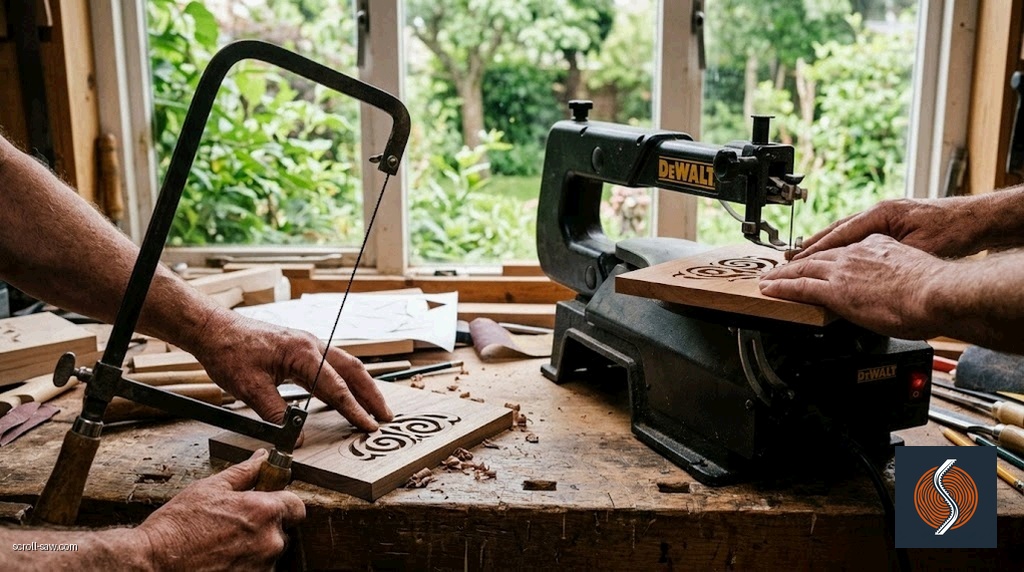
A fret saw looks like a coping saw’s ambitious cousin: same U-frame design, deeper throat, much thinner blade. A scroll saw is the power-tool version of both. Fret saws sit in a specialty corner of hand tools, and they are the right answer for a specific kind of work that neither the coping saw nor the scroll saw quite matches. This piece walks the differences between fret saw and scroll saw so you know when the fret saw earns its place and when the scroll saw simply beats it.
A fret saw is a hand tool with a very deep U-frame (often 10 to 12 inches) and a very thin blade (often #4 or finer). It is designed for delicate fretwork in thin stock. A scroll saw is a benchtop power tool that does most of what a fret saw does, faster and less delicately. This is a head-to-head across the axes that matter.
The short answer
A fret saw is right for very fine, very slow, very delicate hand work in thin stock, especially where the workpiece is too fragile for a scroll saw’s blade motion or where power is unavailable. A scroll saw is right for everything else fret-related. Most modern hobbyists use scroll saws almost exclusively; fret saws are a specialty tool for hand-tool purists and very thin veneer work.
Blade thinness
Fret saw blades are extremely fine (often 0.008 to 0.020 inch thick), thinner than most scroll saw blades. This is the fret saw’s genuine advantage: it can cut curves and interior detail with a kerf almost as thin as a jeweler’s saw.
Scroll saw blades run 0.020 to 0.060 inch thick. Fine enough for most work but rougher than a fret saw’s finest blade.
Throat depth
Fret saw throat is 10 to 12 inches, sometimes 15 inches on specialty models. Scroll saw throat is 16 to 22 inches. Both handle mid-size workpieces; scroll saw handles larger ones.
Speed
Fret saw removes wood at 1 to 3 inches per minute in thin stock, driven by hand. Scroll saw removes wood at 20 to 60 inches per minute driven by motor.
For volume, scroll saw wins by a factor of 10 to 30. For a single very fine cut, the difference does not matter; time is not the constraint.
Delicacy
A scroll saw’s reciprocating motion applies vertical force to the workpiece thousands of times per minute. In very thin (under 1/16 inch) or very fragile stock (thin marquetry veneer, thin bone or shell inlay), this motion can crack or shatter the workpiece.
A fret saw applies force only when the operator pulls or pushes. The workpiece is not subjected to constant vibration. For extremely fragile stock, this is a real advantage.
Materials
Both tools cut wood, plastic, and thin non-ferrous metal. Fret saws are also used for jewelry-scale metal cutting (silver, copper, brass) in thicknesses under 1/16 inch.
Scroll saws are not typically used for jewelry-scale metal work; the blade motion is too aggressive for the small workpiece.
Portability
Fret saw fits in a toolbox. Runs on nothing. Goes anywhere. Cuts silently.
Scroll saw sits on a bench. Requires power. Not portable.
Cost
Fret saw with blades: $30 to $80 for a decent hobbyist model, more for a jeweler’s-grade tool. Blades: very cheap ($5 to $15 per pack).
Scroll saw: $150 entry, $500+ mid-tier, $1,500+ premium.
Learning curve
Fret saw skill is significant. Keeping the blade square through a very thin workpiece, managing tension, feeding at the right rate — takes practice. Blades break often for beginners.
Scroll saw learning curve is gentler. The machine holds the blade square; the operator feeds the work.
Comparison table
| Factor | Fret Saw | Scroll Saw |
|---|---|---|
| Form | Hand tool | Benchtop machine |
| Blade thinness | Very fine (0.008 to 0.020 inch) | Fine (0.020 to 0.060 inch) |
| Throat depth | 10 to 15 inches | 16 to 22 inches |
| Feed rate | 1 to 3 IPM | 20 to 60 IPM |
| Delicacy | Very high | Moderate |
| Best material | Thin wood, veneer, jewelry metal | Wood, thin plastic |
| Cost | Low | Moderate to high |
| Learning curve | Steep | Gentle |
| Portability | Very high | Semi |
| Best for | Marquetry, jewelry, hand-tool work | Pattern work, general fretwork |
When to reach for each
Fret saw for:
-
Marquetry with very thin veneers
-
Jewelry-scale metal cutting (silver, copper, brass)
-
Very fragile stock (thin bone, shell, resin)
-
Hand-tool purist work
-
Portable curve cutting on-site
Scroll saw for:
-
Pattern work at any volume
-
Standard fretwork in 1/4 to 1/2-inch stock
-
Portraits, ornaments, name signs
-
Any project where speed matters
-
Beginners learning curve-cutting
Which do most woodworkers own
Most modern woodworkers own a scroll saw and either no fret saw or a rarely used one. Marquetry specialists and jewelry-scale hobbyists own both. Hand-tool purists sometimes own only a fret saw.
For general scroll saw / fretwork projects, the scroll saw is the honest first buy. Add a fret saw later only if the specific delicate work above appears in your project mix.
Verdict
Fret saw and scroll saw share a name and a category and solve mostly different problems. The fret saw is a specialty tool for very fine, very delicate hand work in thin stock. The scroll saw is the general-purpose fretwork tool for pattern work at volume. Most hobbyists need only the scroll saw; add a fret saw only if you take up marquetry with thin veneers or jewelry-scale metal work.
FAQ
Is a fret saw the same as a coping saw? No. Fret saw has a deeper throat and thinner blade. Coping saw has a shallower throat and thicker blade.
Can I use fret saw blades in a scroll saw? No. Fret saw blades are shorter and designed for a hand-held frame. Some scroll saws accept jeweler’s-scale blades that share the thinness but are cut to scroll saw length.
Do I need a fret saw if I have a scroll saw? Usually no, unless you do marquetry with thin veneers, jewelry metal work, or need portability for delicate hand work.
Which is better for beginners? Scroll saw is more forgiving and faster to learn. Fret saw has a steep learning curve.
Can a fret saw cut thick wood? Not well. Fret saws are designed for stock under about 1/4 inch. Thicker stock is a scroll saw or coping saw job.
Are fret saws still made? Yes. Specialty jewelry-tool suppliers (Otto Frei, Rio Grande) and traditional hand-tool suppliers (Lie-Nielsen, Lee Valley) sell hobbyist fret saws.
References
-
Lie-Nielsen Toolworks, fret saw catalog
-
Lee Valley Tools, fret saw catalog
-
DeWalt DW788 Instruction Manual
-
Fine Woodworking, marquetry and fretwork archives
Title: Fret Saw vs Scroll Saw: Which for Your Work? Meta description: Fret saw or scroll saw for your fretwork: thinness, speed, delicacy, and cost compared, plus when the fret saw earns its place. Slug: fret-saw-vs-scroll-saw Excerpt: Fret saw and scroll saw share a name and solve mostly different problems. Here is when the fret saw earns its place and when the scroll saw beats it.


