
Router vs Scroll Saw: Accuracy, Capacity, and Control Compared
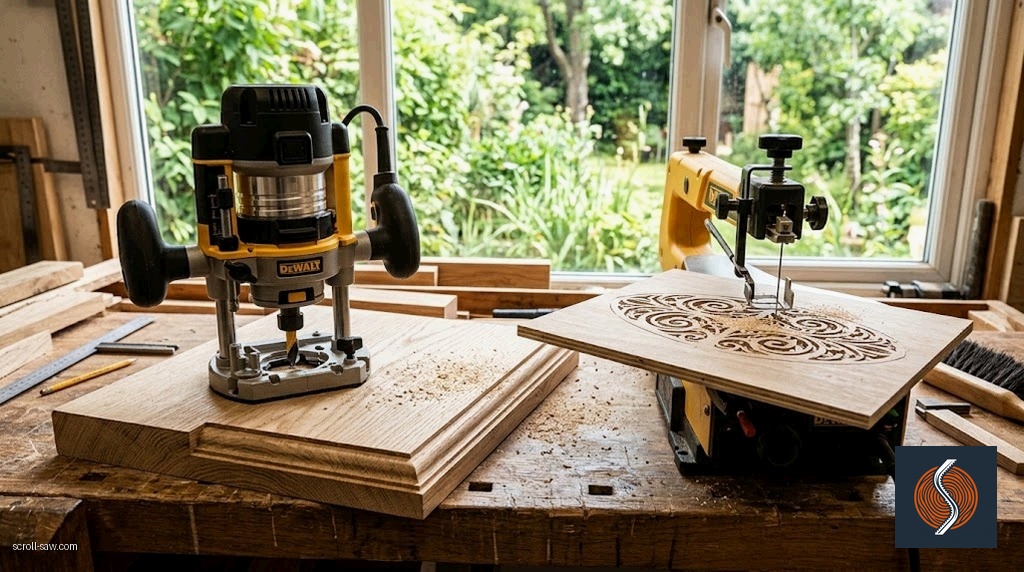
Router vs Scroll Saw: Accuracy, Capacity, and Control Compared
A router and a scroll saw are two tools nobody confuses for each other at the store, but plenty of woodworkers wonder which one to buy first when they want to cut curves. That confusion comes from the marketing photos: routers with template guides show clean rounded shapes, and scroll saws show similar curves in pattern work. Buy one hoping it will do the other’s job and you will be disappointed. This piece walks the accuracy, capacity, and control differences so you buy the one that matches your actual work.
A router is a handheld or table-mounted power tool with a spinning bit that shapes, joints, and cuts edges. A scroll saw is a benchtop machine with a reciprocating blade that cuts curves and interior detail. Both make curved edges in wood, but through completely different geometry.
The short answer
Router is right for edge shaping, joinery, template-guided repeatable curves, and dado/rabbet cuts. Scroll saw is right for pattern-work curves and interior cuts. The tools almost never substitute for each other; nearly every serious woodworker owns both.
Accuracy
Router with a template and bearing-guided bit produces repeatable curves within a few thousandths of an inch, referenced to the template. Excellent for identical parts.
Scroll saw produces curves within about 1/32-inch of the pattern line, referenced to hand feed. Excellent for one-off pattern work.
For repeat production of identical curved parts, router with template wins. For one-off pattern work, scroll saw is more direct.
Capacity
Router cuts full depth in one pass in soft stock; multiple passes in hardwood. Handles any workpiece size (the tool moves, or the workpiece slides across a table).
Scroll saw cuts up to 2 inches thick in one pass. Workpiece limited to throat depth (16 to 22 inches wide).
For large curved edges (a curved tabletop skirt, a rounded shelf edge), router wins by workpiece size. For small pattern work, scroll saw wins by cut depth and precision.
Interior cuts
Router can plunge into a workpiece with a plunge base and cut interior openings; the corners will be rounded to the bit radius. Not clean for square inside corners.
Scroll saw handles interior cuts by threading the blade through a drilled hole; corners can be sharp.
For square inside corners, scroll saw wins. For rounded openings (a cabinet-door dust vent), router works.
Edge shaping
Router is unbeatable for edge shaping (roundovers, ogees, chamfers, decorative profiles). Scroll saw does not shape edges; it only cuts them.
For decorative edge treatments, router. For flat-edge curves cut to a pattern line, scroll saw.
Joinery
Router cuts dadoes, rabbets, mortises, and template-guided joinery. Scroll saw cannot do any of these.
For cabinet and furniture joinery, router is essential. Scroll saw is not a joinery tool.
Materials
Router cuts wood, plastic, some soft aluminum with appropriate bits. Scroll saw cuts wood, thin plastic, thin non-ferrous metal.
Material overlap is mostly wood. Neither tool cuts steel or thick metals.
Noise and dust
Router is very loud (85 to 100 dB at operator ear). Hearing protection required. Generates chip and fine dust.
Scroll saw is much quieter (65 to 75 dB). Hearing protection optional. Generates fine dust that stays near the tool.
For apartment or shared-space use, scroll saw is easier. Router requires more attention to noise and dust management.
Cost
Router: $100 for entry corded, $300 to $500 for mid-tier, $500+ for premium. Bits are extra ($10 to $60 each; a working set is $100 to $300).
Scroll saw: $150 entry, $500 to $700 mid-tier, $1,500+ premium. Blades are very cheap ($5 to $15 per pack).
Router has higher consumable cost due to bits. Scroll saw blades are cheap.
Comparison table
| Factor | Router | Scroll Saw |
|---|---|---|
| Primary use | Edge shaping, joinery, template curves | Pattern curves, interior cuts |
| Accuracy | Excellent (template-guided) | Very good (hand-fed) |
| Cut depth | Full depth in one pass (small stock) | Up to 2 inches |
| Workpiece size | Unlimited | Throat-limited |
| Interior corners | Rounded (bit radius) | Sharp |
| Edge shaping | Yes (decorative profiles) | No |
| Joinery | Yes (dadoes, rabbets, mortises) | No |
| Noise | Very loud | Quiet |
| Cost | Moderate + bits | Low to moderate + blades |
| Best for | Edge and joinery work | Fretwork and pattern cutting |
When to reach for each
Router for:
-
Roundovers, ogees, chamfers, decorative edge profiles
-
Dadoes, rabbets, and mortises
-
Template-guided repeated curves in identical parts
-
Cutting curved workpieces from a pattern in cabinet work
-
Any joinery work
Scroll saw for:
-
One-off pattern work with fine detail
-
Interior cuts with sharp corners
-
Portraits, ornaments, name signs
-
Puzzle making
-
Marquetry inlays
Which do most woodworkers own
Almost every serious woodworker owns a router; it is the most versatile power tool in a woodworking shop. Scroll saw is more specialized and owned by hobbyists whose work leans toward pattern cutting.
If you are building furniture or cabinets, router is a must-have. If you are cutting patterns and decorative pieces, scroll saw is a must-have. The tools solve different problems.
Verdict
Router and scroll saw are fundamentally different tools that share the ability to make curves. Router shapes edges and cuts joinery; scroll saw cuts patterns and interior detail. If your work is furniture and cabinetry, router first. If your work is decorative and pattern-based, scroll saw first. Most serious woodworkers eventually own both because they solve different problems. Do not buy one hoping it will replace the other; the geometry is too different.
FAQ
Can a router cut curves like a scroll saw? With a template and bearing-guided bit, a router can cut curves in the outline of a workpiece. It cannot cut fine pattern detail or interior cuts with sharp corners.
Can a scroll saw shape edges? No. Scroll saw cuts vertically only; it does not shape or profile edges. Use a router for edges.
Which is more versatile? Router, for general woodworking. Scroll saw is more specialized to pattern work.
Which is louder? Router, significantly. Router requires hearing protection; scroll saw usually does not.
Do I need both for furniture making? Router is essential. Scroll saw is optional unless your furniture uses fretwork panels or decorative cutouts.
Which is easier for beginners? Scroll saw. Router is more powerful and less forgiving; beginners often produce burn marks and tear out.
References
-
DeWalt DW616 Router Manual
-
DeWalt DW788 Scroll Saw Instruction Manual
-
Fine Woodworking, router technique archives
-
Popular Woodworking, tool comparison coverage
Title: Router vs Scroll Saw: Which for Your Shop? Meta description: Router or scroll saw for your work: accuracy, capacity, and control compared, plus when to reach for each and why most shops own both. Slug: router-vs-scroll-saw Excerpt: Router shapes edges and cuts joinery; scroll saw cuts patterns and interior detail. Here is why the tools rarely substitute for each other and how to choose.


