
Scroll Saw vs CNC: The Differences That Matter
Scroll Saw vs CNC: The Differences That Matter
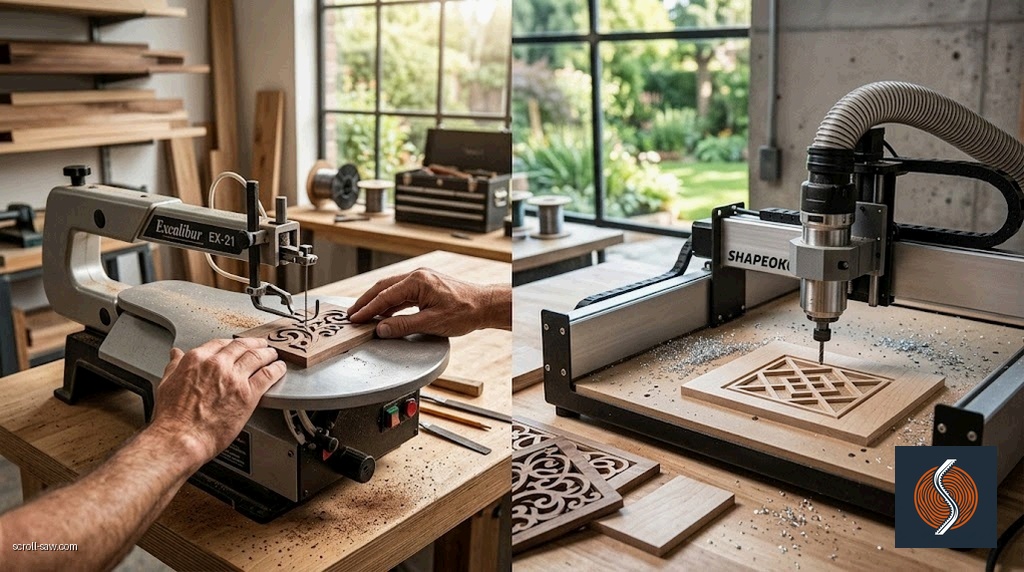
Walk into any small woodworking shop today and you will see one of two setups. Either a scroll saw sits on a bench with a stack of patterns beside it, or a CNC router hums along a table with a laptop nearby. Both cut curves and interior details in wood. Both handle pattern work. And they represent two fundamentally different philosophies of making. This piece walks the honest differences so you buy the one that matches how you actually work.
A scroll saw is a manually operated benchtop machine with a reciprocating blade fed by hand. A CNC router is a computer-controlled machine that cuts along a digital toolpath with a spinning bit. Both make curves and interior cuts; the work models could not be more different.
The short answer
CNC is right for repeat production, digital-file workflows, and precision work in medium to large stock. Scroll saw is right for hand-craft one-off work, fine pattern detail, thicker stock with sharp interior corners, and makers who prefer hand-feed over computer-controlled work. Most serious pattern-focused makers still choose scroll saw; production makers usually add CNC.
Repeatability
CNC repeats a design perfectly. Cut the same file 50 times and you get 50 identical parts.
Scroll saw makes every project a one-off. Even the same pattern cut twice will differ slightly.
For volume production of identical parts, CNC wins by orders of magnitude.
Precision
CNC accuracy is a few thousandths of an inch, referenced to the machine’s encoders.
Scroll saw accuracy is about 1/32 inch, referenced to hand-eye coordination.
For engineering-tight tolerances, CNC. For decorative work where 1/32 inch is fine, either.
Interior corners
CNC router uses spinning bits that cut with a bit-radius rounded corner. Sharp inside corners are impossible without a secondary process (drill relief holes, then bit cut, then hand file).
Scroll saw cuts sharp inside corners natively; the blade is very thin and can pivot in place.
For projects with many sharp inside corners (fretwork, puzzles with squared corners), scroll saw wins.
Cut depth
Hobby CNC: 3 to 6 inches of Z-axis clearance, but practical cut depth in wood is 1/2 to 3/4 inch in a single pass with a small bit.
Scroll saw: up to 2 inches in a single pass.
For thick stock, scroll saw wins in single-pass capacity. CNC handles thick stock with multiple passes.
Workflow
CNC workflow: design in CAD/CAM software, generate toolpaths, load stock, run the program. Setup takes time; execution is automatic. Best for designers who work digitally.
Scroll saw workflow: print pattern, glue to stock, drill starter holes, feed by hand. Setup is minimal; execution is manual. Best for makers who work by hand.
Cost
Hobby CNC: $400 to $1,500 for an entry-tier machine (Sainsmart, Onefinity Woodworker), $2,500 to $8,000 for mid-tier (Onefinity Journeyman, Shapeoko Pro), $10,000+ for professional (Axiom, Laguna).
Scroll saw: $150 entry, $500 to $700 mid-tier, $1,500+ premium.
Entry CNC and mid-tier scroll saw are similar price. Serious CNC costs meaningfully more than any scroll saw.
Skills
CNC requires CAD/CAM software skills. Common tools: Fusion 360, VCarve, Carbide Create. Learning curve is real; commit at least 20 to 40 hours to become competent.
Scroll saw requires hand-eye coordination. Learning curve is gentle; competent basic cuts within a few hours.
Materials
CNC cuts wood (any species), plastic, foam, some soft aluminum with the right bit. Dust extraction is essential; noise is significant.
Scroll saw cuts wood, thin plastic, thin non-ferrous metal. Quiet, generates less dust.
Comparison table
| Factor | Scroll Saw | CNC |
|---|---|---|
| Repeatability | One-off each cut | Perfect repeat |
| Precision | 1/32 inch | Few thousandths |
| Interior corners | Sharp natively | Rounded (bit radius) |
| Cut depth | 2 inches | 1/2 to 3/4 inch per pass |
| Workflow | Hand-fed | Digital + programmed |
| Skills required | Hand-eye | CAD/CAM + machine |
| Cost entry | $150 | $400 to $1,500 |
| Cost mid-tier | $500 to $700 | $2,500 to $8,000 |
| Noise | Quiet | Loud (spindle + dust extraction) |
| Best for | Hand-craft pattern work | Repeat production, precision |
When to reach for each
Scroll saw for:
-
Hand-craft one-off pattern work
-
Sharp interior corners (fretwork, puzzles)
-
Thicker stock (over 3/4 inch)
-
Portraits, ornaments, name signs
-
Makers who prefer hand-feed work
-
Beginners who do not want to learn CAD
CNC for:
-
Repeat production of identical parts
-
Precision engineering work
-
Sign making at scale
-
3D relief carving (scroll saw cannot do this)
-
Designer-makers who work in digital files
-
Small-business production of laser-alternative goods
Which do most makers own
Hand-craft makers usually own scroll saw and no CNC. Production and design-driven makers usually own CNC and either no scroll saw or a scroll saw for the specific work CNC cannot do (sharp interior corners, thick stock).
Hybrid makers own both. The tools rarely substitute for each other; each solves problems the other cannot.
Verdict
Scroll saw and CNC solve overlapping problems via completely different work models. Scroll saw is for hand-craft, one-off, sharp-corner pattern work by makers who prefer feeding by hand. CNC is for repeat production, digital-workflow, precision work by makers who design in CAD. Match your first buy to how you actually want to work, not to which sounds more impressive. Scroll saw remains the reference for hand-craft pattern makers; CNC is essential for anyone producing at volume or designing in digital files.
FAQ
Which is better: scroll saw or CNC? Depends on the work. Hand-craft and sharp corners favor scroll saw. Repeat production and digital design favor CNC.
Can a CNC do everything a scroll saw does? Almost, but not sharp inside corners without a secondary process, and not as fast for very thick stock.
Can a scroll saw do 3D carving? No. Scroll saw is a 2D cutting tool. 3D carving requires a CNC or hand carving tools.
Which is faster? CNC for repeat parts. Scroll saw for a single one-off cut with no digital setup.
Which requires less skill to start? Scroll saw for the machine; CNC has a real learning curve on software.
Which is quieter? Scroll saw is meaningfully quieter than a CNC with a spindle and dust extraction running.
References
-
Onefinity CNC documentation
-
Carbide 3D Shapeoko documentation
-
DeWalt DW788 Scroll Saw Instruction Manual
-
Make Magazine, CNC and scroll saw comparison coverage
Title: Scroll Saw vs CNC: Two Making Philosophies Meta description: Scroll saw or CNC for your work: repeatability, precision, corners, and cost compared for hand-craft and production making. Slug: scroll-saw-vs-cnc Excerpt: Scroll saw and CNC represent two fundamentally different making philosophies. Here is which fits your workflow and why most makers eventually own both.


