
Choosing Pro Tech 3303 Scroll Saw Blades for Clean Curves and Controlled Feed
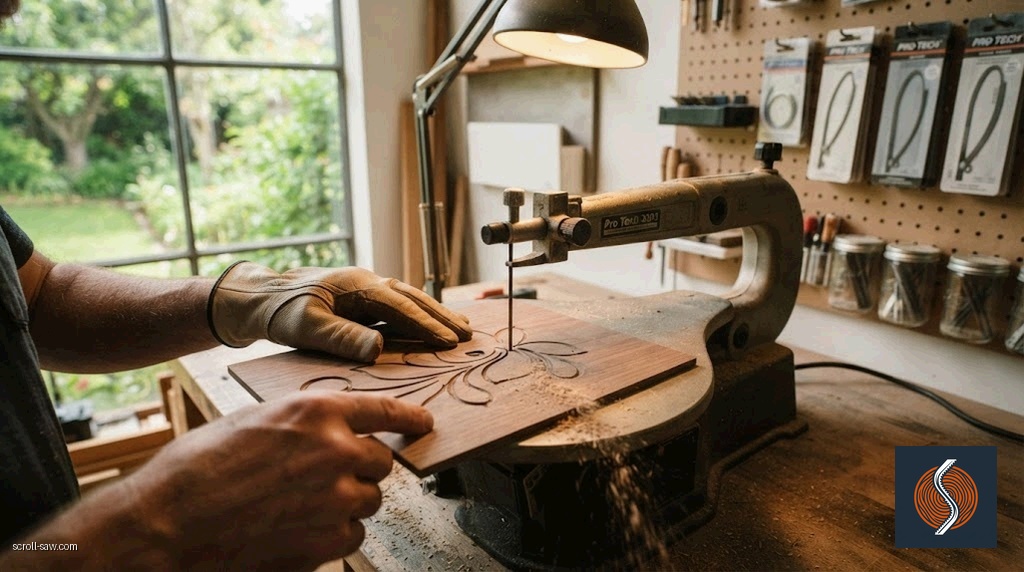
Choosing Pro Tech 3303 Scroll Saw Blades for Clean Curves and Controlled Feed
The Pro Tech 3303 was a 16-inch scroll saw sold primarily through hardware store chains in the 1990s and 2000s. It occupied the entry tier of the scroll saw market and shows up occasionally on used markets today. Owners keep them running for casual weekend work, and blade compatibility is straightforward once you understand the fitting. This piece walks the practical blade selection.
The Pro Tech 3303 is a 16-inch throat scroll saw that uses standard 5-inch scroll saw blades in most configurations. Selection factors: numbered size matched to stock, tooth geometry to material, and blade end type (plain-end vs pin-end) confirmation.
The short answer
The Pro Tech 3303 accepts standard 5-inch blades in most configurations. Use #5 skip-tooth for general work, reverse-tooth for plywood. Match size to stock. Any major brand (Olson, Flying Dutchman, Pegas) fits. Confirm your unit’s blade fitting in the manual; some early units used pin-end.
The Pro Tech 3303 in context
The 3303 is a 16-inch throat entry-tier scroll saw with variable speed and table tilt. Motor: brushed (universal). Arm design: C-arm (single curved arm), typical of entry-tier saws.
Pro Tech scroll saws are no longer in production. Parts availability from Pro Tech is limited; consumables (blades, thumbscrews) remain accessible via generic channels.
As an entry-tier saw, expect more vibration and rougher cuts than mid-tier parallel-arm saws (DeWalt DW788, Delta 40-694). Blade choice cannot fully compensate for the saw’s inherent vibration.
Blade compatibility
Most 3303 units use standard 5-inch plain-end blades with thumbscrew clamps.
Some early 3303 units may use pin-end blades. Check the manual:
-
If the clamp uses a thumbscrew, plain-end.
-
If the clamp has a slot or hole for a pin, pin-end.
Match blade size to stock
Standard framework:
-
1/8-inch stock: #3 skip-tooth.
-
1/4-inch stock: #5 skip-tooth or reverse-tooth.
-
1/2-inch stock: #7 skip-tooth.
-
3/4-inch stock: #7 skip-tooth.
-
1-inch stock: #9 skip-tooth.
3303 cut depth is typically 2 inches.
Match tooth geometry
Baltic birch plywood
Reverse-tooth for reduced bottom tearout. Because entry-tier saws are more prone to workpiece movement, reverse-tooth is particularly helpful.
Blade: Olson Reverse Skip or Flying Dutchman Ultra Reverse #5.
Solid softwood
Standard skip-tooth.
Blade: Olson skip #5.
Softer hardwood
Standard skip-tooth. Premium PGT/MGT is possible but the saw’s vibration limits the finish quality advantage.
Blade: Olson skip #5 or Olson PGT #5.
Dense hardwood
Olson skip-tooth #5 or #7. Premium blades offer marginal advantage.
Exotic hardwood
Not recommended on a 3303. Vibration profile makes fine detail in dense stock difficult.
Working with the 3303’s vibration
Entry-tier C-arm saws vibrate more than mid-tier parallel-arm saws. Mitigation:
-
Bolt the saw to a heavy bench or dedicated stand.
-
Add a rubber shop mat between saw and bench.
-
Set moderate SPM (800 to 1,200). High SPM amplifies vibration.
-
Feed lightly. Aggressive feed transfers vibration to the workpiece.
-
Support the workpiece firmly. Both hands close to the blade.
These mitigations reduce but do not eliminate the vibration inherent to C-arm designs.
Blade installation on 3303
Standard sequence for plain-end blades:
-
Turn off saw.
-
Release tension.
-
Loosen top and bottom clamps.
-
Remove old blade.
-
Insert new blade in bottom clamp with teeth pointing down.
-
Tighten bottom clamp.
-
Feed blade up through table slot.
-
Insert in top clamp.
-
Tighten top clamp.
-
Apply tension.
-
Verify perpendicularity.
-
Test on scrap.
For pin-end blades: snap the pins into the clamps at both ends.
Common 3303 issues
Blade slips in clamp
Cause: entry-tier clamps wear faster than premium saw clamps. Thumbscrew loosens or clamp face wears smooth.
Fix: retighten; clean clamp faces; replace thumbscrews if stripped.
Excessive vibration and workpiece walking
Cause: C-arm design plus loose mounting.
Fix: bolt down; add rubber isolation; reduce SPM.
Cut wanders
Cause: vibration, worn clamps, or dull blade.
Fix: mitigate vibration; check clamps; replace blade.
Blade breaks frequently
Cause: high tension, aggressive feed, or over-tight clamp.
Fix: reduce tension; ease feed; do not over-tighten thumbscrews.
Motor whine at low SPM
Cause: brushed motor behavior. Normal for entry-tier.
Fix: none. Set SPM higher or accept the whine.
Parts availability
Pro Tech parts are limited. Alternatives:
-
Thumbscrews: standard metric replacements.
-
Clamp assemblies: difficult to source; DIY fabrication or salvage.
-
Blades: universal 5-inch plain-end from any major brand.
-
Table inserts: DIY from 1/8-inch acrylic or hardwood.
-
Motor: if failed, likely uneconomical to replace on an entry-tier saw.
For major failures, consider replacing the entire saw rather than repairing.
Setup tips for 3303 owners
-
Bolt down or dedicated stand. Essential.
-
Rubber isolation mat. Reduces vibration transfer.
-
Add LED lighting. Stock lighting is minimal.
-
Add a foot switch. Comfort upgrade.
-
Connect dust extraction. Small dust port; may need adapter.
When to upgrade from a 3303
Common upgrade paths for 3303 owners:
-
To used Delta 40-694: 20-inch parallel-arm at similar or slightly higher used price. Major upgrade in cut quality.
-
To WEN 3921: same tier but newer with better parts availability.
-
To DeWalt DW788: significant step up in cut quality and reliability.
All accept the same standard 5-inch blades, so blade stock transfers.
Recommended blade stock for 3303 owners
Casual weekend work:
-
1 dozen #5 Olson skip-tooth.
-
1 dozen #5 Olson Reverse Skip (for plywood).
-
1 dozen #7 Olson skip-tooth (for thicker stock).
-
6 x #3 Olson skip (for fine detail).
Total cost: $15 to $25.
Premium blades offer marginal advantage on an entry-tier saw; save the premium blade budget for a better saw later.
Verdict
The Pro Tech 3303 is an entry-tier 16-inch C-arm scroll saw with the vibration and finish-quality limits typical of the tier. Blade selection follows the standard framework: match size to stock and geometry to material. Standard 5-inch plain-end blades fit most units. Budget Olson blades are the practical choice; premium blades offer only marginal advantage on the vibration-limited saw. Parts availability from Pro Tech is limited, so plan for eventual replacement of the saw rather than major repair. If you own a 3303 and cut casual weekend patterns, it will serve. For serious pattern work, budget for an upgrade to a parallel-arm saw.
FAQ
What blades fit the Pro Tech 3303? Standard 5-inch plain-end blades in most configurations. Confirm your unit’s fitting.
Is the Pro Tech 3303 a good scroll saw? Entry-tier. Adequate for casual weekend work. Vibration profile limits fine detail.
Does Pro Tech still make scroll saws? No. Parts availability limited.
Can I use premium blades on a Pro Tech 3303? Yes, but the saw’s vibration limits the finish quality advantage. Budget blades are the practical choice.
What is the max cut depth on a Pro Tech 3303? Typically 2 inches.
Should I upgrade from a Pro Tech 3303? If you cut regularly, yes. Used Delta 40-694 or new WEN 3921 are common upgrade paths. DeWalt DW788 for a bigger step up.
References
-
Pro Tech 3303 Instruction Manual
-
Olson Saw Company product specifications
-
Flying Dutchman blade catalog (Mike’s Workshop)
-
Fine Woodworking, entry-tier scroll saw coverage
Title: Pro Tech 3303 Scroll Saw Blades: Selection Guide Meta description: Blade selection for the Pro Tech 3303: standard 5-inch blades, entry-tier considerations, and upgrade paths. Slug: pro-tech-3303-scroll-saw-blades Excerpt: The Pro Tech 3303 uses standard 5-inch blades. Here is how to match blades and when to consider upgrading.


