
Scroll Saw Blade Chart: Size, Tooth Geometry, and Material Guide
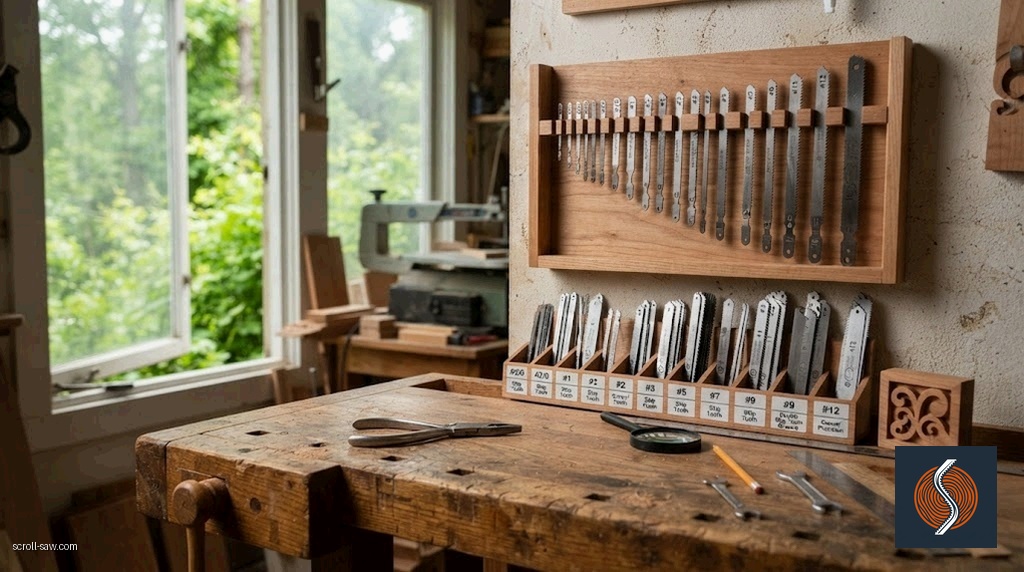
Scroll Saw Blade Chart: Size, Tooth Geometry, and Material Guide
A scroll saw blade chart is the shortcut. Every blade manufacturer publishes one; every scroll saw magazine reproduces some version. The chart tells you which numbered size to use for which stock thickness and which material. But the charts on the market vary in what they include and how they present the data. This piece consolidates the practical chart into a single reference.
A scroll saw blade chart is a reference table matching numbered blade sizes (#2/0 through #12) to stock thicknesses, materials, tooth geometries, and typical use cases. Selection factors: use the chart as a starting point, then adjust for actual material characteristics and desired finish.
The short answer
Use the chart below to pick a starting blade size. #3 for fine detail in thin stock, #5 for general work in 1/4 to 1/2-inch stock, #7 for 1/2 to 3/4-inch stock, #9 for 3/4-inch and thicker. Adjust for material (reverse-tooth for plywood, PGT/MGT for high-finish hardwood, premium for dense stock). Test on scrap; adjust as needed.
The consolidated scroll saw blade chart
| Blade # | Thickness | TPI | Kerf | Stock (in) | Best use |
|---|---|---|---|---|---|
| #2/0 | 0.008 in | 30 | 0.020 | 1/16 - 1/8 | Marquetry, jeweler’s detail |
| #2 | 0.010 in | 25 | 0.022 | 1/16 - 1/8 | Fine detail, small ornaments |
| #3 | 0.012 in | 18 | 0.025 | 1/8 - 1/4 | Fine pattern work |
| #5 | 0.018 in | 14 | 0.035 | 1/4 - 1/2 | General workhorse |
| #7 | 0.024 in | 12 | 0.045 | 1/2 - 3/4 | Thicker stock, faster cuts |
| #9 | 0.030 in | 10 | 0.055 | 3/4 - 1-1/2 | Heavy stock |
| #12 | 0.045 in | 8 | 0.070 | 1-1/2 - 2+ | Very heavy stock |
Tooth geometry selection
Skip-tooth (standard)
Use for: general softwood, general hardwood, most materials. Characteristics: teeth with a gap between each. Fast cutting. Best for: everyday scroll saw work.
Reverse-tooth (skip-reverse)
Use for: Baltic birch plywood, thin veneer, any plywood. Characteristics: standard skip pattern with the last few teeth reversed at the top. Best for: reducing bottom-face tearout in layered materials.
Crown-tooth (double-tooth)
Use for: cuts requiring both-direction cutting, some fret work. Characteristics: teeth on both edges of the blade. Best for: specialty situations. Less common.
Precision-ground (PGT, MGT)
Use for: high-finish hardwood, portraits, visible edges. Characteristics: teeth precision-ground rather than punch-stamped. Smoother cut. Best for: finished surfaces where sanding is impractical.
Polar (specialty premium)
Use for: dense hardwood, hard maple, oak, exotic wood. Characteristics: extra-hardened teeth for longer life in dense materials. Best for: extended cutting in dense wood.
Spiral
Use for: tight curves, irregular freehand cuts, multi-direction cuts. Characteristics: teeth wrapped around the wire body; cuts in any direction. Best for: workpieces that cannot be rotated freely.
Jeweler’s / metal-cutting
Use for: thin non-ferrous metal (brass, aluminum, copper). Characteristics: finer teeth designed for metal. Best for: mixed-media pattern work with metal inlays.
Material-specific chart
Baltic birch plywood, 1/4 inch
-
Best: #5 reverse-tooth.
-
Alternative: #5 skip-tooth (with a backer board for cleaner bottom face).
-
SPM: 1,000 to 1,200.
Baltic birch plywood, 1/2 inch
-
Best: #7 reverse-tooth.
-
Alternative: #7 skip-tooth.
-
SPM: 900 to 1,100.
Solid pine, 3/4 inch
-
Best: #7 skip-tooth.
-
Alternative: #9 skip-tooth for faster cuts.
-
SPM: 1,200 to 1,500.
Cherry or walnut, 1/2 inch (high-finish)
-
Best: #5 PGT or MGT.
-
Alternative: #5 skip-tooth (with more sanding).
-
SPM: 1,000 to 1,200.
Hard maple, 3/4 inch
-
Best: #7 Polar (Flying Dutchman) or #7 MGT (Pegas).
-
Alternative: #7 skip-tooth (shorter blade life).
-
SPM: 800 to 1,000.
Ipe or jatoba, 1/2 inch
-
Best: #7 Polar or #7 MGT.
-
SPM: 500 to 800.
-
Note: Expect very short blade life.
1/8-inch Baltic birch (small ornaments)
-
Best: #3 reverse-tooth.
-
Alternative: #3 skip-tooth.
-
SPM: 1,200 to 1,500.
Portrait fretwork in 1/4-inch Baltic birch
-
Best: #3 reverse-tooth for interior fine detail; #5 reverse-tooth for larger cuts.
-
SPM: 1,000 to 1,300.
SPM guide by material
| Material | SPM range |
|---|---|
| Softwood (pine, basswood) | 1,200-1,500 |
| Baltic birch plywood | 1,000-1,300 |
| Softer hardwood (cherry, walnut, poplar) | 1,000-1,200 |
| Dense hardwood (maple, oak, ash) | 800-1,000 |
| Exotic hardwood (ipe, jatoba, purpleheart) | 500-800 |
| Thin non-ferrous metal | 400-800 (with lubricant) |
Feed rate guide
Feed rate is not a chart number. It is what the blade tells you. Adjust to:
-
Blade cuts fluidly: correct feed.
-
Blade slows or bogs: feed too fast.
-
Blade skips or bounces: feed too fast or wrong tension.
-
Edges burn: feed too slow or dull blade.
-
Blade wanders: feed too fast, dull blade, or tension too low.
Blade brand tiers
Budget: Olson
Full range of sizes and geometries. Widely available.
Standard premium: Flying Dutchman
Ultra Reverse for plywood, Polar for hardwood, standard skip for general.
Premium refined: Pegas
MGT for high-finish, Skip Reverse for plywood, spiral for tight curves.
Specialty: Niqua, Herdim
German-made precision-ground. Regional availability.
When the chart is wrong
Charts are starting points. Real cuts vary because:
-
Wood is not uniform. Grain, moisture, and density vary within a species.
-
Blade brands vary. Same numbered size cuts differently between Olson and Pegas.
-
Saw vibration profile. Same blade cuts differently on a C-arm vs parallel-arm saw.
-
Operator technique. Feed rate and tension differ between operators.
Test on scrap. Adjust as needed.
Verdict
A scroll saw blade chart is a shortcut for picking a starting blade size and tooth geometry for a given material and stock thickness. The consolidated chart above covers #2/0 through #12 across common materials and stock. Adjust for specific material characteristics, brand, saw, and technique. Test on scrap before committing to a real cut. With the chart as reference and testing as verification, blade selection becomes routine.
FAQ
What is a scroll saw blade chart? A reference table matching numbered blade sizes to stock thicknesses, materials, and typical use cases.
Which blade size for 1/4-inch stock? #5 skip-tooth for solid wood; #5 reverse-tooth for plywood.
Which blade size for 3/4-inch stock? #7 or #9 skip-tooth. #9 for dense stock; #7 for softer.
What TPI does a #5 blade have? About 14 TPI in skip-tooth; higher in precision-ground.
Which tooth geometry for Baltic birch plywood? Reverse-tooth (skip-reverse). Reduces bottom-face tearout.
Which brand of blade should I buy? Budget: Olson. Standard premium: Flying Dutchman. Premium refined: Pegas.
References
-
Olson Saw Company product specifications
-
Flying Dutchman blade catalog (Mike’s Workshop)
-
Pegas blade catalog (Seyco)
-
Scroll Saw Woodworking & Crafts, blade coverage archives
-
Fine Woodworking, scroll saw technique archives
Title: Scroll Saw Blade Chart: The Full Reference Meta description: Scroll saw blade chart matching numbered sizes to stock, materials, TPI, kerf, and SPM. Full selection reference. Slug: scroll-saw-blade-chart Excerpt: Consolidated scroll saw blade chart: numbered sizes, TPI, kerf, and material recommendations in one reference.


