
Size #7 Scroll Saw Blades: The Right Match for Thick Hardwood
Size #7 Scroll Saw Blades: The Right Match for Thick Hardwood
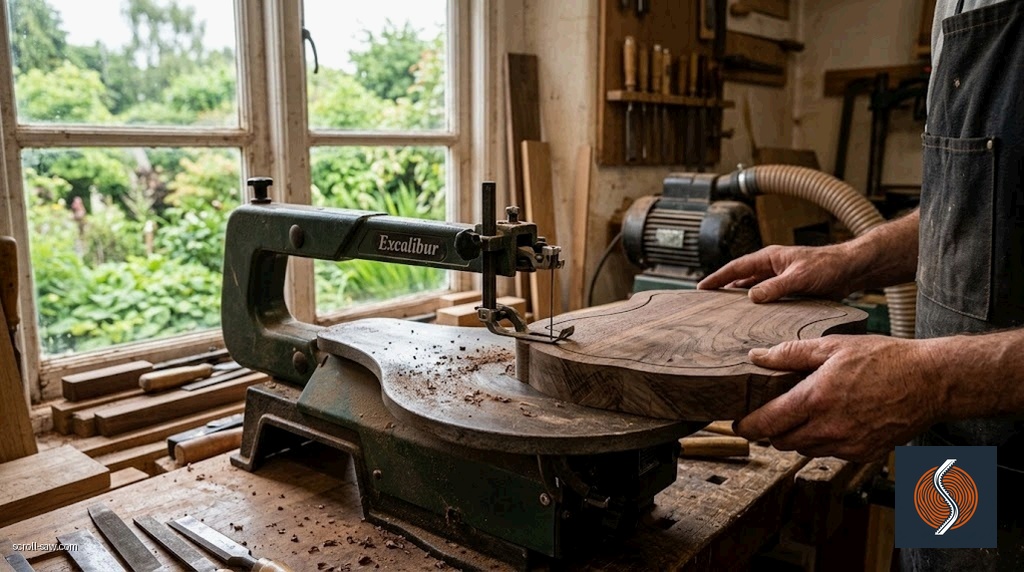
The project is a cutting board with a scrolled inlay in 3/4” walnut. You loaded a #5 because that’s what was in the saw from last weekend. Ten minutes in, the blade is smoking, the walnut smells scorched, and the cut line has a burn stripe you can’t sand out without changing the pattern shape. That’s not a technique problem. You picked the wrong blade.
A #7 was the right blade for that cut, and it would have made the whole afternoon easier. This piece explains where #7s belong, what they feel like when they’re working, and which packs are worth buying.
The direct answer
A size #7 scroll saw blade is about 0.045” wide, 0.018” thick, at roughly 11.5 TPI. It’s built for hardwoods between 3/4” and 1-1/4” thick, and for softwoods up to about 1-1/2”. The wider kerf and coarser teeth clear chips faster, which is what keeps the blade cool in dense wood.
Why #7 exists
As blade numbers climb, three things change together: the blade gets wider, thicker, and coarser. The reason all three move at once is that thick hardwood removes wood one shaving at a time, and thick shavings need room to escape. A #5 in 3/4” hard maple can’t clear chips fast enough. The chips pack into the kerf, generate heat, and the blade starts cutting its own sawdust instead of the wood. That’s the smoke you’re smelling.
A #7 opens the kerf enough that chips fall out the bottom of the cut, keeping the blade cool. The tradeoff is honest: you lose the ability to turn tight and you lose some finish quality on the underside. For thick hardwood, both are prices worth paying.
What #7 doesn’t do well
Don’t load it for anything under 1/2”. The wider kerf splinters thin wood and plywood veneer. Don’t load it for fine interior detail. Minimum comfortable radius on a #7 is closer to a nickel than a dime, and forcing tighter turns cracks bridges. Don’t load it for softwoods under 1/2” unless you like fuzzy edges.
Use a #3 or #5 for those jobs. The #7 is a specialist for one thing: thick, dense wood.
The blade pack to buy
On the plain-end side, the Olson FR49400 Skip Tooth 36-pack includes #7 blades in the assortment. That’s the cheapest and most efficient way to try them without buying a full dozen you might not need.
Once you know you like the size, the Pégas Skip Tooth 5” Pack of 12 Size 7 is the Swiss-made upgrade. Stiffer, sharper, and noticeably longer-lasting in hardwood. If you cut oak, maple, or walnut regularly, this is the pack that lives in the drawer.
For pin-end saws, the Olson FR41001 6-pack of 7 TPI pinned blades is the direct equivalent. Hook-tooth geometry, 5” pinned, rated for wood up to 2” thick. It fits WEN 3921/3922/3923, Delta 40-690, Ryobi, Dremel, Craftsman, and every other pin-end saw taking standard 5” blades.
Honest drawback of the Pégas Skip Tooth #7: they’re slightly more expensive per blade than the Olson equivalent, and the extra stiffness that helps in thick hardwood makes them fight you in tight curves. If you plan to switch blades mid-project for turns, no issue. If you want one blade to do everything from tight interior work to the outer profile, they aren’t it.
How to know a #7 is cutting right
The sound. A properly matched blade in a properly tensioned saw makes a steady, low hum on the cut. If the note rises to a whine, feed pressure is too heavy or the blade is dulling. If the note is buzzy or chattering, the blade needs more tension.
The chips. On the underside of the workpiece, you should see actual chips falling out, not just dust. Chips mean the blade is removing material efficiently. Dust means it’s burnishing the wood.
The finish. A fresh #7 in the right stock leaves a matte, uniform edge, mildly fuzzy on the underside unless it’s a reverse-tooth. A #7 that’s been overworked leaves a shiny, hard, burned edge that sanders can’t easily correct.
Reverse-tooth #7s
For thick hardwood projects where both sides will show (say, a shelf bracket or a stand-alone ornament), a reverse-tooth #7 removes almost all of the underside fuzz that a straight skip-tooth leaves. The Flying Dutchman Ultra Reverse #5 Blade Pack 72 pc doesn’t include #7s directly, but the FD Ultra Reverse line does include #7s through Mike’s Workshop by special order. For Amazon-only shoppers, the closest match is a Flying Dutchman variety pack that overlaps the #7 range.
When to step past #7
At 1-1/2” hardwood or thicker, even a #7 starts to bind. Step up to #9 or #12. The step up beyond #7 is a specialty range: fewer projects live there, but for anything from thick clock faces to signage cut from full-inch stock, having a small stash of #9s pays off.
The verdict
A #7 is the blade you load when the wood is thick, dense, and cutting slowly. Keep a dozen in the drawer. Load them for hardwood over 5/8” and don’t apologize for the wider kerf, that’s the whole point. When your #7 is working, the saw sounds calmer, the wood doesn’t smoke, and the cut takes half the effort of forcing a #5 through the same material. Match the blade to the stock, not the other way around.
FAQ
What thickness of wood does a #7 blade cut best? Hardwoods between 3/4” and 1-1/4”. Softwoods up to about 1-1/2”. Outside that range, drop to a smaller number or step up depending on the direction.
Can a #7 blade cut curves? Yes, but not tight ones. Comfortable radius is roughly a nickel. Anything tighter needs a #3 or #5.
Do #7 blades work in a WEN 3921? Only if they’re pin-end. The Olson FR41001 7 TPI 6-pack is the pin-end equivalent and fits WEN 3921/3922/3923, Delta, Ryobi, and Craftsman.
Why is my #7 blade burning the wood? Usually one of three things: the blade is dull, the feed pressure is too heavy, or you’re pausing mid-cut. A sharp #7 cutting cool wood should produce visible chips out the bottom. If it’s producing dust only, replace it.
How long should a #7 blade last? Depends on the wood. In softwood, one blade can cut a full project. In hard maple or walnut, expect blade life of 20 to 45 minutes of active cutting before performance drops.
Do #7 blades exist in reverse-tooth? Yes. Flying Dutchman’s Ultra Reverse line and Olson’s reverse assortments both cover #7. If both faces of the piece will show, use the reverse version.
Are #7 blades good for cutting acrylic or plastic? Skip-tooth #7 blades can cut acrylic slowly, but they run hot and melt the kerf. For plastic, use a slower stroke rate and a blade designed for plastic (usually higher TPI, finer teeth) instead.
References
-
Olson Saw Company product specifications: olsonsaw.net
-
Pégas Sawblades size chart and technical data: pegas-swiss.com
-
Flying Dutchman blade line, Mike’s Workshop: mikesworkshop.com
-
Scroll Saw Association of the World blade guidance: saw-online.com


