
AMT Scroll Saw Blades: What Fits an Old American Machine & Tool Saw
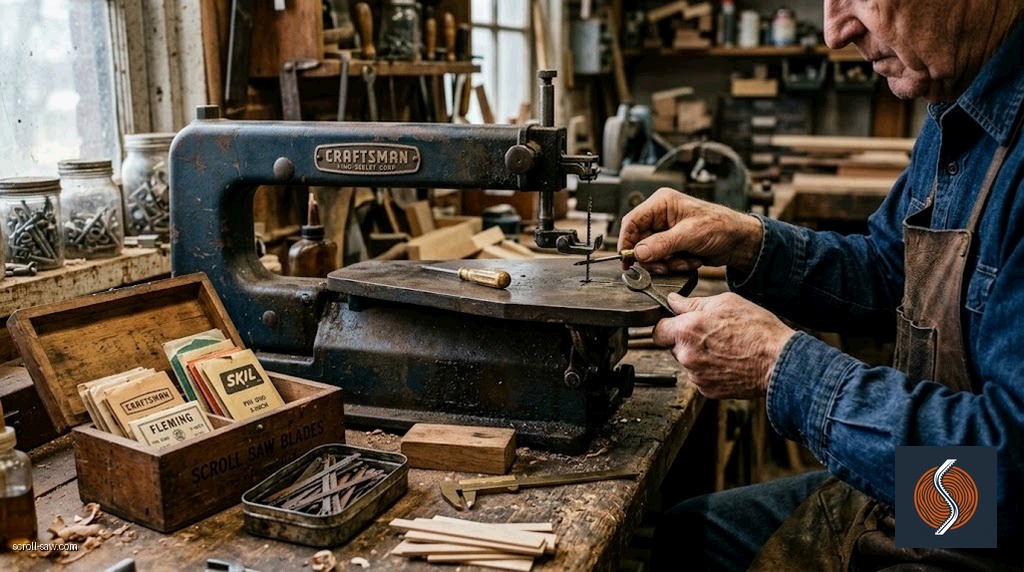
AMT Scroll Saw Blades: What Fits an Old American Machine & Tool Saw
You inherited a green AMT scroll saw from a father-in-law’s basement. It’s cast-iron heavy, the motor still hums like it’s brand new, and the blade in the top clamp is snapped off at the crimp. You need a replacement blade, and the internet keeps offering you generic “AMT scroll saw blades” that don’t quite look like the broken piece in your hand.
Here’s the real story. American Machine & Tool Company (AMT) stopped manufacturing scroll saws decades ago, and nobody makes AMT-branded blades today. What your saw actually needs is a modern standard blade that matches the clamp type it was designed for. This piece explains how to identify that, and points you at what to buy.
The direct answer
Most AMT scroll saws take 5-inch pin-end blades, the same standard blade used by modern WEN, Delta 40-690, Ryobi, and Craftsman saws. A few later-production AMT machines took 5-inch plain-end blades. Look at the broken blade for a small crimped pin at each end. If yes, you need pin-end. If no, you need plain-end. Either way, the length is 5 inches.
Identifying your AMT saw
AMT (American Machine & Tool Company, of Royersford, Pennsylvania) made a family of scroll saws from the 1960s through the 1980s, including the popular 400-series and 600-series machines. Most sold through Sears, hardware stores, and mail-order tool catalogs. They were known for being over-built, cast-iron heavy, and mechanically simple, which is exactly why so many still work.
Check the machine’s tag or nameplate for a model number. If the manual is gone, note whether the blade holders use small slots (pin-end) or set-screw clamps (plain-end). That’s the entire distinction that matters for blade shopping.
The pin-end route
Most AMT saws use pin-end blades. If yours is one of them, buy modern pin-end packs sized 5 inches:
For fine detail work in wood 5/32” to 1/2” thick, grab the Olson 42401 Pin End 18.5 TPI card. Sharp turns, thin kerf, clean finish.
For general woodcutting up to 2” thick, the Olson FR41001 6-pack of 7 TPI pinned blades is the workhorse. Hook-tooth geometry cuts aggressively without burning.
For a broader supply and low per-blade cost, the JTEX 48-pack pin-end assortment is fine for practice. The steel is a step below Olson but the tooth counts cover the range.
Honest drawback: pin-end blades cannot cut internal details as fine as plain-end blades can, because the pilot hole must accommodate the pin. That’s a limit of the saw, not the blade.
The plain-end route
Some later or restored AMT saws use plain-end blades. If yours does, the Olson FR49400 Skip Tooth 36-pack is the default. For cleaner undersides, upgrade to the Olson FR49202 Reverse Tooth assortment. Both are 5-inch plain-end.
What to expect from an AMT saw with modern blades
AMT saws were built well, but their reciprocating arm geometry, bearing surfaces, and clamp designs are older technology. Modern blades cut fine in them, but a well-tuned AMT won’t match a new DEWALT DW788 or Rikon 10-600VS for smoothness or speed. What it will do, that many modern saws won’t, is run for another 30 years without a service.
Honest drawbacks of running an AMT today: parts (bearings, belts, blade clamps) are hard to source; the vibration is higher than modern C-arm designs; and dust collection is essentially non-existent. If your AMT is your only saw and you cut a lot, budget for a used DEWALT or a new Rikon 10-600VS once you’ve outgrown the AMT’s limits.
Who should keep the AMT running: sentimental owners, casual cutters, and anyone who values a machine that will still be cutting in 2050.
Who should sell it and upgrade: anyone whose cuts are being limited by the saw itself, or anyone whose shop time is being eaten by tuning the AMT instead of scrolling.
The verdict
An AMT scroll saw doesn’t need AMT-branded blades. It needs a modern 5-inch blade of the correct end type. Pin-end for most models, plain-end for a few. Olson makes the right pack in either format. Keep the old saw, feed it good blades, and it’ll still be running when the plastic-bodied import saws sold today are landfill.
FAQ
Where can I buy original AMT scroll saw blades? You can’t reliably. AMT-branded blades appear occasionally on eBay from old workshop cleanouts. They’re not being manufactured. Any modern 5-inch pin-end or plain-end blade of the correct end type will fit and cut better than the originals.
How do I know if my AMT takes pin-end or plain-end blades? Look at the broken blade (or the blade clamps if no blade is loaded). Small crimped pin at each end means pin-end. Just steel, no pin, means plain-end. If in doubt, remove the top blade clamp and examine the slot: a narrow slot for a pin means pin-end.
Are AMT saws worth restoring? Mechanically, yes. The castings and motors are usually excellent. Bearings and belts are consumables that are still findable. If you enjoy tinkering, an AMT restoration is a satisfying project.
Can I upgrade my AMT to a modern blade tension system? Some tinkerers have adapted quick-release tension levers from newer saws to AMT frames, but it’s a real modification, not a bolt-on. Unless you’re comfortable with metalwork, live with the original tension knob.
Do modern blades vibrate more in an old AMT? Not because of the blade. Older saws vibrate more than modern C-arm designs regardless of blade brand. The fix is a heavy stand and a clean bench, not a specific blade.
What’s the closest modern equivalent to an AMT scroll saw? In feel and heft, the Shop Fox W1713 or Rikon 10-600VS. Both have cast-iron bases and traditional layouts.
Does AMT still make any tools? The original AMT company is out of business. The name has been used by various importers since; those products are unrelated to the original American Machine & Tool company.
References
-
Olson Saw Company blade specifications: olsonsaw.net
-
Vintage Machinery archive, AMT (American Machine & Tool) history: vintagemachinery.org
-
Scroll Saw Association of the World, blade fundamentals: saw-online.com


