
Are All Scroll Saw Blades the Same? Here
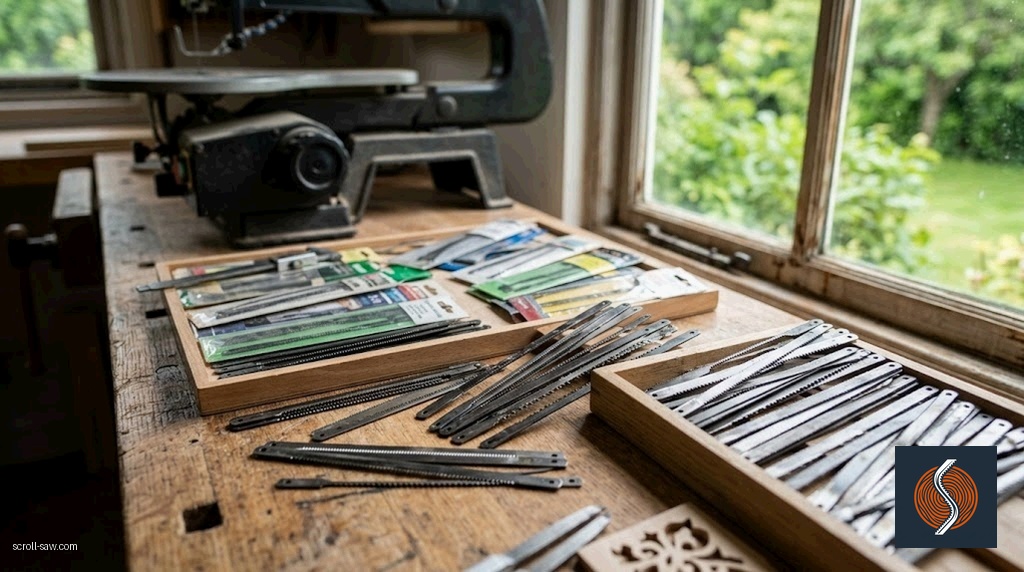
Are All Scroll Saw Blades the Same? Here
You grabbed a random blade from the drawer because it was closest, loaded it in the saw, and started cutting. The blade broke, the wood tore out on the bottom, and the finish looked awful. Same brand as the last blade you used, same length, same shape from three feet away. But not the same blade.
Scroll saw blades vary in six real dimensions, and each one changes what the blade is good at. This piece walks through them so the next blade you grab isn’t a random one.
The direct answer
No, scroll saw blades are not all the same. They vary in end type (pin or plain), length (mostly 5”, occasionally 6”), width, thickness, TPI (teeth per inch), and tooth geometry (skip, reverse, spiral, double reverse, crown, precision-ground). Picking the wrong one for the job is why beginners break blades, burn wood, and get fuzzy edges. Picking the right one is 80% of getting a clean cut.
The six differences that matter
End type. Pin-end blades have a small metal pin crimped into each end that drops into a slot in the blade holder. Plain-end blades have no pin and are clamped by set-screws. Pin-end and plain-end blades are not interchangeable. Your saw takes one or the other.
Length. 5 inches is the industry standard. A few European saws (Hegner, some Excalibur EX models) take 6-inch blades. A hand fret saw or coping saw takes even shorter or different blades entirely. Length is not adjustable, you buy the length your saw requires.
Width. Wider blades (0.045” and up) track straighter and cut faster in thick stock. Narrower blades (0.020” to 0.035”) turn tighter and cut finer.
Thickness. Thicker blades resist flex under pressure. Thinner blades make thinner kerfs. Thickness is what changes when you compare a #3 to a #7 as much as width does.
TPI (teeth per inch). More teeth (18 to 28 TPI) leaves a smoother edge but cuts slowly and heats up in thick wood. Fewer teeth (7 to 12 TPI) removes wood fast, leaves a rougher finish, and clears chips better.
Tooth geometry. This is where things get interesting.
Tooth geometries and what they do
Skip-tooth. Every other tooth is missing, creating gaps that let chips fall out of the cut. General-purpose. Most default assortments are skip-tooth. Try the Olson FR49400 Skip Tooth 36-pack for plain-end saws.
Reverse-tooth. The bottom third of the teeth face upward instead of downward, cutting the underside of the wood as the blade travels down. Result: cleaner bottom edge, less tearout. The Olson FR49202 Reverse Tooth assortment is the standard.
Spiral. The blade is twisted along its length, so teeth face every direction. Cuts sideways, forward, backward simultaneously. Great for portraits where you can’t rotate the workpiece. Terrible for straight lines. The Olson SP46500 Spiral is a good starter pack.
Double reverse. Reverse teeth appear both at the bottom and near the top. Cuts cleanly on both faces even in fussy plywood.
Ultra reverse. More reverse teeth than a standard reverse-tooth, cutting even cleaner underside. Flying Dutchman popularized this. The Flying Dutchman Ultra Reverse 60-piece Variety Pack is the sampler.
Precision-ground. Teeth are ground rather than milled, producing much sharper cutting edges. Cuts faster, leaves a cleaner surface, costs more per blade. The Olson PG45502 Precision Ground is a strong example.
Crown-tooth. Teeth alternate pointing up and down along the blade. Cuts on both strokes. Rare in modern use, but excellent for very thin plastic and veneer.
How to pick between them
Match the blade to the material and the geometry of the cut. Rough rules:
-
Thick hardwood, straight and gentle curves: #7 skip-tooth.
-
Medium wood, tight curves, clean finish both sides: #5 reverse-tooth.
-
Thin detail work, tight interior curves: #3 skip-tooth.
-
Big portrait, can’t turn the piece: spiral, any size.
-
Acrylic or plastic: high TPI (20+), skip-tooth, slow feed.
-
Non-ferrous metal: bimetal or metal-cutting blade, 28+ TPI.
When in doubt, load a reverse-tooth in the size closest to your stock thickness. It’s the most forgiving blade for beginners because it hides the two most common beginner mistakes (bottom tearout, and running the wrong TPI slightly).
The verdict
Scroll saw blades are not interchangeable strips of steel. They’re specialized cutting tools with meaningful differences in every dimension. Learn the six differences, keep at least four blade types in the drawer (#3 skip, #5 skip, #5 reverse, spiral), and load the right one for the job. That single habit change will improve your cuts more than any technique tutorial.
FAQ
Can I use one blade for all my scroll saw projects? You can, but you’ll fight the wood on most of them. Even a single dedicated blade type covers 60% of projects reasonably. Cover 90% with four blades. Trying to do everything with one is a self-imposed limit.
Are more expensive blades really better? Often yes, in ways beginners don’t notice at first. Premium blades (Pégas, Flying Dutchman) stay sharp longer, break less often, and leave cleaner cuts. If you’re past the beginner phase and can feel the difference, they pay off.
What’s the biggest mistake beginners make with blade selection? Using whatever blade is in the saw regardless of the project. Load the right blade for each cut, even if that means changing blades three times in one piece.
Do pin-end and plain-end blades cut differently? Slightly. Plain-end blades can enter smaller pilot holes for interior work. Pin-end blades are marginally quicker to change but limit interior detail. Cut quality is comparable when the blade and saw are matched.
Are all 5-inch scroll saw blades really 5 inches? Yes, tip to tip. If you’re measuring pin-base to pin-base, you’ll get less. Measure the full physical length of the steel.
Can I use a jigsaw blade in a scroll saw? No. Jigsaw blades are shorter, thicker, and shaped differently. They won’t fit the clamps or the cutting motion.
Is there any standardization between brands? Blade numbering (#2/0 through #12) is broadly consistent across Olson, Pégas, and Flying Dutchman for wood blades. Store brands can deviate. Cross-check width and TPI, not just the number on the pack.
References
-
Olson Saw Company blade type reference: olsonsaw.net
-
Flying Dutchman blade design notes, Mike’s Workshop: mikesworkshop.com
-
Pégas Sawblades technical documentation: pegas-swiss.com
-
Scroll Saw Association of the World blade fundamentals: saw-online.com


