
Black and Decker Scroll Saw Blades: What Fits and What to Buy
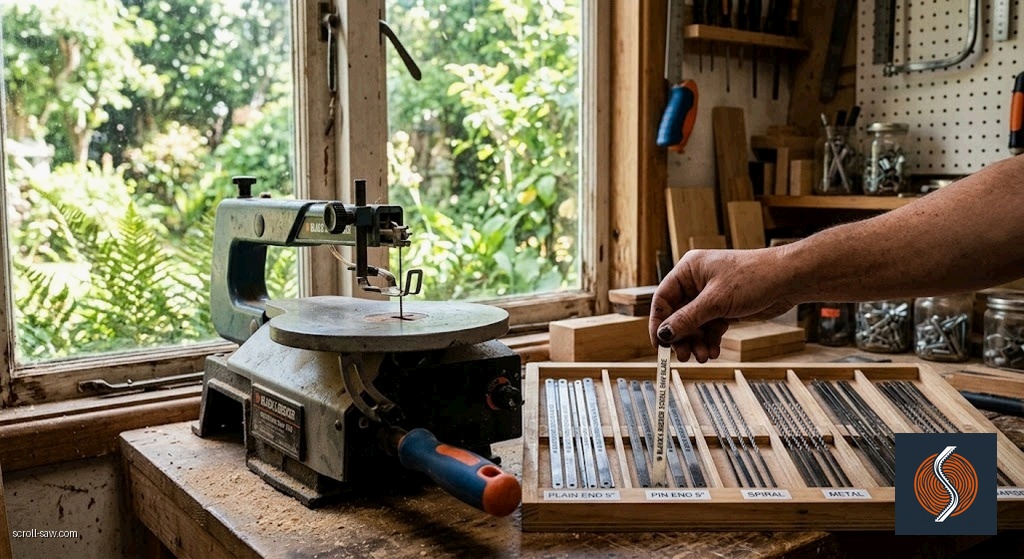
Black and Decker Scroll Saw Blades: What Fits and What to Buy
The Black and Decker scroll saw in the corner of your garage came from a yard sale, or was inherited, or was purchased at Sears in 1998. It works. You just need blades. And the internet keeps offering you “Black and Decker scroll saw blades” that turn out to be generic imports with a photo of a random B&D saw on the package.
The truth is simpler. Black and Decker stopped focusing on scroll saws years ago. The saws they made in the 1980s and 1990s take standard 5-inch pin-end blades, the same blade used by every other pin-end hobby saw. There is no need for a Black and Decker branded blade.
The direct answer
Most Black and Decker scroll saws take 5-inch pin-end blades. The Olson 42401 Pin End 18.5 TPI card and the Olson FR41001 7 TPI 6-pack cover fine and coarse cutting between them. For a budget bulk supply, the JTEX 48-pack pin-end assortment works.
What Black and Decker scroll saws were
Black and Decker made a family of hobbyist scroll saws through the 1980s and 1990s, including 15-inch and 18-inch variable-speed models. Most were sold through Sears (under the Craftsman badge, which was a rebranded B&D on many models) and directly through B&D dealers. They were solid entry-level machines: pin-end blade clamps, cast tables, adequate vibration control for their price.
B&D consolidated its portfolio in the 2000s and shifted focus away from stationary power tools. The scroll saw line quietly discontinued. Existing B&D saws are still cutting in home shops across the country.
Identifying your saw’s blade requirement
Check two things: length and end type.
Length: pull an existing blade if you have one, and measure tip to tip. It’ll be 5 inches for essentially every B&D scroll saw.
End type: look at the blade holders. Pin-end saws have small slots at the top and bottom that accept a crimped pin on the blade. Plain-end saws use set screws or thumbscrews to clamp the blade body. Almost every B&D scroll saw is pin-end. A few later-production models offered plain-end, but they’re the exception.
The right blades to buy
Fine detail work in thin to medium wood. The Olson 42401 Pin End 18.5 TPI card. Thin kerf, tight turns, clean edge on wood 5/32” to 1/2”.
Coarser cuts in thicker stock. The Olson FR41001 6-pack of 7 TPI pinned blades. Hook-tooth aggressive geometry, wood up to 2” thick.
Beginner practice bulk. The JTEX 48-pack pin-end assortment. Softer steel, cheaper per blade, useful while learning to not force the cut.
Very thin metal or plastic work. A dedicated bimetal or high-TPI blade in pin-end format. Selection is thinner. Look for 24 to 32 TPI packs labeled metal-cutting.
Getting the best cuts from a B&D saw
Blade tension. Older B&D saws use a screw-tension mechanism at the top of the arm. Tighten it until a flick of the blade produces a clean, high-pitched ping. Too loose and the blade wanders. Too tight and blades snap.
Table alignment. Check that the blade is 90 degrees to the table. B&D tables slip out of square over decades. Adjust with a small square before starting a project.
Feed pressure. Let the blade do the work. Push gently, keep the piece moving evenly. B&D’s arm design is not the smoothest, and heavy feed pressure amplifies vibration.
Blade clamp condition. After years of use, the pin slots in the clamps can wear, letting the blade rock. If your cuts have started drifting, replace the clamps or accept that the saw is nearing end of life.
Honest reality of using an older Black and Decker
A well-maintained B&D scroll saw cuts fine for hobbyist work. It’s not competitive with modern DEWALT, Rikon, or WEN saws for smoothness or precision, but it doesn’t need to be. If it does what you need, keep using it and feed it good blades.
Who should keep the B&D: casual cutters, occasional users, and anyone who inherited the saw and enjoys the sentimental value.
Who should upgrade: anyone whose cuts are being limited by the saw itself, anyone dealing with worn clamps or excessive vibration, and anyone whose project ambition has outgrown a hobby-grade saw. The WEN 3921 or WEN 3922 is a modern replacement in the same price bracket. For a real step up, look at the Rikon 10-600VS or DEWALT DW788.
The verdict
Black and Decker scroll saws take standard 5-inch pin-end blades. Buy Olson (or JTEX for budget) and skip anything labeled specifically as “Black and Decker scroll saw blades.” That labeling is a marketing convenience, not a product distinction. Same steel, same fit, same cut, whatever the box says.
FAQ
Does Black and Decker still make scroll saws? The original B&D scroll saw line has been discontinued for years. Any saw currently sold under B&D branding for scroll-saw-adjacent work is a jigsaw or similar tool, not a stationary scroll saw.
Can I get replacement parts for a Black and Decker scroll saw? Some parts (belts, bearings, generic hold-downs) are available at industrial suppliers. Proprietary parts (specific blade clamps, tables, arm assemblies) are usually only found through eBay and workshop cleanouts.
Do B&D and Craftsman scroll saws use the same blades? Yes. Many Craftsman scroll saws from the 1990s were rebranded B&D machines. Both take standard 5-inch pin-end blades.
Why does my B&D saw vibrate so much? Older single-arm scroll saw designs vibrate more than modern C-arm designs. A heavy stand helps. Loose blade tension amplifies vibration, so check tension first.
How do I know my B&D saw’s specific model? Check the nameplate on the saw for a model number. If the nameplate is missing, measure the throat depth and note whether it’s pin-end or plain-end to narrow down the family.
Are B&D scroll saws worth restoring? They’re worth using if they run well. Restoring means bearings, belts, and clamps, which is fine if you enjoy the process. For pure economics, replacing with a modern saw is usually cheaper.
What TPI does a B&D saw handle best? Any TPI, since the saw doesn’t care. TPI is about the wood, not the saw. Match TPI to material thickness the same as with any other scroll saw.
References
-
Olson Saw Company product line: olsonsaw.net
-
Vintage Machinery archive, Black and Decker stationary tool history: vintagemachinery.org
-
Scroll Saw Association of the World blade guidance: saw-online.com


