
Rockwell Blade Runner: How It Compares to a Real Scroll Saw
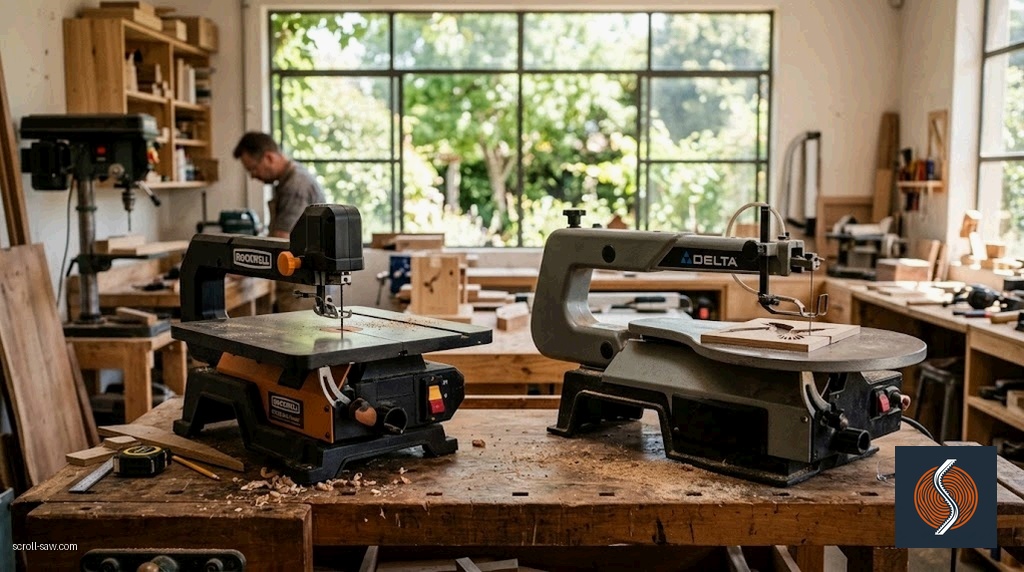
Rockwell Blade Runner: How It Compares to a Real Scroll Saw
You saw a demo. A small tabletop tool cut through wood, sheet metal, ceramic tile, and PVC pipe in the same three minutes. It looked like a scroll saw. The salesperson called it a scroll saw. You bought one, brought it home, and now you’re trying to cut a fretwork pattern with it and the blade won’t turn.
The Rockwell BladeRunner is not a scroll saw. It’s a tabletop reciprocating saw using T-shank jigsaw blades pointed upward through a work surface. That difference matters for what it can actually do.
The direct answer
The Rockwell BladeRunner (models RK7320, RK7323, and BladeRunner X2) is a tabletop reciprocating saw that uses standard T-shank jigsaw blades, not scroll saw blades. It’s good for straight cuts and gentle curves in mixed materials (wood, plastic, thin metal, tile). It’s poor for detailed scroll work, tight curves under about 3/4-inch radius, or interior fretwork cuts. If you need actual scroll saw work, buy a scroll saw.
What the BladeRunner actually is
Rockwell designed the BladeRunner as a hybrid: the versatility of a jigsaw with the stability of a table-mounted tool. The blade projects upward through the table and reciprocates. You feed the workpiece into it, guiding the cut with your hands, using a fence or guide when useful.
T-shank jigsaw blades come in a wide range of materials and TPIs, giving the BladeRunner real flexibility in what it can cut. Wood, plywood, thin non-ferrous metal, PVC, laminate flooring, ceramic tile with the right blade. This versatility is genuinely useful for someone doing mixed home-repair tasks.
Where the BladeRunner fails as a scroll saw
Blade width. The narrowest T-shank jigsaw blade is significantly wider than the smallest scroll saw blade. Turning radius is limited to maybe 3/4 inch at best, versus 1/8 inch or tighter on a scroll saw with a #3 blade.
Blade travel. Jigsaw blades have a wider stroke than scroll saw blades and are held only at the bottom, not clamped at both ends. This means the blade can wander in tight cuts, and it’s less controllable on curved lines.
Interior cuts. A scroll saw lets you drill a pilot hole, thread the blade through, reconnect the top clamp, and cut interior shapes without breaking the outer edge of the workpiece. The BladeRunner cannot do this, because the blade is only held at the bottom.
Speed control and fine cutting. The BladeRunner has speed control, but the stroke is coarser than a scroll saw. Fine detail work is not what it was designed for.
Where the BladeRunner beats a scroll saw
Cutting thicker or harder materials. Ceramic tile up to about 3/8 inch, PVC pipe, sheet metal up to 1/8 inch, laminate flooring. A scroll saw struggles or refuses these.
Straight cuts. With a fence guide, the BladeRunner rips straighter than a scroll saw’s freehand cut.
Portability. It’s small, light, and folds up. A scroll saw is a bench-committed tool.
Cost of blades. T-shank jigsaw blades are cheap and available everywhere.
Who should buy which
Buy a BladeRunner if you want a versatile tabletop cutter for occasional mixed-material projects (home improvement, small tile jobs, PVC cutting, quick wood rips). Skip it if you specifically want to do scroll saw work.
Buy a scroll saw if you want to cut fretwork, portraits, ornaments, intarsia, jigsaw puzzles, or anything with tight curves and interior details. For entry level, the WEN 3921 or WEN 3923 covers most hobby work. For serious work, the DEWALT DW788 or Rikon 10-600VS.
Owning both is entirely reasonable if you have the shop space. They serve different jobs and don’t overlap much.
Blades for the BladeRunner
Any T-shank jigsaw blade fits. Match TPI and material to the job: 6 to 10 TPI for thick wood, 14 to 18 TPI for plywood and thin wood, 24+ TPI for metal, and specific tile-cutting blades for ceramic. These are widely available at any hardware store and online, no need for scroll-saw specific inventory.
Honest drawback of the BladeRunner
The BladeRunner is marketed with demo videos that show it doing scroll-saw-like curved cuts. In practice, curved cuts on the BladeRunner are wobbly, radius-limited, and rough compared to what a real scroll saw does. Buyers who saw the demo and expected fretwork are consistently disappointed. It’s not a bad tool, it’s just marketed misleadingly.
Who should be happy with a BladeRunner: renovators, DIY repair folks, and anyone doing occasional mixed-material cuts.
Who should return it and buy a scroll saw: anyone whose actual goal is detailed wood cutting.
The verdict
The Rockwell BladeRunner is a useful little hybrid, but not a substitute for a real scroll saw. It uses jigsaw blades, cuts a wider range of materials than a scroll saw, and handles thick or hard materials better. It doesn’t turn tight curves, can’t do interior cuts, and doesn’t produce the finish quality that a scroll saw does on wood. Buy the right tool for your actual project, not for the demo video.
FAQ
Is the Rockwell BladeRunner a scroll saw? No. It’s a tabletop jigsaw. The blade is T-shank jigsaw stock, not scroll saw stock, and it’s held only at the bottom.
Can I do scroll-saw-style detail work on a BladeRunner? No. The blades are too wide for tight curves and the tool has no way to accept plain-end scroll saw blades. Any detail work needs a real scroll saw.
What blades fit a BladeRunner? Any standard T-shank jigsaw blade. Wide selection, cheap, available everywhere.
Is the BladeRunner good for cutting tile? Yes, with a diamond or ceramic jigsaw blade. It’s one of the tool’s better use cases.
Should I buy a BladeRunner instead of a scroll saw? Only if you need multi-material cutting flexibility more than scroll saw detail. They serve different needs.
Where do BladeRunner replacement parts come from? Rockwell (positec) sells parts directly and through some retail channels.
Can I convert a BladeRunner to use scroll saw blades? No. The blade holder is designed for T-shank jigsaw blades. Scroll saw blades have no compatible mounting.
References
-
Rockwell Tools BladeRunner product information: rockwelltools.com
-
Consumer reviews and shop tool comparisons on ToolGuyd: toolguyd.com
-
Scroll Saw Association of the World, scroll saw versus jigsaw distinctions: saw-online.com


