
Diamond Wire Scroll Saw Blade: When a Wire Cuts Better Than a Blade
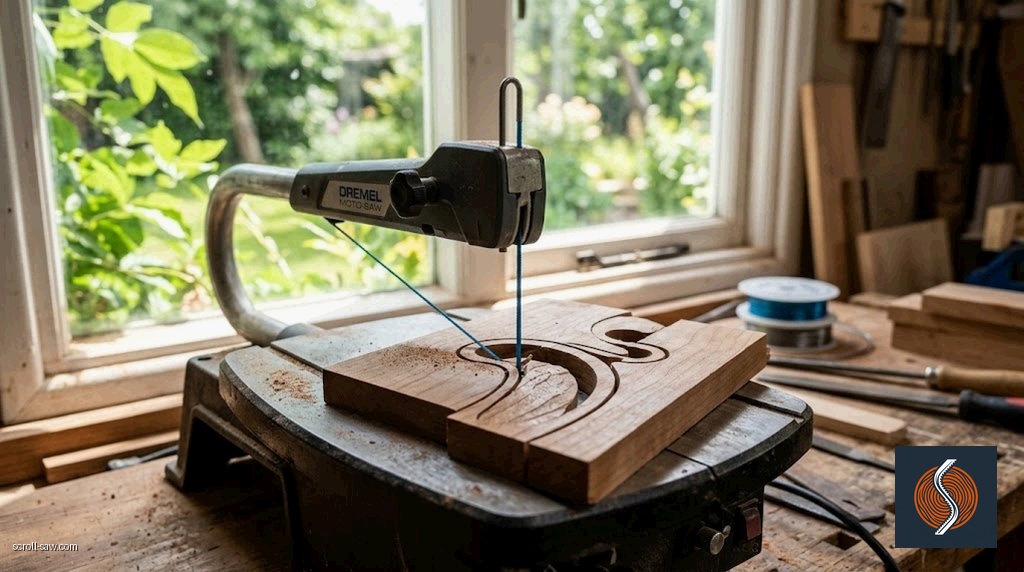
Diamond Wire Scroll Saw Blade: When a Wire Cuts Better Than a Blade
Most scroll saw blades are flat strips with teeth. A diamond wire scroll saw blade is different in every way. It’s a thin round rod with diamond grit bonded around its full circumference. Instead of teeth pointing down, the whole cylinder is abrasive, front, back, sides, all of it.
That single design change matters when you’re cutting in directions a flat blade can’t handle.
The direct answer
A diamond wire scroll saw blade is a round wire with diamond grit bonded all around. It cuts in any direction from the workpiece, has no set kerf orientation, and turns as tightly as you can move the piece. Use it for glass, gemstones, seashell, thin ceramic, and other hard materials where a flat blade’s directional kerf gets in the way. Feed slowly with water, and expect a shorter blade life than flat diamond blades.
Why a wire beats a flat blade in some situations
A flat diamond scroll saw blade cuts a kerf as wide as the blade. Turn the workpiece, and the kerf turns with it. Straight cuts and gentle curves work fine. Very tight interior turns start pinching the blade because the kerf can’t follow the workpiece angle.
A diamond wire has no kerf orientation. The cut kerf is a round hole. Turn the workpiece in any direction and the wire follows. Tight interior curves, figure-eights, and multi-directional cuts happen effortlessly.
This is exactly what you need for jewelry-scale glass or shell work, for cutting complex inlay shapes, and for gemstone cutting where the wire acts as a very small kerf cutter.
Where diamond wire shines
Small glass inlays with tight curves. Under an inch across, complex outlines.
Mother of pearl and abalone shell. For instrument inlays, jewelry, boxes.
Thin natural stone (marble, alabaster, soapstone). Decorative work at small scale.
Semi-precious gemstone for lapidary work. Preforming rough stones.
Ceramic tile detail cuts. For mosaic makers who want unusual shapes.
Where diamond wire fails
Straight cuts. The wire wanders. A flat blade or a proper wet saw cuts straighter.
Thick material. More than about 1/4 inch, and the wire flexes into the cut, wandering. Wire blades are for thin stock.
Wood or plastic. The wire has no clearance geometry for chip removal in soft materials. Kerf packs, blade heats up, cutting stops.
Metal. Similar problem, plus the diamond bond isn’t optimized for metallic chip loading.
Setup and technique
Cool the wire. Wet cutting is essential. Set up a drip line or use a wet sponge kept fresh throughout the cut. The wire heats fast because there’s no chip clearance and no tooth breaks. Heat kills the diamond bond.
Feed extra slowly. The wire doesn’t have teeth to bite the material. It grinds. Push very lightly. Rushing dulls the wire in minutes.
Tension the wire moderately. Wires can snap if over-tensioned. Follow the manufacturer’s spec, and start conservative.
Support the workpiece. Small workpieces vibrate against a bare table. Back with a rubber pad, and clamp when practical.
Expect blade replacement. Diamond wire is a consumable. A single wire may last one small project.
What to buy
Diamond wire scroll saw blades sit in the smallest corner of the blade market. General hardware stores don’t carry them. Amazon has thin selection. Best sources: stained glass suppliers (Delphi Glass, Anything in Stained Glass), lapidary suppliers (Kingsley North, Diamond Pacific), and jewelry-making suppliers (Rio Grande).
Confirm blade length matches your saw (5” for most scroll saws, 6” for Hegner) and end type (plain-end for nearly all diamond wire; pin-end diamond wire is essentially unavailable).
Honest drawbacks
Expensive per cut. A single diamond wire scroll saw blade costs multiple times what a good wood blade costs, and lasts a fraction as long.
No blade guide help. The wire is a smooth cylinder, so the saw’s blade guides can’t clamp on it the way they clamp on a flat blade. Some scrollers remove the upper guide entirely for diamond wire work.
Messy. Wet grinding of glass or stone throws slurry everywhere. Set up a dedicated area or protect the work zone.
Limited to thin material. Not a general-purpose blade even within diamond work. A flat diamond blade covers thicker stock more practically.
Who should own a diamond wire blade: jewelry makers, guitar builders using shell inlay, lapidary hobbyists, stained glass artists cutting very small complex shapes.
Who should skip: anyone doing wood, plastic, or metal work exclusively.
The verdict
Diamond wire is a specialty tool for specialty work. If your project involves small, complex shapes in glass, shell, stone, or gemstone, and you already own a plain-end scroll saw, a diamond wire blade is the tool. For everything else, a flat diamond blade or a conventional scroll saw blade does the job faster and cheaper.
FAQ
Is diamond wire the same as a diamond band saw? Related but not the same. Band saws use a continuous loop of diamond wire or band. Scroll saw diamond wire is a short segment clamped like any scroll saw blade.
Can I use diamond wire in a wood scroll saw? Yes. Any plain-end scroll saw can accept a diamond wire blade. The saw doesn’t know what’s clamped in it.
Do diamond wire blades cut in both directions of the stroke? Yes. Because the whole cylinder is abrasive, both up and down strokes cut. Cutting is more continuous than with toothed blades.
How thin can diamond wire cut? Very thin. The kerf is roughly the wire diameter (typically 0.5 to 1 mm). Great for fitting inlay pieces snugly.
Do diamond wire blades break often? Yes, more often than flat diamond blades. Handle gently, tension moderately, and expect replacement.
Where do I get diamond wire scroll saw blades? Stained glass, jewelry, and lapidary suppliers. Delphi Glass and Rio Grande carry them. Amazon selection is thin.
Can I cut PCB or fiberglass with diamond wire? Better to use a carbide grit blade for those. Diamond wire works but is overkill and blade life is short.
References
-
Delphi Glass diamond wire and cutting supplies: delphiglass.com
-
Rio Grande jewelry-making tool catalog: riogrande.com
-
Diamond Pacific lapidary blade selection: diamondpacific.com
-
International Guild of Glass Artists: igga.org


