
Different Types of Scroll Saw Blades: The Full Family Tree
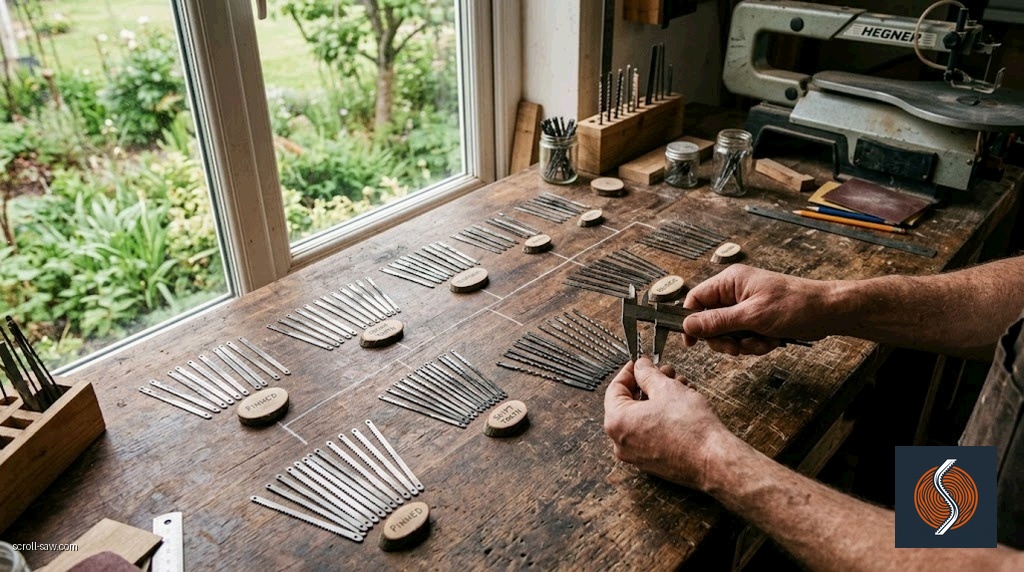
Different Types of Scroll Saw Blades: The Full Family Tree
Every scroll saw blade in the drawer belongs to one of seven main types. Once you learn the names and jobs of the seven, blade shopping stops feeling like a lottery.
The direct answer
The seven main types of scroll saw blade are: skip-tooth, reverse-tooth, double-tooth, precision-ground, spiral, crown-tooth, and metal-cutting (bimetal or carbide). Each type has a specific job. Owning one pack of skip-tooth and one pack of reverse-tooth covers the majority of hobbyist work. Add other types as projects demand.
The seven types, one by one
1. Skip-tooth
Every second tooth is missing, creating gaps that let chips fall out of the kerf. General-purpose. Fast cutting in soft to medium wood. Rougher underside than reverse-tooth.
Best for: general practice, thick softwood, projects where the underside doesn’t show.
Example pack: Olson FR49400 Skip Tooth 36-pack.
2. Reverse-tooth
The bottom third of teeth face upward instead of downward, cutting the underside of the wood as the blade travels down. Result: cleaner bottom edge, less tearout on the exit face.
Best for: projects where both faces show (ornaments, portraits, decorative signs).
Example pack: Olson FR49202 Reverse Tooth assortment.
3. Double-tooth
Pairs of teeth separated by a gap, similar to skip-tooth but with denser tooth pairs. Cuts faster than skip-tooth with slightly cleaner edges. Good compromise between speed and finish.
Best for: intermediate work, hardwood at moderate thickness, when speed and quality both matter.
Example pack: Olson DT49300 Double Tooth.
4. Precision-ground
Teeth ground rather than milled. Sharper cutting edges give faster feed rates and cleaner finish. Costs more per blade.
Best for: fine detail work, hardwood pieces where finish matters, intarsia and marquetry.
Example pack: Olson PG45502 Precision Ground.
5. Spiral
The blade is twisted along its length, so teeth face every direction. Cuts sideways, forward, and backward. Turns in any direction without rotating the workpiece.
Best for: portrait work, large workpieces that can’t be rotated, cuts requiring 360-degree flexibility.
Drawback: doesn’t cut straight lines cleanly.
Example pack: Olson SP46500 Spiral.
6. Crown-tooth
Teeth alternate pointing up and down along the blade. Cuts on both up and down strokes. Rarely used today but excellent for very thin plastic and veneer.
Best for: acrylic, thin plastic, veneer under 1/8” thick.
Drawback: obscure in modern retail, not stocked by mainstream suppliers.
7. Metal-cutting (bimetal and carbide)
Specialized for non-wood materials. Bimetal uses HSS teeth welded to spring-steel body, cutting brass, copper, aluminum, and mild steel sheet. Carbide uses tungsten-carbide grit for abrasive materials like phenolic, fiberglass, and PCB.
Best for: metal, plastic, and composite work.
Drawback: cuts wood poorly, expensive per blade.
What most scrollers actually own
Minimum starter: one pack of reverse-tooth in a #5. Covers roughly 70% of casual wood scrolling.
Common intermediate kit: reverse-tooth in #3 and #5, skip-tooth in #7, one spiral pack.
Serious hobbyist kit: reverse-tooth (#3 and #5), skip-tooth (#5 and #7 or #9), precision-ground (#5), spiral (one pack), plus a bimetal pack for occasional metal work.
Budget bulk packs to fill out are worth having for practice: JTEX 48-pack pin-end assortment for pin-end saws, Olson FR49400 36-pack skip-tooth for plain-end.
Honest tradeoffs across types
Every type is a compromise. Reverse-tooth cuts cleaner but slightly slower than skip-tooth. Precision-ground cuts faster and cleaner but costs more per blade. Spirals cut in any direction but track badly. Crown-tooth is great for thin plastic but hard to find. Metal blades cut metal well but wood poorly.
No single blade type wins everything. Match the type to the project.
Who should learn all seven: serious scrollers doing varied work.
Who can stay on two: casual scrollers doing similar projects repeatedly.
The verdict
The seven types cover the entire scroll saw blade universe. Own at least skip-tooth and reverse-tooth in a #5, add spiral when you need it, and add precision-ground when your finish work justifies the cost. Metal blades enter the drawer only when metal projects arrive. Learn the types once, save the blade-selection guessing forever.
FAQ
What’s the difference between skip-tooth and double-tooth? Skip-tooth alternates single teeth with gaps. Double-tooth alternates pairs of teeth with gaps. Double-tooth cuts a little smoother.
Are ultra-reverse and reverse-tooth the same? Similar concept, different implementation. Ultra-reverse has more of the blade’s teeth pointing upward, giving even cleaner underside. Flying Dutchman popularized ultra-reverse.
Can I use spiral blades all the time? You can, but the finish is rougher and straight cuts are difficult. Spirals belong in the drawer for specific jobs.
Are precision-ground worth the price for beginners? Most beginners won’t notice the difference at first. Buy them once you’ve hit the limits of standard blades.
Which type breaks least often? Wider blades (#5, #7, #9) in standard steel break less than narrow blades (#2/0, #3). Beginners can start with wider blades to reduce breakage while learning.
Do all seven types exist in both pin-end and plain-end? Most do. Spiral, precision-ground, and specialty geometries appear more often in plain-end selections. Pin-end limits some tooth patterns.
Where do I find the more obscure types (crown-tooth, ultra-reverse)? Mike’s Workshop for Flying Dutchman patterns. Bear Woods and Rockler carry specialty types. Amazon has limited selection.
References
-
Olson Saw Company full blade type reference: olsonsaw.net
-
Flying Dutchman blade type overview, Mike’s Workshop: mikesworkshop.com
-
Pégas Sawblades product line: pegas-swiss.com
-
Scroll Saw Association of the World, blade type fundamentals: saw-online.com


