
Flying Dutchman Scroll Saw Blade Chart: Size, Tooth Geometry, and Material Guide
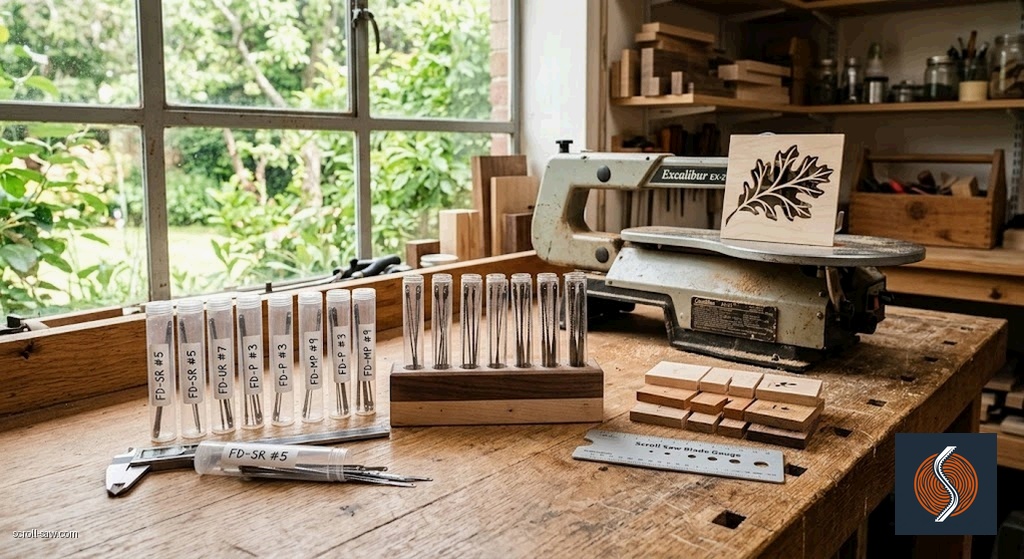
Flying Dutchman Scroll Saw Blade Chart: Size, Tooth Geometry, and Material Guide
Mike’s Workshop lists dozens of different Flying Dutchman blade options once you count sizes, patterns, and specialties. That’s a lot of choice, and most of it is overkill unless you cut for a living. This chart maps the useful subset to real projects.
The direct answer
The most useful Flying Dutchman blades for hobbyists are the Ultra Reverse pattern in sizes #2/0, #3, #5, and #7, plus New Spiral #1 for portrait and multi-direction cuts. Ultra Reverse covers cleanest underside; New Spiral covers turning without rotating the workpiece. Add the Polar pattern for softer feel on hardwood detail work.
The blade chart
| Flying Dutchman blade | Best material | Thickness range | Best use |
|---|---|---|---|
| Ultra Reverse #2/0 | Hardwood, plywood | 1/8” to 1/4” | Fretwork, tiny interior cuts |
| Ultra Reverse #1 | Hardwood, plywood | 1/8” to 3/8” | Fine detail, ornaments |
| Ultra Reverse #3 | Hardwood, plywood | 1/4” to 1/2” | Detail work, tight curves |
| Ultra Reverse #5 | Hardwood, softwood | 3/8” to 3/4” | General purpose, sweet spot |
| Ultra Reverse #7 | Hardwood, softwood | 1/2” to 1” | Medium thickness, cleaner underside than skip-tooth |
| Ultra Reverse #9 | Hardwood, softwood | 3/4” to 1.5” | Thick stock with clean bottom |
| Ultra Reverse #12 | Softwood mostly | 1” to 2” | Very thick, straight and sweeping cuts |
| Polar #3 | Hardwood | 1/4” to 1/2” | Fine detail, softer feel than UR |
| Polar #5 | Hardwood | 3/8” to 3/4” | General detail, hardwood focus |
| New Spiral #3/0 | Any wood | Under 1/2” | Very fine multi-direction cuts |
| New Spiral #1 | Any wood | 1/4” to 3/4” | Portrait work, standard spiral |
| New Spiral #3 | Any wood | 1/2” to 1” | Larger portraits, medium stock |
| Ranger #5 | Softwood | 3/8” to 1” | Fast rough cutting |
| Jeweler #4 | Metal, thin plastic | Under 1/16” metal | Precision metal work |
Which packs actually to buy
For a beginner sampling Flying Dutchman for the first time:
Ultra Reverse 60-piece Variety Pack. Best single starter. Multiple sizes of UR to find preferences.
For a hobbyist committing to Flying Dutchman:
Ultra Reverse #5 72-piece. The workhorse size in bulk.
Ultra Reverse #3 6-dozen. For detail work.
Ultra Reverse #2/0 6-dozen. For very fine fretwork.
Ultra Reverse 5-dozen assortment. Mixed sizes for varied projects.
For spiral work:
New Spiral #1 6-dozen. Standard portrait spiral.
New Spiral #3/0 6-dozen. For very fine multi-direction cuts.
For a different feel on detail work:
Polar 5-dozen. Try alongside Ultra Reverse.
Understanding the pattern names
Ultra Reverse (UR). Double-reverse pattern with more upward-facing teeth than standard reverse. Cleanest underside cut.
Polar. Double-reverse variant with different tooth spacing. Some scrollers prefer its feel in hardwood detail.
New Spiral. Modernized spiral with better tracking than legacy spirals. Still cuts in any direction, but with less wander.
Ranger. Skip-tooth pattern with aggressive geometry for fast material removal.
Jeweler. Very narrow, high-TPI for fine metal work.
Choosing between UR and Polar
Both are double-reverse. Ultra Reverse tends to cut slightly more aggressively with cleaner underside. Polar tends to feel smoother in hardwood detail work.
Most scrollers eventually settle on UR as their default and reach for Polar occasionally. Try one pack of each to find your preference.
Where to buy
Mike’s Workshop directly is the primary source and often stocks patterns Amazon doesn’t. Amazon carries a curated selection through third-party sellers, usually authorized. Rick Hutcheson also distributes in the US.
Honest reality of the chart
This chart is opinionated. Different scrollers use different sizes for the same material. The chart reflects common preferences, not universal rules. Adjust to your feel.
Blade wear and tension affect how each blade cuts. A #5 UR with worn teeth cuts more like a #3. A well-tensioned #7 sometimes cuts like a #5.
Who benefits from this chart: scrollers new to Flying Dutchman who need a starting point.
Who can ignore it: experienced Flying Dutchman users who already know their preferences.
The verdict
Start with Ultra Reverse #5 and add sizes as projects demand them. Add spirals when portrait work enters the project list. Try Polar as a comparison to UR once you’re familiar with the standard pattern. Skip Ranger, Jeweler, and specialty patterns until specific projects call for them.
FAQ
Are Flying Dutchman blade numbers the same as Olson numbers? Mostly. Both use the industry standard sizing. Minor width and TPI differences between brands even within the same number.
Does Flying Dutchman offer pin-end blades? A small selection. Most of the Flying Dutchman range is plain-end.
How many blades come in Flying Dutchman packs? Standard is 12 (one dozen) per size. Bulk packs of 5 dozen or 6 dozen are common. Variety packs mix sizes.
What’s the difference between #3 and #3R? Some Flying Dutchman product names use suffixes to indicate specific pattern variants. Read the pack description to confirm which pattern is inside.
Do Flying Dutchman blades work on WEN, Bauer, or other budget saws? Only if the saw is plain-end. Most Flying Dutchman blades are plain-end.
Can I mix Flying Dutchman blades with other brands in the same drawer? Absolutely. Many scrollers keep multiple brands and use each for its strength.
Where do I get Flying Dutchman fret saw blades? Mike’s Workshop carries a fret saw blade line. Different length from scroll saw blades and not interchangeable with a power scroll saw.
References
-
Mike’s Workshop Flying Dutchman product catalog: mikesworkshop.com
-
Scroll Saw Woodworking & Crafts magazine blade reviews
-
Scroll Saw Association of the World: saw-online.com
-
Steve Good’s Scroll Saw Workshop: scrollsawworkshop.blogspot.com


