
Hitachi Scroll Saw Blades: TPI, Kerf, Radius, and Finish Explained
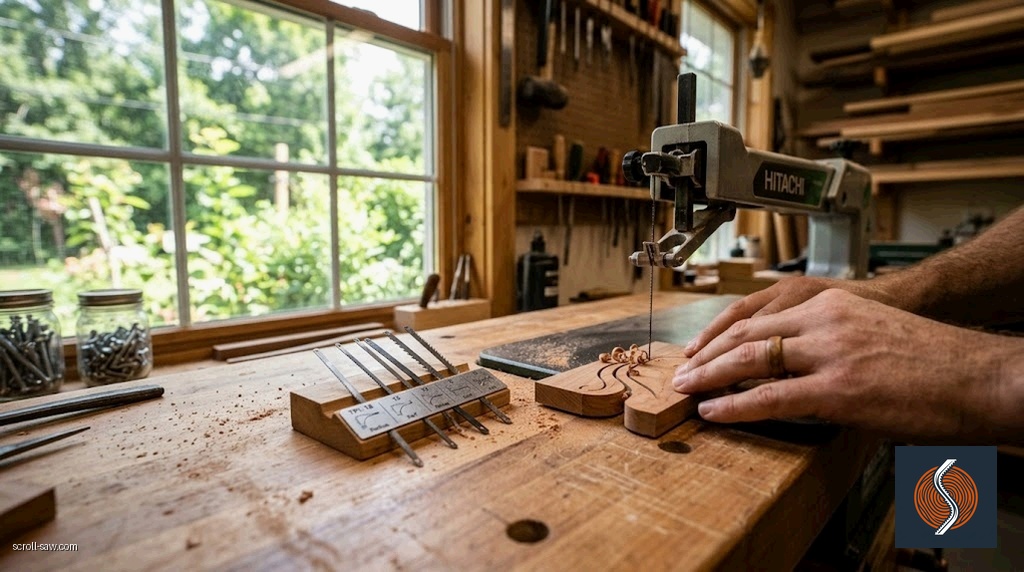
Hitachi Scroll Saw Blades: TPI, Kerf, Radius, and Finish Explained
The Hitachi CW40 has been a workhorse in home shops since the late 1990s. Solid cast-iron table, reasonably smooth arm motion, pin-end blade clamps. The current version is branded Metabo HPT after Hitachi’s power tool division renamed. Same saw, different label.
Blades are the same story. Standard 5-inch pin-end. No need to hunt for Hitachi-branded blades.
The direct answer
The Hitachi CW40 and current Metabo HPT scroll saws take standard 5-inch pin-end blades. The Olson 42401 Pin End 18.5 TPI card and the Olson FR41001 7 TPI 6-pack cover fine and coarse cutting between them. For budget bulk, JTEX 48-pack pin-end assortment.
About the Hitachi CW40
Hitachi’s CW40 is a 16-inch pin-end scroll saw with variable speed (400 to 1,600 SPM), tilting table (up to 45 degrees), and cast-iron construction. Weight around 40 pounds. Motor around 60 watts.
Strengths: cast iron mass keeps vibration reasonable. Variable speed helps with detail work. Tilting table opens beveled cuts.
Weaknesses: pin-end clamps limit blade selection. Blade change speed is average. The stock dust blower is underpowered.
Most CW40 saws in home shops today are 15+ years old. Still cutting fine on standard blades.
Blade specifications for a CW40
Length. 5 inches (127 mm). Standard scroll saw length.
End type. Pin-end. Blades have a small crimped pin at each end that drops into a slot in the blade holder.
Width range. The clamps accept blade widths from about 0.020” to 0.055”, covering the entire standard pin-end range.
Compatible blades. Any 5-inch pin-end blade from any reputable brand.
What to buy
Fine detail cuts in wood 5/32” to 1/2” thick. Olson 42401 Pin End 18.5 TPI card. Thin kerf, clean edges.
Thicker stock, up to 2” wood. Olson FR41001 6-pack 7 TPI pinned. Aggressive tooth geometry, cooler running.
Beginner bulk supply. JTEX 48-pack pin-end assortment. Softer steel, cheaper per blade.
Higher quality pin-end (harder to find). Some specialty scroll saw suppliers stock premium pin-end blades. Selection is limited compared to plain-end.
Getting the best out of a CW40
Blade tension. Use the top-mounted tension knob to firm the blade until a plucked blade produces a clear high ping. Avoid over-tensioning; pin-end pins can rip out of the blade under excessive force.
Table square check. Set a small engineer’s square against the blade and verify 90 degrees. Adjust the tilt lock if needed.
Blade orientation. Teeth point down toward the table. Look at the tooth angle before installing.
Feed pressure. Let the blade cut. Push just enough to keep chips forming. Excess pressure snaps blades and bends pins.
Stock blower upgrade. The CW40’s built-in blower is weak. Consider adding an aquarium-pump-based DIY dust blower or an aftermarket kit.
Kerf and turn radius for a CW40
Pin-end blades have slightly wider kerf than equivalent plain-end due to the pins themselves in the material. For a #5 pin-end blade, expect roughly 0.040” kerf. Minimum turn radius similar to plain-end for the equivalent size:
-
#3 pin-end: about 1/16” minimum radius
-
#5 pin-end: about 1/8” minimum radius
-
#7 pin-end: about 3/16” minimum radius
Interior cuts require drilling a pilot hole large enough for the pin to pass through, which is usually 3/32” or bigger. Compare to plain-end where a much smaller pilot hole works.
Honest reality of the CW40
A well-maintained Hitachi CW40 is a solid hobbyist saw. It doesn’t compete with a DEWALT DW788 or Rikon 10-600VS for smoothness, and its pin-end format limits blade selection. But for casual work in wood up to about 1.5” hardwood or 2” softwood, it does the job.
Who should keep a CW40: casual scrollers happy with pin-end, and anyone whose saw is still running well after a decade.
Who should upgrade: anyone doing frequent interior fretwork (plain-end quick-change saws are much faster), or anyone whose blade selection is being limited by pin-end availability.
The verdict
Hitachi and Metabo HPT scroll saws take standard 5-inch pin-end blades. Buy Olson for the best mainstream quality, JTEX for bulk beginner supply. Skip anything specifically labeled “Hitachi scroll saw blades” unless it’s Olson or a comparable premium brand rebadged with the Hitachi logo. Same blades, different box.
FAQ
Does Hitachi still make scroll saws? The brand renamed to Metabo HPT. Current scroll saws under the Metabo HPT badge are similar to the historical CW40 line.
Where do I get replacement parts for a Hitachi CW40? Metabo HPT authorized service centers, and some parts through eBay and industrial suppliers. Consumables (belts, blades, hold-downs) are generic.
Can I convert a CW40 to accept plain-end blades? Not practically. The clamps are designed for pins. Aftermarket adapters exist but rarely hold plain-end blades securely.
Is a CW40 worth restoring if it stops working? Depends on what stopped. Belts and switches are cheap. Motor or arm damage usually makes the repair uneconomic; a modern replacement costs about the same.
What’s the closest current equivalent to a CW40? Metabo HPT’s current scroll saw line, the WEN 3922, or the WEN 3923 all cover similar ground. For a real step up, plain-end saws like Rikon 10-600VS or DEWALT DW788.
Are Hitachi-branded blade packs any different from generic blades? No. Hitachi doesn’t manufacture blades. Any Hitachi-branded pack is a rebadged blade from a third-party maker.
Do CW40 pin holders wear out? Over years of heavy use, yes. Symptoms include blade rocking at the top of the stroke and cuts drifting. Replacement clamp assemblies are available through Metabo HPT service.
References
-
Metabo HPT (formerly Hitachi) power tool documentation: metabo-hpt.com
-
Olson Saw Company product line: olsonsaw.net
-
Scroll Saw Association of the World: saw-online.com
-
Old Woodworking Machines Forum, CW40 restoration threads: owwm.org


