
A Practical Selection Guide to Jewelers Scroll Saw Blades
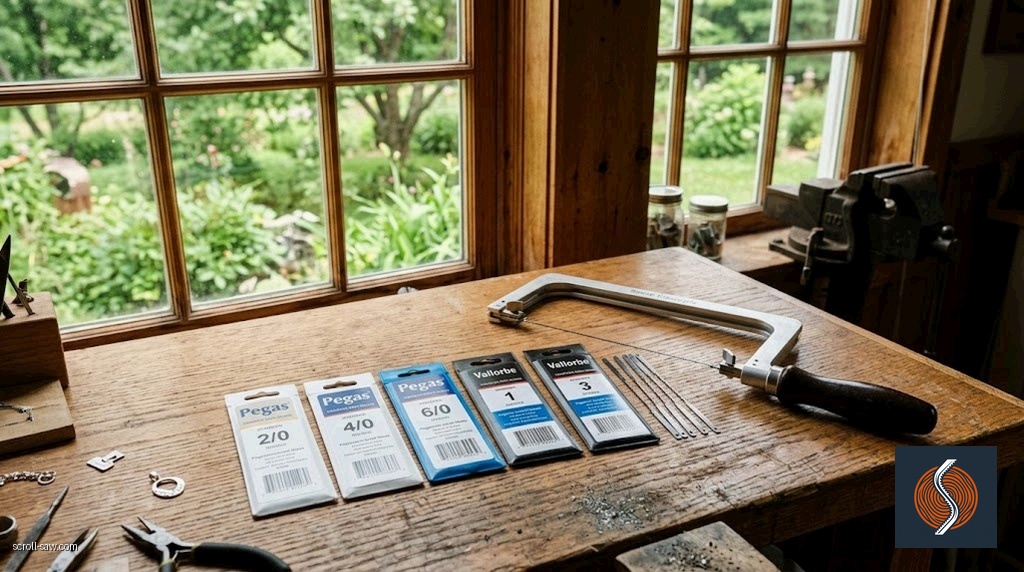
A Practical Selection Guide to Jewelers Scroll Saw Blades
Jewelers’ blades and scroll saw blades overlap in name, but they’re not always the same thing. A blade sold for a benchtop scroll saw is not the same as a piercing saw blade in a jeweler’s fret saw. Confusing the two leads to broken blades and bad cuts.
The direct answer
Jewelers scroll saw blades are very high-TPI, very narrow blades for cutting metal, hardwood detail, and small precision work. In a benchtop scroll saw, they’re typically labeled as fine blades (#3/0 to #2/0 sizes). In a jeweler’s fret saw or piercing saw, they’re 3-inch blades numbered 8/0 (finest) to 4 (moderate). Different tools, different lengths, sometimes overlapping fineness.
Two very different tools
Benchtop scroll saw with jeweler-grade blades. A regular scroll saw (DEWALT DW788, Rikon 10-600VS, etc.) loaded with fine wood blades or specialty metal blades. Blades are 5 inches long.
Handheld piercing saw or Knew Concepts fret saw. Used at a bench pin with blades 3 inches long, numbered 8/0 (very fine) through 4 (coarser). This is the traditional jeweler’s tool.
Same job (fine metal cutting), different tools, different blades.
Blade numbering for piercing saw blades
Jeweler numbering runs from very fine to moderate:
| Blade # | Approximate TPI | Best for |
|---|---|---|
| 8/0 | ~90 | Very fine metal, filigree |
| 6/0 | ~80 | Fine metal, small piercing |
| 4/0 | ~66 | Common fine work |
| 2/0 | ~56 | Standard fine work |
| 0 | ~50 | General jeweler cuts |
| 1 | ~46 | Slightly heavier metal |
| 2 | ~41 | Metal 20 to 22 gauge |
| 4 | ~36 | Metal 18 gauge |
Materials and matching blades
Silver 24 gauge and thinner. 8/0 or 6/0 piercing blade.
Silver 22 to 20 gauge. 4/0 or 2/0.
Silver 18 gauge. 0 or 1.
Brass and copper. Similar to silver by gauge.
Aluminum. Coarser blade for its thickness. Aluminum is soft and packs teeth easily.
Steel. Bimetal blades. Piercing saw blades don’t cut steel well.
What to buy
For benchtop scroll saw jeweler-grade work: Flying Dutchman Ultra Reverse #2/0 6-dozen is the finest widely-available scroll saw blade. Handles very fine wood and thin non-ferrous metal.
For piercing saw work: Rio Grande, Otto Frei, and Contenti carry Herkules, Antilope, and Laser Gold branded piercing saw blades. Not typically on Amazon; buy directly from jewelry suppliers.
For crossover work in wood: Olson SP46500 Spiral for very fine wood detail on a benchtop saw. Flying Dutchman New Spiral #3/0 for very fine multi-direction cuts.
Technique for fine metal cutting on a scroll saw
Slow speed. Set the saw to its lowest SPM. Fast strokes generate heat and pack teeth.
Cutting wax or beeswax. Rub the blade on beeswax before each cut. Reduces friction, extends blade life.
Backer board. Sandwich the metal between two pieces of thin plywood or MDF. Prevents burrs and gives the blade something to grip.
Light feed pressure. Metal resists cutting more than wood. Push gently and let the blade do the work.
Watch for heat. Blade discoloration or workpiece warping means it’s overheating.
Change blades often. Metal dulls blades faster than wood.
Technique for fine wood cutting
Standard scroll saw setup. Same tension test, same feed technique as regular scroll saw work.
Watch for chipping. Fine blades in hardwood can chip out the edge. Slow the feed rate.
Support small pieces. Very small workpieces flex; back them with a scrap or hold them in a vise-supported fixture.
Honest tradeoffs
Jeweler-grade blades in a benchtop scroll saw are useful but limited. The saw is faster than a hand piercing saw but less precise for very small work. For jewelry-scale detail, most professionals still prefer a Knew Concepts fret saw or traditional piercing saw.
A benchtop scroll saw with fine blades is great for wooden marquetry, model making, and detail fretwork. Not the best tool for jewelry-scale metal work.
Who benefits most from jeweler-grade scroll saw blades: hobbyist scrollers doing occasional detail work.
Who should use a piercing saw instead: anyone doing serious jewelry-scale metal cutting.
Compatible saws
Any scroll saw with plain-end blade clamps can use fine plain-end blades. Pin-end saws are more limited; the finest widely-available pin-end blade is the Olson 42401 Pin End 18.5 TPI card, which is fine but not jeweler-grade.
For jeweler-scale work, prefer a plain-end saw or move to a handheld piercing saw.
The verdict
Jewelers scroll saw blades split into two categories: fine plain-end blades for benchtop saws, and short piercing saw blades for jewelry work. Match tool to blade. Neither is universally better. A benchtop saw with Flying Dutchman UR #2/0 handles most fine hobbyist detail work. Jewelry professionals reach for a Knew Concepts fret saw with piercing blades.
FAQ
Can I cut silver on a benchtop scroll saw? Yes, with a fine plain-end blade (metal-cutting bimetal or very fine wood blade). Slow speed, cutting wax, and backer board are important.
What’s the finest scroll saw blade for wood? #2/0 in most brands, occasionally #3/0. Flying Dutchman and Pégas make both.
Are jewelers blades sharper than wood blades? Sharper edge geometry, more teeth per inch. Not “sharper” in a durability sense.
Do jewelers blades break more easily? Yes. Very high TPI and narrow width means high fragility. Buy in bulk.
Can I use piercing saw blades in a benchtop scroll saw? No. Piercing saw blades are 3 inches; scroll saw blades are 5 inches. Not interchangeable.
What’s the best all-purpose jeweler-grade blade for hobbyist scroll saw work? Flying Dutchman Ultra Reverse #2/0 for wood. Bimetal for metal.
Where do I buy piercing saw blades? Rio Grande, Otto Frei, Contenti. Specialty jewelry suppliers.
References
-
Rio Grande jewelry saw blade selection: riogrande.com
-
Otto Frei jewelry-making tools: ottofrei.com
-
Flying Dutchman fine blade specifications: mikesworkshop.com
-
Knew Concepts fret saw information: knewconcepts.com


