
Is a Small Scroll Saw Useful? A Practical Answer
Is a Small Scroll Saw Useful? A Practical Answer
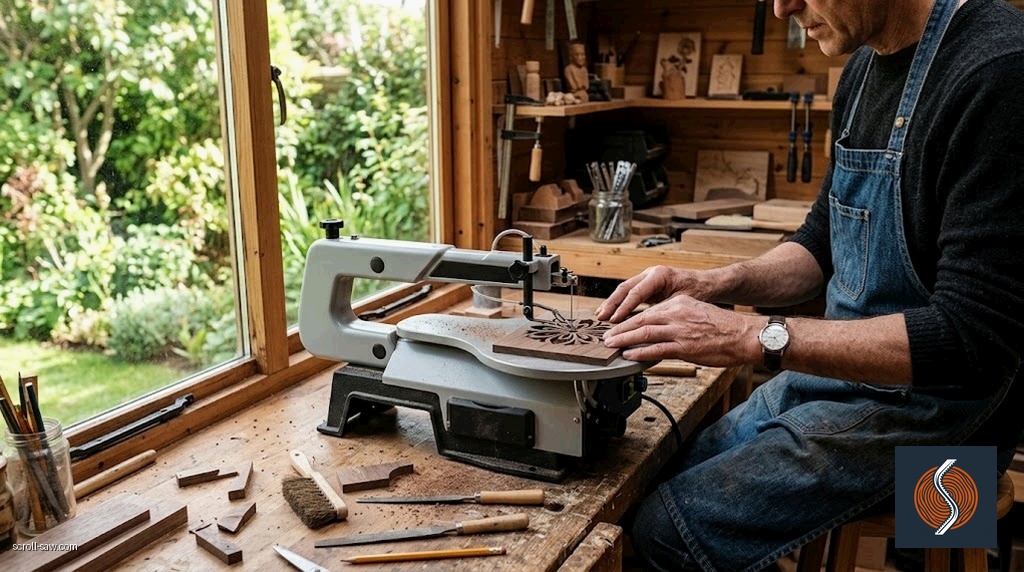
A small scroll saw sits in one of two spots in a workshop. Either it is the primary machine because space is tight and a larger saw simply will not fit, or it is a specialist that lives on a shelf and comes out for specific tasks a bigger machine cannot do as well. Both roles are legitimate. What is not legitimate is the assumption that a small scroll saw is a compromised version of a full-size one. It is a different tool with different strengths.
After running a compact scroll saw alongside a 21-inch full-size machine for the past three years, I can tell you exactly where each one wins, and where a small saw quietly does the better job.
What counts as a small scroll saw
The scroll saw market splits into three rough size classes.
Mini or hobby saws have a throat depth of about 10 to 12 inches, weigh under 15 pounds, and often run on a small universal motor. Examples include the Proxxon DSH/E and the Dremel Moto-Saw. These are used for jewelry, model work, and light craft cutting.
Compact benchtop saws run 14 to 16 inches of throat, weigh 25 to 45 pounds, and have variable speed with a real induction or brushed motor. The WEN 3920 and 3921, the Rockwell BladeRunner, and the older Delta Q3 sit in this class. This is what most people mean when they say “small scroll saw”: a machine that fits on a small bench and can handle real hobby work.
Full-size scroll saws have 20 to 30 inches of throat and typically weigh 45 pounds or more. DeWalt DW788, Excalibur EX-21, Delta 40-694, and Pegas 21 sit here. They are the reference class for professional and serious hobby work.
In this article “small scroll saw” refers primarily to the compact 14- to 16-inch class, with notes on the mini class where relevant.
Applications where a small scroll saw is actually the right tool
A compact scroll saw is useful in several situations, and in a few of them it is genuinely better than a bigger machine.
Craft-scale ornament cutting. Ornaments rarely need more than 6 inches of throat. A small saw has less moving mass, which means faster response to feed changes and less arm bounce at low speeds. For 1/4” plywood ornaments and small silhouettes, a well-tuned compact is at least as accurate as a large saw.
Jewelry-scale and inlay work. Mini and compact saws in the 12- to 14-inch class handle brass, silver, and precious-metal blanks better than full-size machines because you can slow them down to 300–500 SPM without stalling the motor. The blade selection matters more than throat size at this scale.
Portable and classroom setups. A 30-pound saw can be moved to a garage bench, back to a shelf, or into a car for a class. A 55-pound saw stays where you put it. If you teach beginner scroll sawing, a small saw is what you want.
Apartment and small-shop use. The compact saw runs quieter, produces less dust, and fits on a folding worktable. Full-size saws demand a dedicated bench and often a stand.
What a compact scroll saw does not do well is hardwood over about 1-1/2” thick, long production runs where the smaller motor overheats, and any project with dimensions past the throat depth. These are the situations that push you toward a full-size machine.
The direct answer: is a small scroll saw useful?
Yes, in three specific cases.
First, if you cut projects smaller than 12 inches on a side and thinner than 3/4”, a compact saw is not just useful but often ideal. The reduced mass helps at low speeds, the smaller footprint keeps the bench available for other work, and the price of a good compact (typically $130–$250 new) is a fraction of a full-size saw.
Second, if you work in an apartment, a shared shop, or a garage with seasonal storage, portability is worth real money. A compact saw stows in a closet between projects. A full-size saw does not.
Third, if you cut jewelry or metal blanks, the ability to slow a compact saw to 400 SPM or below matters more than throat depth. Most full-size saws run 500–1,700 SPM and their slowest speed is often faster than what fine metal work needs.
Outside those three cases, the honest answer is that a full-size scroll saw is a better tool for most habitual scroll sawing. The trade-off is space, portability, and price.
Setup on a small scroll saw
A small saw magnifies setup errors because it has less mass to absorb them. Get these right and the machine cuts well.
Anchor the saw. Every compact scroll saw ships with rubber or plastic foot pads. Those pads work if the saw is bolted to a heavy bench or clamped to a solid surface. They do not work if the saw sits loose on a light table. Bolt or clamp before every session.
Set the table square first. Compact saws often ship with the table off zero by 1–3 degrees. Set an engineer’s square against the blade and adjust the tilt stop before your first cut. Do this every time you move the saw.
Match blade to work. A small saw with a #9 blade cutting 1/4” plywood will not just be slower; it will wander and leave a ragged edge because the blade is too coarse for the mass of the saw. Match blade thickness to stock thickness. For 1/4” plywood, a #3 or #5 skip-tooth or reverse-tooth. For 1/16” veneer, a #2/0 or #3.
Watch the duty cycle. Small saw motors are rated for shorter continuous run times than full-size induction motors. If the housing is hot to the touch, let the saw rest 15 minutes before continuing. Ignoring this shortens motor life.
Fix the dust airflow. The stock dust nozzles on most compact saws are aimed poorly. Bend the flexible tube (or replace it with a scrap of aquarium airline hose) so it directs air at the blade entry, not at the operator. A shop vac attached to the built-in port removes the rest.
Blade selection on a small saw
Blade choice on a compact scroll saw matters more than on a full-size saw because you cannot muscle through a bad match. A small saw with the right blade cuts faster than a full-size saw with a mediocre blade.
For general 1/4” plywood and softwood work, a #5 reverse-tooth blade is the workhorse. For 1/2” hardwood, step up to a #7 skip-tooth. For 1/8” model plywood or veneer stacks, drop to a #2 or #3 skip-tooth. For metal or plastic under 1/8”, a fine-tooth spiral or a plain-tooth metal blade at the slowest speed the saw offers.
Compact saws are less forgiving of dull blades. Change blades sooner than you would on a full-size machine. A blade that cuts fine in a 21-inch saw for two hours may only give you one hour of clean work in a 16-inch compact before it starts to burn.
Common problems on small scroll saws
Vibration ruins fine cuts
Almost always the saw is not bolted down, or the bench itself is flexing. Move the saw to a heavier surface, or add mass under the bench top. If the vibration persists, check the foot pads for compression damage and the upper arm for looseness.
Motor bogs down on hardwood
Small saw motors have honest torque limits. If a #7 blade is stalling in 3/4” oak, either step down to a coarser blade (#9 or #12), reduce the feed rate substantially, or accept that this stock is at the edge of what the machine can do. A compact saw is not the right tool for habitual thick-hardwood work.
Blade snaps often
Usually excess tension combined with a coarse blade in thin stock. Small saws let you overtension without warning because the arm flex is limited. Retension by ear (a clear ringing note when plucked, not a strained buzz) and drop one blade size for thin work.
Table will not stay locked
The compact saw tilt lock is often a small plastic knob that loses grip with age. Retension the knob if possible, or replace the small under-table clamp assembly. Some owners upgrade to a metal knob from the parts catalog.
Dust obscures the cut line
Route the dust tube directly at the blade entry point, and add a shop vac at the rear port. A magnetic-base LED lamp aimed at the workpiece also helps you see through residual dust.
Comparison: compact versus full-size scroll saws
| Feature | Compact 16" | Full-size 21" |
| Weight | 25–45 lb | 45–80 lb |
| Throat depth | 14–16 in | 20–21 in |
| SPM range | 400–1,600 | 500–1,750 |
| Motor | Universal or small induction | Induction, higher torque |
| Duty cycle | Short to moderate | Continuous |
| Best for | Ornaments, jewelry, portability | Portraits, thick stock, long sessions |
| Typical new price | Lower entry cost | Substantially higher |
Where a compact saw actually beats a full-size saw
There are two specific tasks where a small scroll saw does the better job.
Very fine metal work. A small saw with a jeweler’s blade can be slowed to a speed where the operator can see individual strokes. Full-size saws often have a slowest speed too fast for fine metal because the induction motor is designed for wood.
Teaching and demonstration. A small saw sits on a folding table in front of a class. The operator is visible over the top of the arm. Students can see the blade at a distance. A full-size saw hides the operator behind the arm and takes floor space that a classroom often does not have.
Outside these two cases, a full-size saw is usually the better tool for serious hobby scroll sawing. But those two cases are real, and if you fit either one, a compact saw is not a compromise; it is the right machine.
Who should skip a small scroll saw: anyone who cuts habitually in hardwood over 1”, who works in long sessions of two hours or more, or who plans to move into portrait scroll sawing where a 20” or larger throat is needed. A compact saw will disappoint on all three.
FAQ
Is a small scroll saw good for a beginner?
Yes, if the beginner’s projects fit within its size envelope. Ornaments, silhouettes, and small plaques all work well on a compact saw. If the beginner plans to eventually cut portraits or large decorative panels, buying a full-size saw from the start avoids a second purchase.
Can a small scroll saw cut hardwood?
Yes, up to about 3/4” reliably and 1” with careful blade selection. Beyond that, the motor works harder than the design intended and the cut quality drops. For habitual thick-hardwood cutting, a full-size saw is the right choice.
What is the throat depth on a mini scroll saw?
Mini scroll saws (Dremel Moto-Saw, Proxxon DSH/E) have throats around 10 to 12 inches. Compact benchtop saws sit at 14 to 16 inches. Anything below 12 inches limits the workpiece size significantly.
Are compact scroll saws loud?
Generally quieter than full-size saws because the smaller motor and shorter blade stroke produce less noise. A compact saw at moderate speed reads around 70–75 dB at the operator’s ear. A full-size induction motor saw sits similar or slightly higher. Hearing protection is not strictly necessary but is still a good habit for long sessions.
Can you do intarsia on a small scroll saw?
Intarsia benefits from a larger throat because the assembled piece can be big. For small intarsia panels under 12 inches, a compact saw handles the individual piece cuts fine. For larger panels, throat depth becomes limiting.
How much should I spend on a small scroll saw?
At the compact class, expect to pay roughly the price of a good hand-held random-orbit sander for a functional entry model, and roughly twice that for a saw with proper tool-less blade changes, real variable speed, and a stable table. Below the entry price, corners are cut on the clamps and the motor, and the machine will disappoint.
Are compact scroll saws worth buying used?
Yes, particularly the WEN 3921 and older Delta compact saws. Used units at half the new price are common and most components (blades, foot pads, work lights) are aftermarket-serviceable. Check the arm assembly and blade clamps before buying.
Does throat size or table size matter more?
Throat size matters more. The throat sets the maximum workpiece dimension you can cut. Table size affects work-holding comfort but a small table can always be extended with an auxiliary sacrificial insert or a plywood extension.
References
-
Scroll Saw Woodworking and Crafts Magazine, buyer’s guides and comparison reviews. Fox Chapel Publishing.
-
Fine Woodworking scroll saw tool reviews. finewoodworking.com
-
Manufacturer specifications for WEN 3921, Dremel Moto-Saw, Proxxon DSH/E, and Rockwell BladeRunner.
Title tag: Is a Small Scroll Saw Useful? A Practical Answer
Meta description: Where small and compact scroll saws are the right tool, where they are not, and the setup and blade choices that make a small saw cut as well as a bigger one.
URL slug: small-scroll-saw-uses
Excerpt: A small scroll saw is not a compromised version of a bigger one. It is a different tool with different strengths. Here is where a compact saw is genuinely the right choice, where it is not, and how to set one up well.


