
How a Good Scroll Saw for Beginners Fits Your Workflow
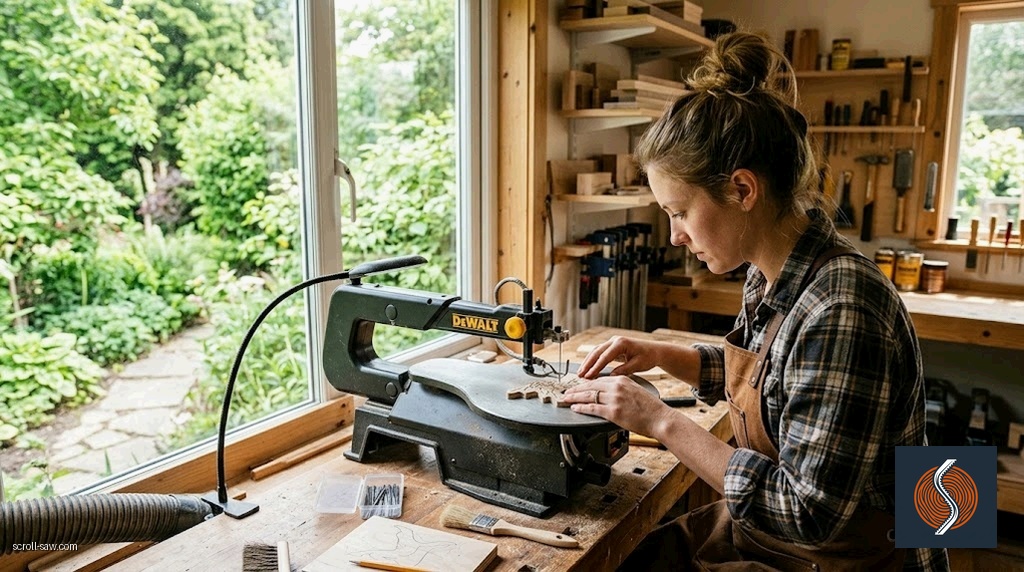
How a Good Scroll Saw for Beginners Fits Your Workflow
The advice a new scroll-sawyer usually hears is either buy the cheapest saw and upgrade later, or buy the DeWalt DW788 and never look back. Both are wrong for most people. The right advice depends on what a beginner actually needs from the machine in the first year, and on how the machine fits into a working scroll-saw bench setup.
A good beginner scroll saw is not simply an inexpensive scroll saw. It is a specific combination of features that make the first hundred hours at the machine productive instead of frustrating. Miss any of those features and the learning curve stalls, no matter how much the saw cost.
What a good beginner scroll saw actually needs
Five features separate a good beginner scroll saw from one that will disappoint. In order of importance:
Variable speed from around 400 to 1,600 SPM. Beginners need to slow down for hardwood, thin veneer, and any material with grain that fights the blade. A single-speed saw locks you into one compromise. Variable-speed control, even a coarse analog knob, gives the beginner the range needed to match speed to material.
Reliable blade clamps that hold plain-end blades. Pin-end blades are limited to about #5 equivalent and above, which is too coarse for fine detail work. A saw that only takes pin-end blades will hit a ceiling within the first month. Plain-end capability with clamps that hold a #3 blade without slipping is the working minimum.
A table that squares to zero reliably. Fretwork, marquetry, and joinery all depend on the table being genuinely square to the blade. A trunnion with a positive zero stop, ideally adjustable, is what makes this practical. Many entry-level saws ship 1–3 degrees off zero, and if the stop cannot be adjusted, the operator fights the tilt every session.
Enough throat depth for common projects. Sixteen inches of throat handles almost every ornament, silhouette, and puzzle. Below 14 inches, projects like even simple portrait work become impossible. Above 16 inches, you are paying for capacity a beginner rarely uses.
Mass or mounting stability that resists vibration. A 25-pound saw bolted to a heavy bench is stable. A 25-pound saw sitting loose on a light table is not. Beginners rarely know to bolt down, so the machine’s own mass helps compensate. Anything under about 25 pounds needs mounting attention before it will cut cleanly.
Machines that clear all five are working beginner tools. Machines that miss even one force the operator to work around a limitation on every project.
The direct answer: what is a good beginner scroll saw?
Among currently available machines, three fit the beginner profile well.
The WEN 3921 16-inch two-direction variable-speed scroll saw is the practical entry point. Variable speed from 400 to 1,600 SPM. Plain-end and pin-end blade capability. Tilting table with left and right lean. Sixteen-inch throat. Around 30 pounds unmounted. The dust nozzle is aimed poorly out of the box, and the plastic blade-clamp knobs are known to break; both are easy fixes and neither disqualifies the saw. This is the working entry point.
A used DeWalt DW788 in the $250–$350 range is the step up. Better clamps, better arm, better long-term parts availability. Beginners who plan to invest years in scroll sawing benefit from starting here rather than upgrading from a WEN in year two.
The Delta 40-694 20-inch sits between the WEN and the DeWalt in price and capability. Solid clamps, larger throat, real induction motor. Beginners who know they will scale up to portrait work should consider it.
Below the WEN in price, corners get cut on the clamps and the motor, and the machine will disappoint within the first month. Cheap hobby-store saws with fixed speed and no plain-end blade capability are false economies. They are not good beginner saws; they are toys.
Where a beginner scroll saw sits in a full workflow
A scroll saw is not a standalone tool. It sits inside a workflow that includes pattern preparation, wood preparation, drilling, sawing, and finishing. A good beginner setup includes the saw plus the surrounding tools that let the workflow move without stopping.
Pattern preparation. A home printer set to actual-size printing. Painter’s tape. Repositionable spray adhesive. A small metal rule for scale verification.
Wood preparation. A source of 1/4” and 1/2” Baltic birch plywood. A source of basswood or poplar for hand-finished work. A hand saw or bandsaw to break down larger stock. A block plane to true edges before layout.
Drilling. A cordless drill or drill press with 1/16” and 3/32” twist bits. Entry holes for interior cuts are drilled before the saw work begins.
Sawing. The scroll saw itself, plus a starter blade assortment. A magnetic-base LED task light. A small shop vac connected to the dust port. Safety glasses at the bench.
Finishing. 220-grit sandpaper. A small sanding drum on a rotary tool for interior curves. A wipe-on stain or finish appropriate to the project.
The scroll saw is the star, but the workflow around it determines how enjoyable and productive the sessions are.
Machine features that seem important but are not
Beginner buying guides often over-emphasize features that do not matter much in the first year.
Tool-less blade changes. Nice to have. Not essential. A WEN 3921 with a small allen key for blade changes lets you learn the craft as well as a DW788 with tool-less clamps. The tool-less clamps become valuable at the intermediate level when you are doing dozens of interior cuts per project.
Foot pedal. Useful eventually. Not essential in the first year. A manual switch works fine for beginner-scale interior cuts.
Table size beyond the basic footprint. A 16-inch scroll saw has enough table for almost every beginner project. Larger tables help with big pieces, but big pieces are not beginner work.
Dust blower nozzle sophistication. All the good saws have a dust nozzle. Aim matters more than sophistication. A cheap bendable air tube aimed correctly outperforms a fancy fixed nozzle aimed poorly.
Onboard blade storage. Cosmetic. Blades store fine in a drawer or a small case on the bench.
Spending extra to get these features on a first saw is often not worth it. Spending to get the five essential features (variable speed, plain-end clamps, square table, adequate throat, mass) is always worth it.
Learning curve: what a good saw enables
The first hundred hours at a scroll saw follow a rough progression. A good beginner machine supports the curve without adding friction.
Hours 1–10. Basic cuts, outer profiles, learning feed rate and blade selection. Any saw with variable speed and reasonable clamps works.
Hours 10–25. Interior cuts, entry-hole drilling, first ornaments. Plain-end blade capability starts to matter as patterns get finer.
Hours 25–50. Fretwork, letter cuts, small portrait work. Square table becomes critical because mismatched joins ruin the piece.
Hours 50–100. Marquetry, intarsia, layered projects, sacred and secular patterns from named designers. Blade selection widens; a saw whose clamps hold #2/0 through #12 is now clearly better than one that struggles at the extremes.
A good beginner scroll saw supports the operator all the way to hour 100 without needing an upgrade. A poor beginner saw needs replacement somewhere between hour 25 and hour 50, which is why buying a merely-cheap saw is usually a false economy.
Common problems on beginner-grade scroll saws
Even good beginner saws have known limitations. The five most common problems and their fixes:
Blade knobs strip or break
A known issue on the WEN 3921 and some Delta compact saws. The plastic knobs crack after a few dozen changes. Fix: use a small allen key or a metal replacement knob from the parts catalog. The machine still cuts fine; the knob is a comfort feature, not a critical one.
Dust nozzle aimed poorly
The stock air tube usually points too far away from the blade entry or at the operator. Fix: bend the tube by hand until it aims directly at the cut. On saws where the tube is not bendable, replace with a scrap of aquarium airline hose held with a small clamp.
Table tilt returns off zero
Common on compact saws. Fix: adjust the trunnion stop screw. Set an engineer’s square against the blade with the tilt lock fully open, adjust the stop until the square shows true, then tighten the lock. Recheck weekly.
Motor housing gets hot
More common on universal-motor saws than on induction-motor saws. If the housing is hot to the touch, let the saw rest 15 minutes. Ignoring the heat shortens motor life. Long continuous sessions call for a saw with an induction motor.
Stock work light is dim or clamps poorly
Most stock work lights are cosmetic. Fix: add a magnetic-base LED task lamp aimed at the blade entry. This is often the single most useful upgrade to a beginner saw.
Comparison of good beginner scroll saws
| Model | Throat | Variable speed | Blade types | Best for |
| WEN 3921 | 16" | 400–1,600 SPM | Plain and pin | New buyer on a budget |
| Delta 40-694 | 20" | 500–1,750 SPM | Plain and pin | Beginner planning to scale up |
| DeWalt DW788 (used) | 20" | 400–1,750 SPM | Plain only | Serious beginner, long horizon |
| Rikon 10-600VS | 16" | 400–1,600 SPM | Plain and pin | Beginner who wants pro-grade features |
Who should skip the DeWalt DW788: buyers who scroll saw occasionally, or who need portability for classroom or shared-shop use. The DW788 is heavy, expensive, and wasted on light hobby duty.
FAQ
What is the best scroll saw for a complete beginner?
A WEN 3921 covers 90 percent of beginner needs at the lowest realistic price point. If budget allows, a Rikon 10-600VS or a used DeWalt DW788 gives a smoother learning experience. Below the WEN, the compromises on clamps and motor make the first year harder than it needs to be.
Do I need variable speed on a beginner scroll saw?
Yes. Fixed-speed scroll saws lock you into one compromise across all materials. Variable speed lets you match the machine to hardwood, plywood, veneer, and even light metal. It is the single most important spec on a beginner saw.
Should I buy new or used?
Used if you find a well-maintained saw in the DeWalt or Delta lines under retail. New if the used market is thin or if you want warranty coverage. Check clamps, arm bearings, and table trueness before buying used.
Is a scroll saw safe for a young beginner?
Yes, with supervision and standard safety practices. Scroll saws are among the safest power tools in the shop because the blade is short and the workpiece stays flat. Children as young as seven can use one under close adult supervision.
What blades should I buy first?
An Olson assortment pack with #3, #5, and #7 skip-tooth blades, plus a small pack of reverse-tooth #5 for plywood. That covers 90 percent of beginner work. Add finer sizes as your projects require them.
How much bench space does a beginner scroll saw need?
A 16-inch scroll saw with clearance for the workpiece needs roughly 30 by 40 inches of clear bench top. Add space for a task light, a shop vac, and pattern materials, and a 4-foot by 2-foot dedicated bench is comfortable.
What is the biggest mistake beginners make when buying?
Buying below the practical entry level to save money. A cheap scroll saw with unreliable clamps and no plain-end blade capability will limit the operator within weeks. The false economy adds up to buying two saws in the first year.
How long before a beginner needs to upgrade?
With a good beginner saw (WEN, Delta, or similar), the machine supports the operator for one to three years of regular hobby use. Serious hobbyists eventually upgrade to a DeWalt, Rikon, or Excalibur when they move into portrait or heavy-fretwork work.
References
-
WEN 3921 product documentation. wenproducts.com
-
Scroll Saw Woodworking and Crafts Magazine buyer’s guides. Fox Chapel Publishing.
-
Fine Woodworking scroll saw tool reviews. finewoodworking.com
-
Scroll Saw Village community reviews and long-term ownership threads. scrollsawvillage.com
Title tag: How a Good Scroll Saw for Beginners Fits Your Workflow
Meta description: What actually makes a good beginner scroll saw, which models clear the bar, and how the saw sits in a first-year scroll-sawing workflow.
URL slug: good-scroll-saw-for-beginners
Excerpt: A good beginner scroll saw is not simply an inexpensive one. Here are the five features that separate a working entry machine from one that will disappoint, and how the saw fits in a real bench workflow.


