
Mini Scroll Saw for Crafts: Purpose and Setup
Mini Scroll Saw for Crafts: Purpose and Setup
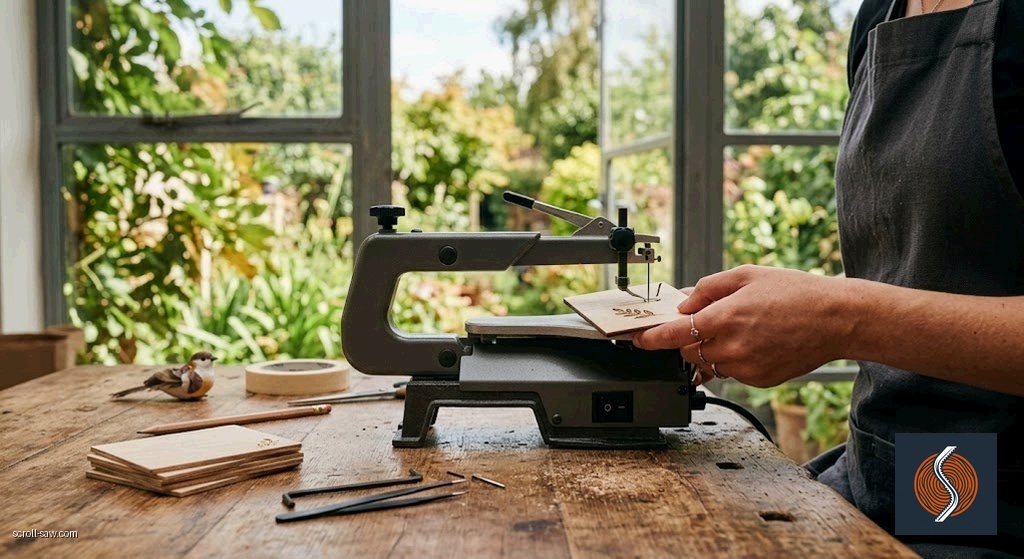
A friend brought over a mini scroll saw last winter, a Proxxon DSH/E she had bought for jewelry work but was not using much. She wanted to know if it was worth keeping. We set it up on my kitchen table, cut a few small pieces of 1/8” cherry, and by the end of the afternoon she had decided to keep it. Not because the saw did anything her larger scroll saw could not do, but because the mini did specific small-work tasks better, and it lived in a corner of her craft room without demanding a bench.
That is what a mini scroll saw is for: not to replace a bigger saw, but to be always available for small work where a bigger saw would be overkill or unwelcome.
What counts as a mini scroll saw
The mini scroll saw class sits below the compact benchtop class. Typical features:
-
Throat depth of 10 to 14 inches.
-
Motor amperage of about 0.5 to 1 amp.
-
Weight under 20 pounds, often under 15.
-
Table small enough to feel cramped on projects larger than a postcard.
-
Blade capacity limited to fine and moderate sizes, roughly #2/0 to #7.
-
Speed range often 800 to 1,600 SPM, sometimes narrower.
Examples include the Proxxon DSH/E, the Dremel Moto-Saw MS20 in its stationary configuration, and various hobby-store imports. These saws sit on a shelf or a small worktable and come out for specific projects rather than living on a dedicated bench.
The direct answer: is a mini scroll saw useful for crafts?
Yes, for four specific craft applications.
Jewelry and precious-metal work. A mini saw slowed to 800 SPM cuts brass, silver, and copper cleanly with a jeweler’s blade. Full-size scroll saws often cannot slow to the required speed without stalling. Cutting thin metal sheet, cutting bezels to size, and shaping small findings all favor a mini.
Small model-making. Airplane and ship models, dollhouse fittings, and miniature furniture parts often come from 1/32” to 1/16” plywood. A mini saw’s fine blade selection handles this stock without tearing. A larger saw with a coarser minimum blade tends to shred thin material.
Ornament and gift-tag production. Small holiday ornaments, gift tags, and paper-craft embellishments are quicker on a mini because the smaller machine spins up faster and the operator does not need to walk to a shop bench. Kitchen-table use is realistic.
Teaching young children. A mini scroll saw is less intimidating than a full-size saw and its lower mass makes accidental over-feeding less consequential. Children as young as six or seven, with close supervision, can use a mini safely.
Outside these four applications, a compact benchtop scroll saw is a better tool. The mini saves size and cost. It does not save time or improve results on ordinary hobby projects.
Setup: making a mini scroll saw cut well
Mini saws show setup errors quickly because they have less mass to hide them. Get these right.
Bolt or clamp the saw to its work surface. A 12-pound saw sitting loose on a kitchen table will walk. Use small C-clamps on the base or, if the saw has a footprint plate, bolt through it into a piece of plywood you can clamp to any surface.
Square the table before every session. Mini saw tables are lighter and more likely to shift than compact saw tables. Set an engineer’s square against the blade at the start of each project. Adjust the tilt stop screw if needed.
Match the blade to the fine-work capability. A #7 blade in a mini saw wastes the machine. The saw’s advantage is at the fine end. Keep #2/0 through #5 blades stocked and reach for the finer sizes first.
Aim the dust tube at the cut. Mini saw dust tubes are often even worse-aimed than compact saw tubes. Bend the tube or use a scrap of aquarium hose to direct air at the blade entry.
Add task lighting. Mini saws rarely include work lights. A small LED task lamp aimed from the front of the saw removes the shadow the arm casts on the cut.
Support the workpiece around the small table. Mini saw tables are often only 6 by 8 inches. A larger workpiece hangs off the edges and puts leverage on the table. Set up temporary supports (a stack of magazines works fine) around the saw to support long workpieces.
Blade selection for a mini scroll saw
Mini saws work best with fine blades. This is where they beat compact and full-size saws for specific tasks.
For jewelry and metal work, jeweler’s fret blades in sizes 3/0, 4/0, and 5/0. These are much finer than typical wood blades and are sold specifically for metal cutting.
For thin plywood and model stock, #2/0 or #3 skip-tooth or modified-geometry blades. Pégas modified-geometry in the fine sizes cuts especially cleanly.
For slightly thicker craft plywood (1/4”) up to 1/2” softwood, a #5 skip-tooth or reverse-tooth. Beyond this, the mini saw is at the edge of its capability.
Avoid coarse blades on a mini. The saw does not have the mass to control a #9 or #12 blade cleanly, and the projects a mini is used for rarely call for cuts that coarse.
Where a mini scroll saw disappoints
Honest limits worth naming:
Duty cycle is short. A mini saw’s small motor is not built for continuous hour-long sessions. Fifteen to thirty minutes of cutting followed by a rest is realistic. Ignoring this shortens motor life measurably.
Larger workpieces feel cramped. Anything over about 8 by 8 inches becomes awkward on the small table. Projects that fit on a postcard work well; projects that need a full-size sheet do not.
Thick hardwood is not the mini’s job. Half-inch hardwood strains most mini saws. Three-quarter-inch hardwood is beyond the working envelope. For thicker stock, use a compact or full-size saw.
Vibration reveals bench-mounting problems. A mini saw on a floppy surface will produce cuts that wander because the surface is moving. This is not a saw defect; it is a mounting defect. Anchor the saw firmly.
Blade change can be fiddly. Small chucks on mini saws demand more careful handling than the larger clamps on compact saws. Fine blades are easy to bend during installation. Take time on each change.
Craft-specific setup examples
Jewelry cutting
Mount the saw on a sturdy small bench. Use a jeweler’s blade at 3/0 to 5/0. Slow the saw to its lowest speed (around 400–800 SPM). Support the metal blank on a small wooden or plastic bench-pin platform placed on the saw table. Cut slowly, letting the blade remove material at its own pace. Blades dull quickly in metal; expect to change several per cutting session.
Model plywood
Use 1/32” to 1/16” aircraft or model-plywood. A #2/0 or #3 skip-tooth blade at moderate speed (1,000–1,300 SPM) cuts cleanly. Print the pattern at exact scale and adhere it to the plywood with a light spray of repositionable adhesive. Support thin stock on a piece of scrap MDF under the workpiece to prevent chip-out on the exit face.
Ornament production
Batch identical ornaments by stacking two or three pieces of thin plywood held together with double-sided tape. A #5 skip-tooth blade cuts the stack in one pass. This triples output without tripling the cut time.
Introduction to scroll sawing
For a young beginner, start with 1/8” balsa or basswood. A #5 blade at moderate speed. Simple silhouettes: a fish, a heart, a small tree. Have the adult make the initial entry hole and set the blade. Let the child do the cutting with the adult’s hand covering their hand for the first cuts.
Books, patterns, and reference material
Mini scroll saw work benefits from resources that focus on small-scale craft.
Scroll Saw for the First Time and similar starter books cover the basics that apply to any size saw.
For jewelry cutting specifically, The Complete Metalsmith by Tim McCreight covers fret saw and jeweler’s saw technique that translates directly to a mini scroll saw with a jeweler’s blade.
For model-making, plans and patterns from established model manufacturers (Guillow’s, Dumas, and similar) come with fine-tolerance drawings suited to mini-saw work.
Steve Good’s Scrollsaw Workshop archive includes many small-scale patterns that fit on a mini saw’s table.
Who should skip a mini scroll saw: hobbyists who cut mostly plywood ornaments and small silhouettes on any bench, who already have a compact benchtop saw, and who do not do jewelry or precious-metal work. The mini adds capability the compact already covers, and it takes up shelf space.
Common problems and their fixes
Saw walks across the bench
Anchor the saw. Use C-clamps on the base, bolt through the footprint plate, or mount to a heavier plate that you then clamp to the work surface.
Cut wanders on curves
Usually feed rate combined with blade tension. Slow the feed. Check tension by plucking the blade for a clear note. On a mini, tension is easier to over-set; a note that rings brightly rather than strains is the target.
Blades break often
Over-tension or over-feed. Reduce tension slightly. Reduce feed rate. Replace worn or heat-damaged blades before they fail catastrophically.
Motor stalls in thick stock
The stock is beyond the mini’s working envelope. Move to a compact benchtop saw for thicker material.
Table will not stay square
Small trunnion locks on mini saws wear faster than larger ones. Retension the lock lever or replace the small under-table clamp assembly. Verify square with an engineer’s square before every project.
Comparison of mini scroll saws and their alternatives
| Tool | Best for | Weight | Blade sizes |
| Mini scroll saw (Proxxon DSH/E) | Jewelry, models, small crafts | Under 15 lb | #2/0 to #5 typical |
| Convertible (Dremel Moto-Saw) | Mixed handheld and bench work | Around 6 lb | Limited proprietary range |
| Compact benchtop (WEN 3921) | General hobby scroll sawing | Around 30 lb | #2/0 to #12 |
| Jeweler's fret saw (hand-powered) | Precision metal cutting | Very light | Jeweler's blade sizes |
FAQ
What is the best mini scroll saw for jewelry?
The Proxxon DSH/E is the most commonly recommended mini scroll saw for jewelry work because it slows to a speed where jeweler’s blades stay controllable. For fine precious-metal work, a hand-powered jeweler’s fret saw often outperforms any mini scroll saw and costs a fraction of the price.
Can a mini scroll saw cut thin plywood?
Yes, and this is one of its strengths. A #2/0 or #3 blade in 1/32” to 1/16” plywood produces cleaner cuts on a mini than the same blade in a full-size saw because the mini’s lower mass and finer control help on thin stock.
Is a mini scroll saw safe for a child?
Yes, with adult supervision and standard safety practices. The blade is short, slow, and the workpiece stays on the table. Children as young as six or seven can use one under close supervision. Safety glasses and hair tie-back are the same as for any scroll saw.
How much stock thickness can it cut?
Rated capacity is usually around 1/2” softwood and 1/4” hardwood. Practical clean-cut capacity is somewhat less, especially in dense hardwoods.
Do mini scroll saws take standard blades?
Most accept standard plain-end and pin-end scroll saw blades in the smaller size range. Very fine jeweler’s blades in dedicated jewelry mini saws may use a proprietary system. Check the specific model.
Can I use a mini scroll saw for intarsia?
Small-scale intarsia, yes, especially for the individual piece cutting. For larger intarsia panels, the small table becomes limiting. A compact benchtop saw is the better choice for regular intarsia work.
Why is my mini scroll saw so loud?
Usually the housing resonating on a hard surface. Add a rubber mat or foam pads under the saw’s base. Check that mounting bolts are snug but not overtightened.
Are mini scroll saws worth the money?
Worth it for the four use cases named at the top: jewelry, models, small crafts, and teaching. Not worth it for general hobby scroll sawing where a compact benchtop saw is a better use of the same money.
References
-
Proxxon product documentation for DSH/E and related scroll saws. proxxon.com
-
Dremel Moto-Saw MS20 product documentation. Dremel Tool Company.
-
Scroll Saw Woodworking and Crafts Magazine buyer’s guides. Fox Chapel Publishing.
-
McCreight, Tim. The Complete Metalsmith. Brynmorgen Press.
Title tag: Mini Scroll Saw for Crafts: Purpose and Setup
Meta description: Where a mini scroll saw is genuinely the right tool for craft work, how to set one up so it cuts cleanly, and where a bigger saw is a better choice.
URL slug: mini-scroll-saw-for-crafts
Excerpt: A mini scroll saw does not replace a bigger one. It earns its space by being always available for small work: jewelry, models, ornaments, and teaching. Here is how to set it up and where it fits.


